
The Discovery
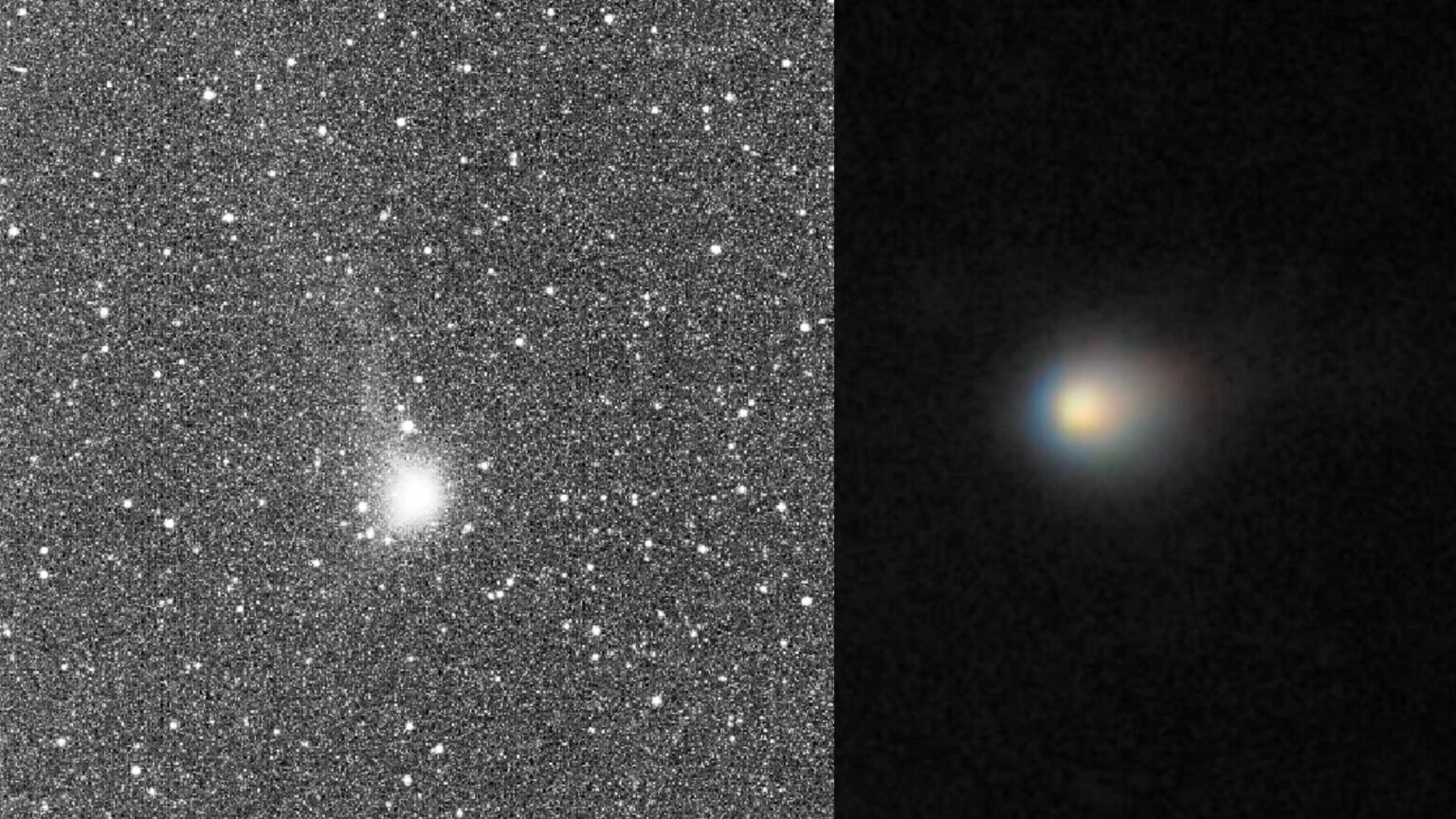
Discovered on the first day of July 2025, by the Atlas Terrestrial-Impact Last Alert System (ATLAS), 3I/ATLAS is an interstellar comet in the constellation of Leo. It flew closest to the Sun on October 29, 2025, an event known as “perihelion,” when a comet passes by a star and releases its icy dust that sparks the night sky on Earth. The exocomet has been baffling the scientific community and the stargazers on Earth alike with its anomalous properties. While major space observatories tried capturing the 3I/ATLAS but came back with grainy portraits, disappointing the lay, several studies have been made possible with these observations.
The Age & Origin
Some experts like Matthew Hopkins et al. estimate the 3I/ATLAS’s age between 7.6 and 14 billion years. The origin of the interstellar visitor is pegged near the constellation Sagittarius, which is near the galactic center of the Milky Way. When it was first spotted, 3I/ATLAS was in the southern celestial hemisphere.
The Size & Composition
Prof. Avi Loeb, a Harvard astrophysicist, estimated the size of 3I/ATLAS to be around 10 kilometers, making it the largest interstellar object amongst 1I/Oumuamua (2017) and 2I/Borisov (2019). For comparison, the conservative estimated age of our own solar system is 4.6 billion years.
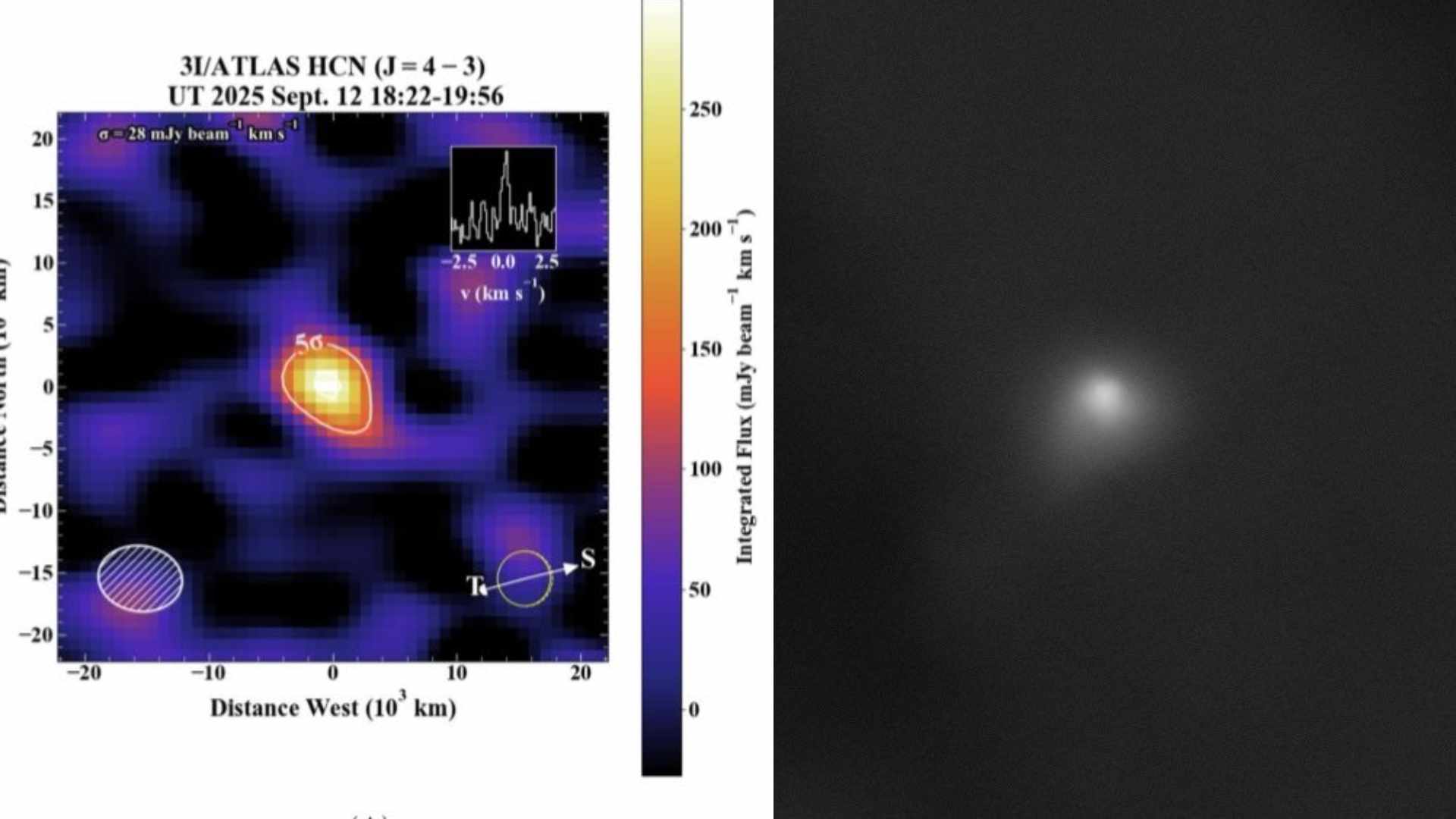
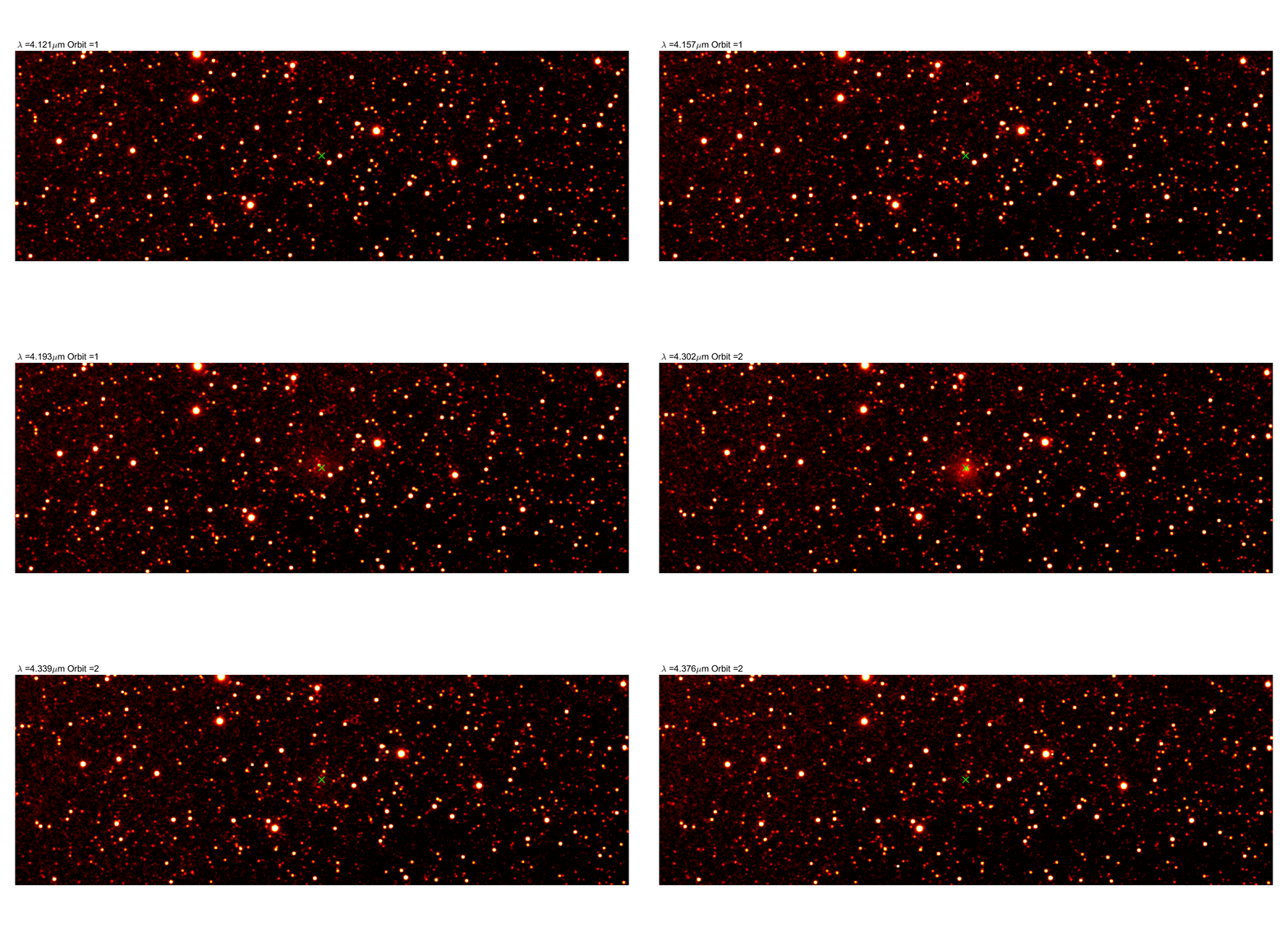
The JSWT observation revealed the comet’s chemical composition, including an abundance of carbon dioxide. XIRSM’s analysis revealed the comet is emitting x-rays, while the ALMA observatory found the interstellar interloper loaded with methanol (CH₃OH) and hydrogen cyanide (HCN). In the first quarter of November, a faint radio signal was also detected by the MeerKAT radio telescope that confirmed the presence of hydroxyl (OH) molecules. The presence of glowing nickel vapor has raised many eyebrows. Speaking of the discovery, Darryl Z. Seligman and Rohan Rahatgaonkar, the two researchers, quipped
“our team has detected glowing nickel vapor in the gas surrounding the incoming interstellar comet 3I/ATLAS at an extraordinary distance from the sun, where temperatures remain far too cold for metals to normally vaporize.”
The Trajectory & Earth Flyby
The 3I/ATLAS’s path has been baffling the scientific community. It is following an extremely hyperbolic path with a speed of 210,000 km/h. At its perihelion on October 29, the comet’s speed increased to 246,000 km/h. It will approach the Earth at a distance of 1.79 AU on December 19, 2025.
How To Watch? Livestream
While you cannot possibly see the 3I/ATLAS with naked eyes or a regular scope, you can track it via apps like Sky Live and also keep an eye on livestreams by NASA, SETI, and The VIrtual Telescope Project, among many other observatories. If you can invest, maybe a bigger telescope will help you catch a fleeting glimpse.
We will update a livestream link here once it is on air.
See Also; EXCLUSIVE: Harvard Astrophysicist Avi Loeb On 3I/ATLAS, Aliens, Stranger Things & Indian Food