
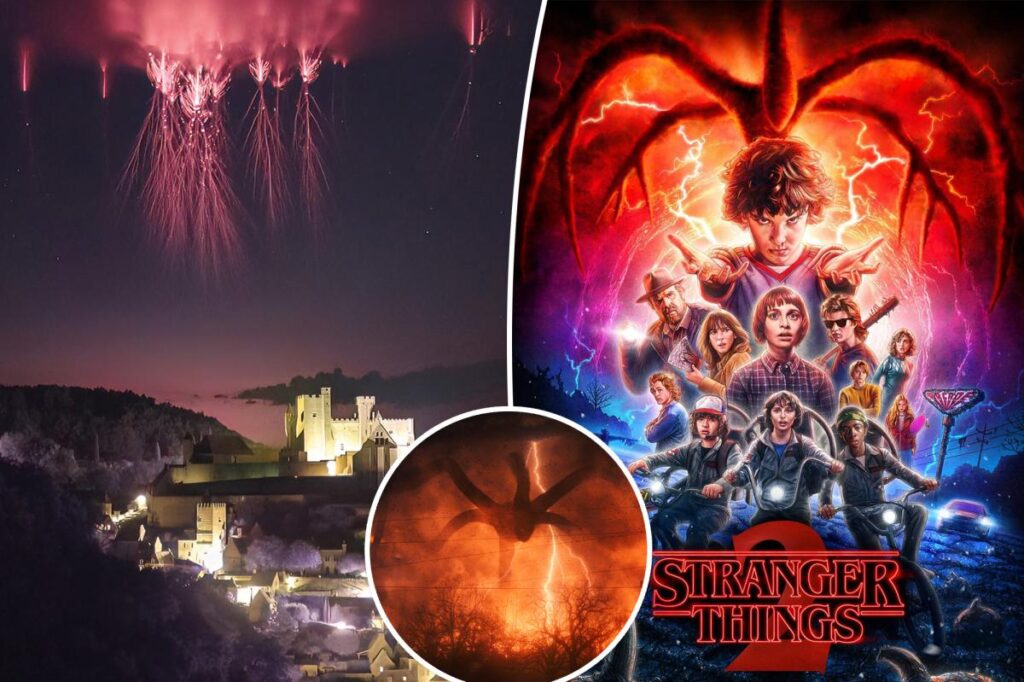
They’ve shed light on this glowing interstellar hydra.
Luminescent images of a glowing “red jellyfish” have sparked speculations of alien visitations — but NASA assured us that there’s nothing to fear.
The bizarre vermillion lights, detailed in an X (formerly Twitter) post by the space agency, reportedly appeared in the sky above a thundercloud.
The crimson fireworks display evoked an intergalactic sea jelly or a visage from the Upside Down realm in the paranormal Netflix series “Stranger Things.”
Some even floated the idea that it could be a celestial visitor, Unilad reported.
Sprites generally occur 50 miles up in Earth’s atmosphere. NASAs Spritacular project participant Nicolas Escurat
However, NASA has dispelled any rumors of its extra-terrestrial provenance, noting on X that it’s an extremely rare weather-related phenomenon known as a Sprite (an acronym meaning Stratospheric Perturbations Resulting from Intense Thunderstorm Electrification).
These “red jellyfish” like figures seen hovering above storms have caught people’s attention. Courtesy of Netflix
“This fleeting red flash above a thunderstorm cloud is one of Earth’s most elusive electrical phenomena!” gushed the space agency of the event, which was shot by citizen scientist Nicolas Escurat of Spritacular.
Also known as red lightning, the Transient Luminous Event (TLE) is associated with extremely intense thunderstorms, Space.com reported, which are typically only spotted using specific cameras or from space.
Sprites look like something straight out of a scene from the hit Netflix show, “Stranger Things.” ©Netflix/Courtesy Everett Collection / Everett Collection
Unlike most lightning that extends from the clouds to the ground, these bright red bolts spout up into the atmosphere.
In fact, they reportedly occur about 50 miles up in the Earth’s atmosphere, producing quick flashes of reddish light that only last for a few milliseconds and show up in bizarre shapes — generally either a jellyfish or a carrot.
It’s unclear what causes the luminescent phenomenon, which was discovered by accident after a photograph was inadvertently snapped in 1989.
In July, the International Space Station snapped a striking photo of a red lightning storm over Mexico and the Desert Southwest.