
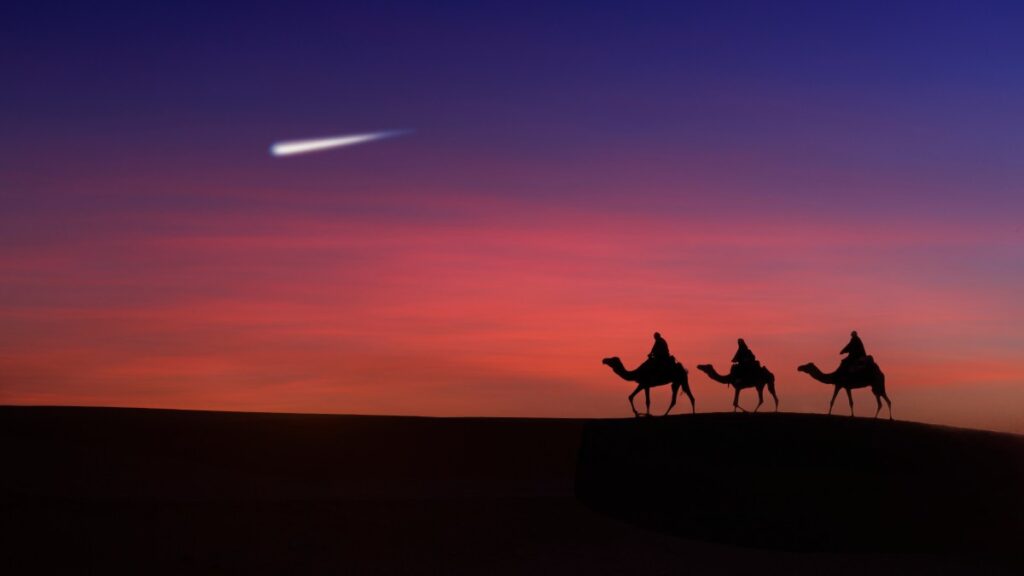
In the next two weeks more will be spoken and sung about an unusual astronomical phenomenon than about any other heavenly body throughout the year. What was the Star of Bethlehem? How did it guide three kings of the Orient — or maybe “wise men” or magi — from Babylon across some 900 miles of desert caravan routes to arrive at Bethlehem in time to witness Christ’s birth? Was the “wandering star” an asteroid, a comet, a rare triple conjunction between Earth, Jupiter and Saturn, or simply a delightful myth?
Mark Matney, a Nasa planetary scientist, has been poring over ancient Chinese records and is convinced that a bright comet visible for more than 70 days in China in the spring of 5BC was the same one that appeared to settle over Bethlehem.
• Has a wise man at Nasa solved the Star of Bethlehem mystery?
He argues that the comet’s trajectory brought it perilously close and for a few hours its eastern motion would nearly cancel out the effect of Earth’s rotation, which satellite engineers know as “temporary geosynchronous motion”. By then the magi, in reality astronomers excited by comets thought to herald royal births and divine intervention, had arrived in Jerusalem. The “star” pointed them south to Bethlehem.
Another astronomer from Sheffield, Professor David Hughes, had already posited in the 1970s that the star was an alignment between the Sun, Earth, Jupiter and Saturn, a conjunction occurring every 900 years. Or it could have been a “dirty” comet, its melting ice blown by solar winds into a tail in space. Or maybe it was even the light from a new star, or nova.
But why should science and mathematical calculations spoil our carols, Christmas trees and festive decorations? Surely the star was a divine early sat-nav — a way of guiding the world to the stable, thrilling us with hope and joy ever since.