
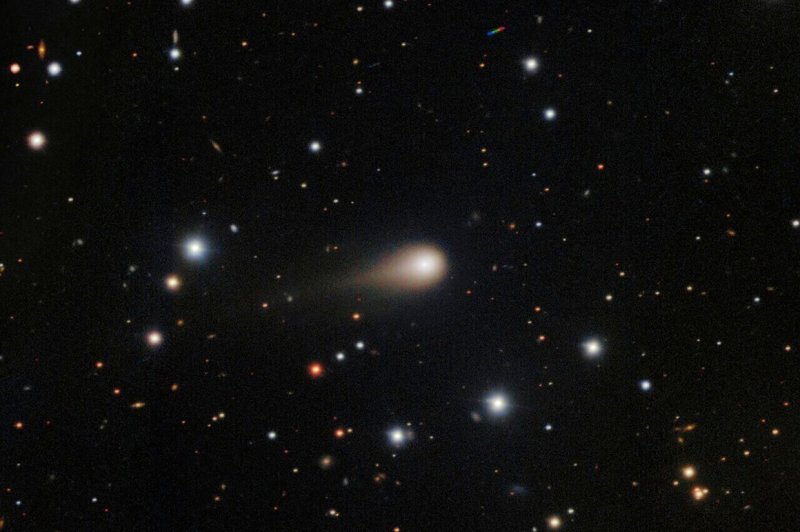

A comet streaking across a star field above the International Gemini Observatory near La Serena, Chile. NoirLab via AP file
A mysterious interstellar comet, 3I/ATLAS, has been traveling through our solar system in recent months, drawing keen interest from astronomers and space enthusiasts.
3I/ATLAS is only the third confirmed object to enter our cosmic neighborhood from elsewhere in the galaxy, News.Az reports, citing NBC News.
Its rare journey has been captured by satellites, space telescopes, orbiters, and even rovers.
The latest photos, released last week, come from a Jupiter-bound spacecraft operated by the European Space Agency and NASA’s Hubble Space Telescope. These new images add to a growing collection that has sparked fascination about the interstellar visitor, though there is no evidence suggesting it is alien technology.
The comet reached its closest point to the sun at the end of October and is set to fly by Earth on Dec. 19 at a safe distance of approximately 170 million miles.
Here are some of the most striking and intriguing photos of 3I/ATLAS captured so far.
 This animation shows the observations of comet 3I/ATLAS when it was discovered on July 1.ATLAS / University of Hawaii / NASA
Comet 3I/ATLAS was first detected in July by the Asteroid Terrestrial-Impact Last Alert System (ATLAS) in Rio Hurtado, Chile. The NASA-funded survey telescope (made up of two telescopes in Hawaii, one in Chile and a fourth in South Africa) is designed to scan for asteroids that could pose a threat to Earth.
When it was first spotted, the comet was about 420 million miles away.
 Interstellar comet 3I/ATLAS.David Rankin / Saguaro Observatory
Until now, the only other two objects confirmed to have entered our solar system from elsewhere in the galaxy were the cigar-shaped Oumuamua in 2017 and comet 2I/Borisov in 2019.
NASA’s SPHEREx observatory (short for Spectro-Photometer for the History of the Universe, Epoch of Reionization and Ices Explorer) trained its eyes on Comet 3I/ATLAS from Aug. 7 to Aug. 15, providing scientists with new details about the object’s size, physical properties and chemical composition.
At the time, the comet was about 290 million miles away from the sun. The SPHEREx observations revealed the comet’s coma, a hazy cloud of gas and dust akin to an atmosphere that surrounds its nucleus. Researchers determined that the coma contained an abundance of ice water and carbon dioxide, similar to the chemistry of comets formed in our solar system.

A comet streaking across a star field above the International Gemini Observatory near La Serena, Chile. NoirLab via AP file
In late August, the Gemini South telescope in Chile captured what were the most detailed images of the comet at the time. The photos, released in September, showed an extended coma of dust and gas around the icy nucleus.
Astronomers suggested that 3I/ATLAS was becoming more active as it approached the sun, judging by the object’s lengthy tail, which appeared more elongated in the telescope’s images compared to previous sightings.
 The European Space Agency’s ExoMars Trace Gas Orbiter image of 3I/ATLAS as it passed close to Mars. The European Space Agency
The European Space Agency released new images of the comet in October, which were taken by a spacecraft in orbit around Mars. The ExoMars Trace Gas Orbiter, jointly operated by ESA and Russia’s Federal Space Agency, observed the comet for about a week beginning on Oct. 1.

3I/ATLAS as it moves. The European Space Agency
The photos show a fuzzy white dot — the center of the comet — moving against a dark and starry expanse. When the images were taken, 3I/ATLAS was roughly 18.6 million miles from the orbiter.
 3I/ATLAS, circled in the center, as seen by NASA’s Lucy spacecraft. This image was made by stacking a series of images taken Sept. 16 as the comet was zooming toward Mars. NASA / Goddard / SwRI / JHU-APL
After weeks of delays because of the government shutdown, NASA released a trove of 3I/ATLAS photos taken by various spacecraft from late September through mid-October.
The comet mostly appeared as an illuminated dot, but some images were detailed enough to pick up its tail as a faint, elongated smudge.

Observations of 3I/ATLAS from Sept. 28 to Oct. 10 from the PUNCH satellites in low-Earth orbit, when the comet was 231 million to 235 million miles away. NASA / Southwest Research Institute
Among the NASA missions that observed the comet relatively up-close were the sun-watching PUNCH satellites, the Solar and Heliospheric Observatory, the Lucy space probe, the Mars Atmosphere and Volatile EvolutioN (MAVEN) mission and the Perseverance Rover on the surface of Mars.
 NASA’s Hubble Space Telescope reobserved 3I/ATLAS on Nov. 30 with its Wide Field Camera 3 instrument.NASA, ESA, STScI, D. Jewitt (UCLA) / M.-T. Hui (SAO) / J. DePasquale (STScI)
Late last month, NASA’s Hubble Space Telescope tracked 3I/ATLAS when it was approximately 178 million miles away from Earth. Hubble’s instruments recorded the moving comet as a luminous point while the background stars appeared as streaks of light. NASA released the images on Thursday and said it intends to gather more data on 3I/ATLAS in the coming months as the comet moves out of the solar system.