
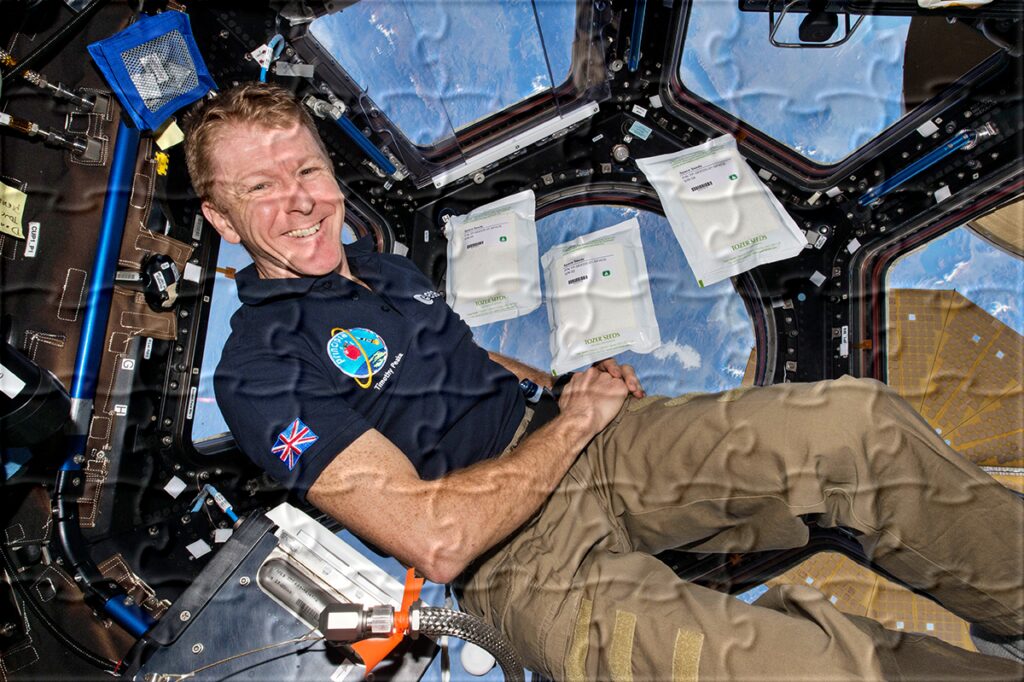
A decade on from British ESA astronaut Tim Peake’s historic mission to the ISS in December 2015, RICHARD LOWE from the RAeS Space Group looks at the funding landscape for UK space sector.
There are three elements to UK national funding for space. Money is divided between the ESA programme (in collaboration with other member states), the civil national programme (mostly delivered through the UK space agency) and the defence programme (through various parts of the MoD).
Puzzle piece #1 – ESA

Every three years, the national delegates of ESA members states get together. Bargains are struck, and funding is committed. Programmes are created – and sometimes destroyed.
For the UK, this year’s CMIN comes at a time when the UK Space Agency is trying to focus its efforts. For a long time, UK money has been widely spread – both in the ESA programmes and the national programme that runs alongside it. That has yielded a space sector which is a jack-of-all-trades, but struggles to achieve dominance in any specific field.
In the recent ESA funding negotiations, there were winners and losers. The UK delegation agreed to a strong uplift in launcher programme funding but a softening on Earth Observation. Space Weather monitoring (through the VIGIL programme) and Mars Exploration (in the form of the Rosalind Franklin rover) were strongly backed. Overall, the UK’s contribution to ESA is reduced, compared to the last CMIN.
The boost to launch capability is long overdue. It has been an achingly long road to UK sovereign launch. Over the last 20 years, much of the UK government’s space policy has been rooted in the expectation that the market will provide. As a result, pursuit of a UK launcher has been based on “removing barriers”, rather than “making it happen”. The government (including the MoD) has carefully avoided looking like a customer… so we’re still waiting for a launch, year after year. Maybe in 2026? It’s an approach that doesn’t deter adversaries or overseas competition. It does deter investors.
Puzzle piece #2 – UK civil programme

The UK Space Agency is an ‘arms-length body’ of the Department for Science, Innovation & Technology (DSIT). That separation has given it some freedoms – but has also created confusion and duplication. Responsibilities for space are spread across a complicated landscape of organisations and roles. During 2025, a decision was taken to merge the space-related offices of DSIT and UKSA. The “UKSA” branding will persist, but DSIT will have more direct control.
The change will come into effect in 2026. It should simplify ‘government for space’, and help industry to know which door to knock on. So what other changes will we see in 2026?
“Grant-repreneur” might be a contender for UK Space Sector Word-of-the-Year. Grant-based funding has been a major feature of daily survival for many UK space companies. With government buying few services, and even less flight hardware, grants have been a vital source of funding for start-ups trying to stay afloat. By contrast, organisations like SpaceX were propelled to greatness by investing to deliver on large US government service contracts.
In the UK, grants are issued based on a mutually agreed narrative that they will ‘unlock’ hoped-for commercial growth in the market. It’s a story that industry is compelled to tell, and civil servants are obliged to ask for. It hasn’t really worked. The UK’s space sector comprises around two thousand companies – but the majority of them run as expert consultancies and show little to no growth over time. In the absence of commercial market customers, they become adept at living from grant to grant – either from the UK national programme or tapping UK contributions via ESA. As a national policy, it has supported genuinely world-leading specialists to ‘stay in the game’ – but it doesn’t deliver enough growth or private investment, nor national capability that can be wielded. It deters investors. It doesn’t deter adversaries. A poor combination.
The good news (if you’re a taxpayer), or bad news (if you’re a “grant-repreneur”) is that the policy is starting to shift. UKSA is expected to start issuing more contracts and fewer grants, in pursuit of prioritised capabilities. It may lead to a phase of consolidation in the UK space sector as micro-companies have to band together, to deliver against more demanding commercial procurement goals. It will also require upskilling and partnering at UKSA, which will need to play a more direct role as a customer.
As UKSA and DSIT complete their docking manoeuvres, look out for a more ‘capability’ focussed way of working in 2026. In the interim, with UK-to-ESA funding shrinking, the sector waits to see if the ‘civil programme’ will get bigger… or maybe the third piece of the puzzle?
Puzzle Piece #3 – The MoD

Space is universally recognised as vital to our national interests. It’s a government-recognised Critical National Infrastructure (CNI) sector. It’s a warfighting domain. Space Command has been created in the MoD. The Strategic Defence Review allocated space a section of its own – but the MoD’s Defence Investment Plan has yet to conclude. The sector doesn’t know what to expect. December’s Defence Space Conference 2025 (organised by the Air & Space Power Association) was cancelled at short notice, to return in late in September of 2026.
The UK has some catching up to do. France and Italy both operate their own launch systems, intelligence-gathering constellations and secure communications systems. Both are partners in the European Galileo navigation system (the UK stepped out, with Brexit).
The UK space sector awaits clarity from the government on its approach to space and defence. Aspiration has been signalled, but that’s not new. It has been 13 years since the last Skynet-5 military communications satellite was launched. The gap-filler, Skynet 6A, was due up in 2025 but hasn’t gone yet. The recent UK Strategic Defence Review (SDR) very politely questioned the relevance of the Skynet6 programme in the presence of newer approaches like Starlink, the EU’s IRIS2 and Amazon’s Kuiper constellations. A more nimble – and active – approach to capability procurement is needed, working with the creative new-space community through iterative “spiral” development.
The sector has heard the trumpets, calling for a more robust posture in orbit. It’s keen to respond. A small change in the overall fraction of defence spending, tilting towards space capability, would have a huge effect on the sector.
Three pieces of a funding puzzle – but only the ‘ESA’ piece is yet in clear sight. The other two will be anxiously awaited.
9 December 2025