
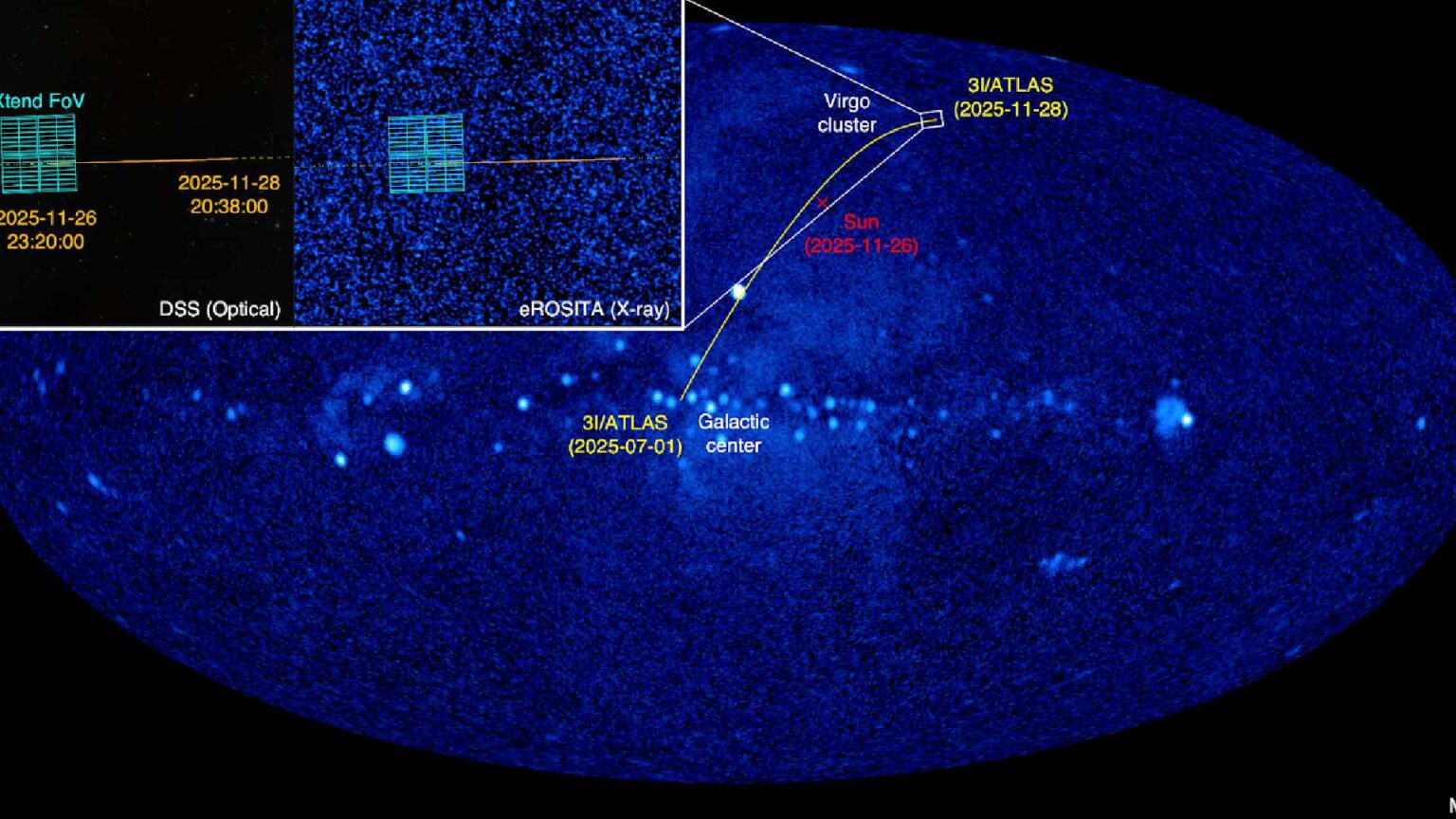
Japan Aerospace Exploration Agency (JAXA)’s X-Ray Imaging and Spectroscopy Mission, aka XRISM published its observation of 3I/ATLAS. In its findings, the XRISM observatory stated
From 23:20 on November 26 to 20:38 on November 28, 2025, XRISM conducted observations with an effective exposure of 17 hours. A preliminary analysis of the obtained data, after reconstructing images centered on the comet, revealed a faint X-ray glow extending roughly 5 arcminutes—corresponding to a distance of 400,000 km—around the cometary nucleus.
But how does a comet emit X-rays? XRISM explains
Comets are enveloped by clouds of gas produced as sunlight heats and vaporizes their icy surfaces. When this gas interacts with the energetic stream of charged particles flowing from the Sun—the solar wind—a process called charge-exchange reaction occurs, producing characteristic X-ray emission.
XRISM describes further in the study
X-ray components likely associated with carbon, nitrogen, and oxygen appear in ways that cannot be explained by ordinary background emission, such as Galactic X-rays or Earth’s atmospheric emission. This provides an important clue that the observed emission may indeed arise from charge-exchange interactions between the cometary gas and the solar wind.
XRISM has caught sight of interstellar #comet 3I/ATLAS !
Our early data hint at a faint X-ray glow spreading hundreds of thousands of kilometers across its coma — a first glimpse of this rare visitor from beyond the Solar System.
Stay tuned for more.#JAXA #NASA pic.twitter.com/je3rT6UhyJ
— XRISM (@XRISM_jp) December 6, 2025
3I/ATLAS, ever since its discovery on July 01, 2025 has baffled scientists and stargazers alike. The rather anomalous exocomet is the third interstellar visitor to cruise through the solar system after 1I/Oumuamua (2017) and 2I/Borisov (2019).
The interstellar interloper’s perihelion on October 29, was dubbed as a black swan event, as speculations of it being an alien spaceship sparked conspiracy theories. Despite the conjectures, 3I/ATLAS has shown cometary behavior with few exceptions or anomalies. These anomalies, at least 13 of them, have been enlisted by Harvard astrophysicist Avi Loeb.
Amid all the buzz, all stargazing assets of space agencies like NASA, ESA, JAXA, ISRO and others are now glued onto the exocomet. Its closest flyby to Earth is on December 19, when 3I/ATLAS will be 1.78 AU nearer, still 270 million kilometers away.
See Also: 3I/ATLAS: NASA & ESA Release Fresh Pictures Of The Interstellar Comet Triggering Memefest On X