

As winter nights grow longer, the skies above are putting on a show worth braving the cold for. From a rare interstellar comet to dazzling meteors and a close encounter between the Moon and Jupiter, December’s celestial lineup is simply unmissable.
Comet 3I/ATLAS makes its closest approach
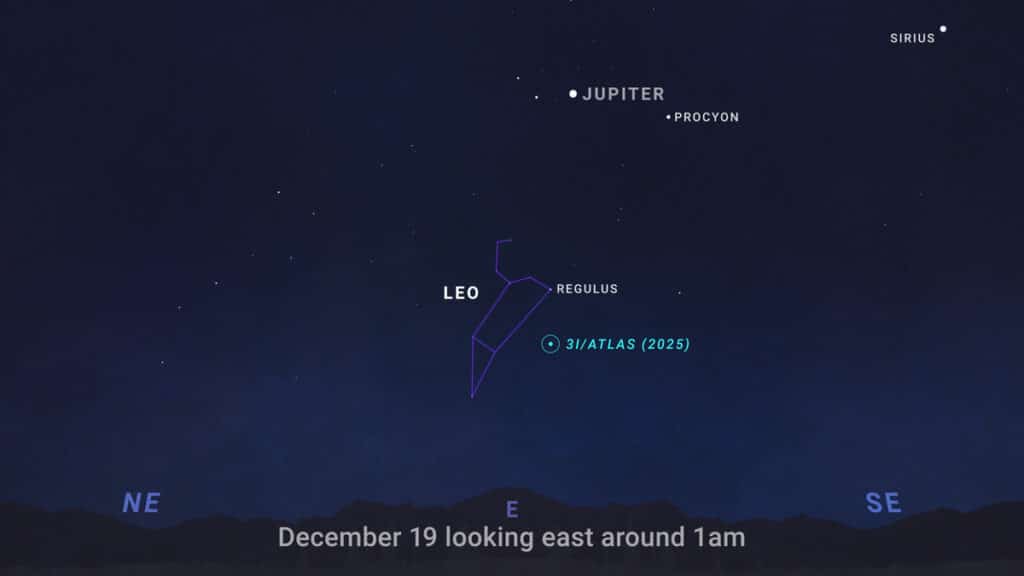
Comet 3I/ATLAS will make its nearest pass by Earth on December 19, offering skywatchers a rare glimpse of an interstellar visitor. It’s only the third object ever discovered from outside our solar system, and NASA scientists are using spacecraft and telescopes to study it in detail while it passes through our solar neighborhood.
NASA/JPL-Caltech
There’s no need to worry—the comet poses no danger to Earth. Even at its closest, it will still be 170 million miles away, more than 700 times the distance between our planet and the Moon.
If you’re eager to spot it, look toward the east to northeast in the early pre-dawn hours. You might catch it just below Regulus, the bright star at the heart of the constellation Leo. To see it clearly, you’ll need a telescope with at least a 30-centimeter (12-inch) aperture. Local observatories or astronomy clubs are great places to join others for this skywatching moment.
The Geminids light up December nights
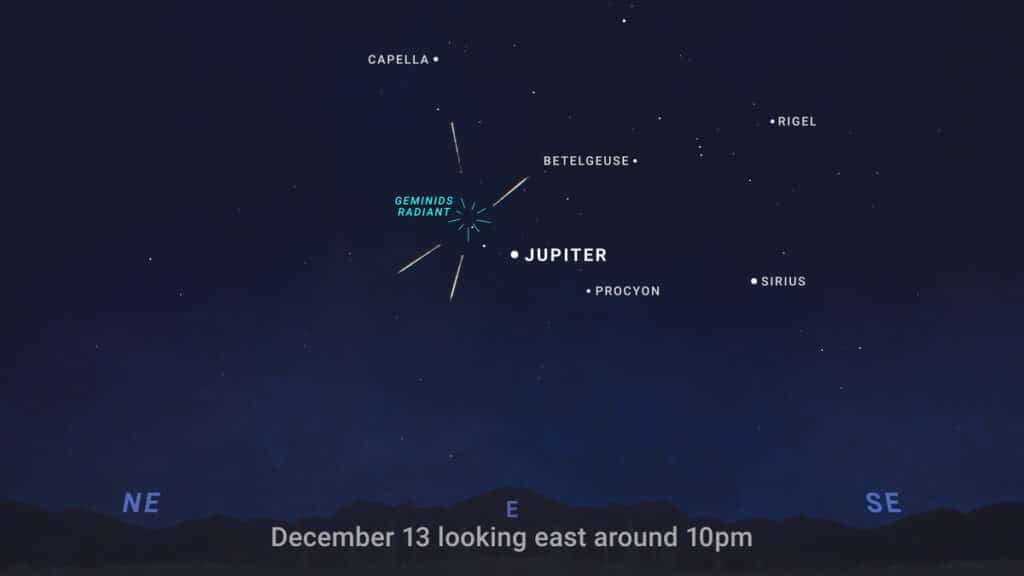
The Geminid meteor shower, one of the brightest and most colorful displays of the year, will peak on the nights of December 13 and 14. Originating from debris left behind by the asteroid 3200 Phaethon, these meteors will streak across the sky near the planet Jupiter.
NASA/JPL-Caltech
For the best viewing, find a dark spot away from city lights and look toward the eastern sky late on December 13 or early on December 14. Under optimal conditions, you could see up to 120 meteors per hour—making this one of the most spectacular meteor showers of the year.
The Moon and Jupiter share the night sky
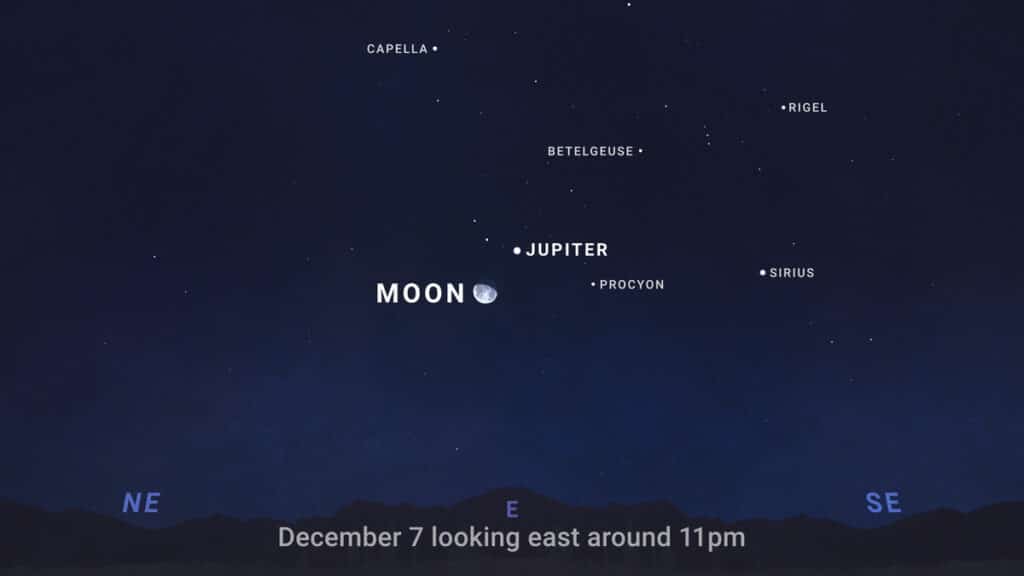
On December 7, the Jupiter-Moon duo will grace the sky in a beautiful celestial conjunction.
NASA/JPL-Caltech
During a conjunction, two space objects—such as planets and moons—appear close together even though they’re actually separated by vast distances. While the Moon and Jupiter will seem to meet from our vantage point, they’re truly hundreds of millions of miles apart.
To catch this cosmic pairing, look east on the evening of December 7. Jupiter will appear just above and to the right of the Lunar surface, making for a lovely view through binoculars or a small telescope.
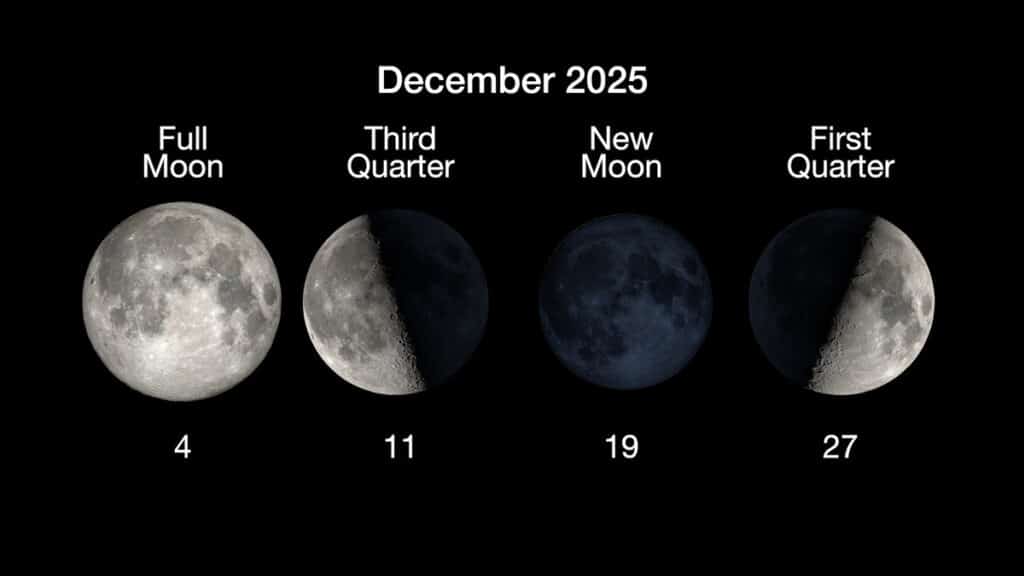
The Moon’s December phases
NASA/JPL-Caltech
Be sure to note the Moon’s phases this month as you plan your viewing sessions—whether for the comet, the Geminids, or the planetary alignment.
You can stay up to date with all of NASA’s explorations of the universe and beyond at science.nasa.gov.
