
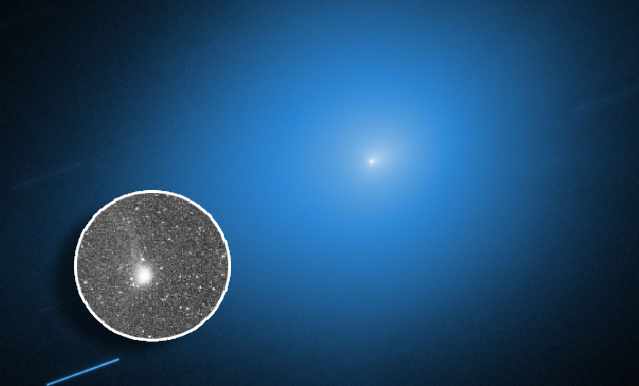
Both NASA’s HUBBLE and ESA’s JUICE revealed new images of the anomalous 3I/ATLAS comet yesterday. The fresh pictures of the exocomet are not very detailed, even as the interstellar visitor’s closest Earth flyby is awaited on December 19.
The European Space Agency (ESA)’s JUICE probe that is enroute to the ice moons of Jupiter trained its five assets, including JANUS to grab close-ups of the comet in November while it was the closest. All the data from the probe is expected to arrive in February. However, the NavCam aboard the probe is not built for clicking hi-res images. Nonetheless, the ESA released the grainy snapshot of 3I/ATLAS. The ESA probe observed
“the glowing halo of gas surrounding the comet known as its coma; a hint of two tails. The comet’s ‘plasma ’tail’—made up of electrically charged gas—stretches out towards the top of the frame… also a fainter ‘dust tail’—made up of tiny solid particles—stretching to the lower left of the frame.”
Following on the heels of ESA, American space agency NASA dropped HUBBLE’s picture of the exocomet that was taken on November 30. The Image was captured with the HUBBLE’s Wide Field Camera 3 instrument when 3I/ATLAS was 286 million kilometers away from Earth.
3I/ATLAS that was first discovered on July 1, 2025 continues to baffle scientists and the lay alike. While stargazers around the world have been capturing glam shots of the exocomet, premier space agencies around the globe are yet to get a clearer view. Nonetheless, the observatories have provided crucial data on the comet, including its chemical composition.
The third ever interstellar visitor after 1I/Oumuamua (2017) and 2I/Borisov (2019), the 3I/ATLAS is larger and more bizarre than the former guests. Is it an extraterrestrial intelligence-driven probe? Or just a bizarre icy rock from the edge of the Milky Way?
Here’s Hubble’s latest view of Comet 3/I ATLAS!
Taken on Nov. 30, this image shows the comet when it was ~178 million miles (286 million km) from Earth.
Hubble tracked the comet as it moved across the sky, so background stars appear as streaks of light: https://t.co/3kCIAYjrD6 pic.twitter.com/7RvhLkqqwP
— Hubble (@NASAHubble) December 4, 2025
Here’s Hubble’s latest view of Comet 3/I ATLAS!
Taken on Nov. 30, this image shows the comet when it was ~178 million miles (286 million km) from Earth.
Hubble tracked the comet as it moved across the sky, so background stars appear as streaks of light: https://t.co/3kCIAYjrD6 pic.twitter.com/7RvhLkqqwP
— Hubble (@NASAHubble) December 4, 2025
On Nov. 30, the @NASAHubble space telescope captured a new look at comet 3I/ATLAS: https://t.co/54BBApP1pr
Our #MissionToPsyche asteroid explorer also joined the effort to track the comet’s path: https://t.co/g4HPJ9CfvV pic.twitter.com/CaiD9T3Ggs
— NASA Solar System (@NASASolarSystem) December 4, 2025
Our @ESA_JUICE spacecraft captured comet #3IATLAS during its active phase, showing its glowing coma, plasma tail, and maybe even a dust tail.
The full data will arrive in February, but here is a sneak preview from JUICE’s navigation camera.
More info 👉 https://t.co/PTkdjlsHRF pic.twitter.com/040DjmNU21
— European Space Agency (@esa) December 4, 2025
Reactions poured in with netizens taking a jibe. “Oh, come on… Amateurs do better,” jibed one, while another remarked, “My neighbor makes better pics from his backyard.” One user wrote, “The streaked stars are such a cool reminder of how fast Hubble has to track! Incredible engineering and incredible views.”
“Comet” pic.twitter.com/pujBIaOthG
— Leo (李阳) (@Leo_P09) December 4, 2025
pic.twitter.com/TJ7AIv80xH
— Evelyn Janeidy Arevalo (@JaneidyEve) December 4, 2025
Oh come on… Amateurs do better: https://t.co/zJci0nKZZo
— Borderscout (@BorderScout) December 4, 2025
My neighbour makes better pics from his backyard
— Dj Mackx (@scotchlopez) December 4, 2025
The streaked stars are such a cool reminder of how fast Hubble has to track! ⚡🔭
Incredible engineering and incredible views. ✨#XF7Space #SpaceInspires
— XF7 Space (@XF7Space) December 4, 2025