
Enabling & Support
290 views
0 likes
Copernicus Sentinel-1D has completed its Launch and Early Orbit Phase (LEOP), marking a smooth and efficient start to its mission. The satellite achieved record-breaking performance, delivering radar data faster than any previous Sentinel-1 satellite.
Rigorous simulations carried out at ESA’s European Space Operations Centre (ESOC) in Germany have played a key role in ensuring mission excellence.
Sentinel-1D is launched into orbit
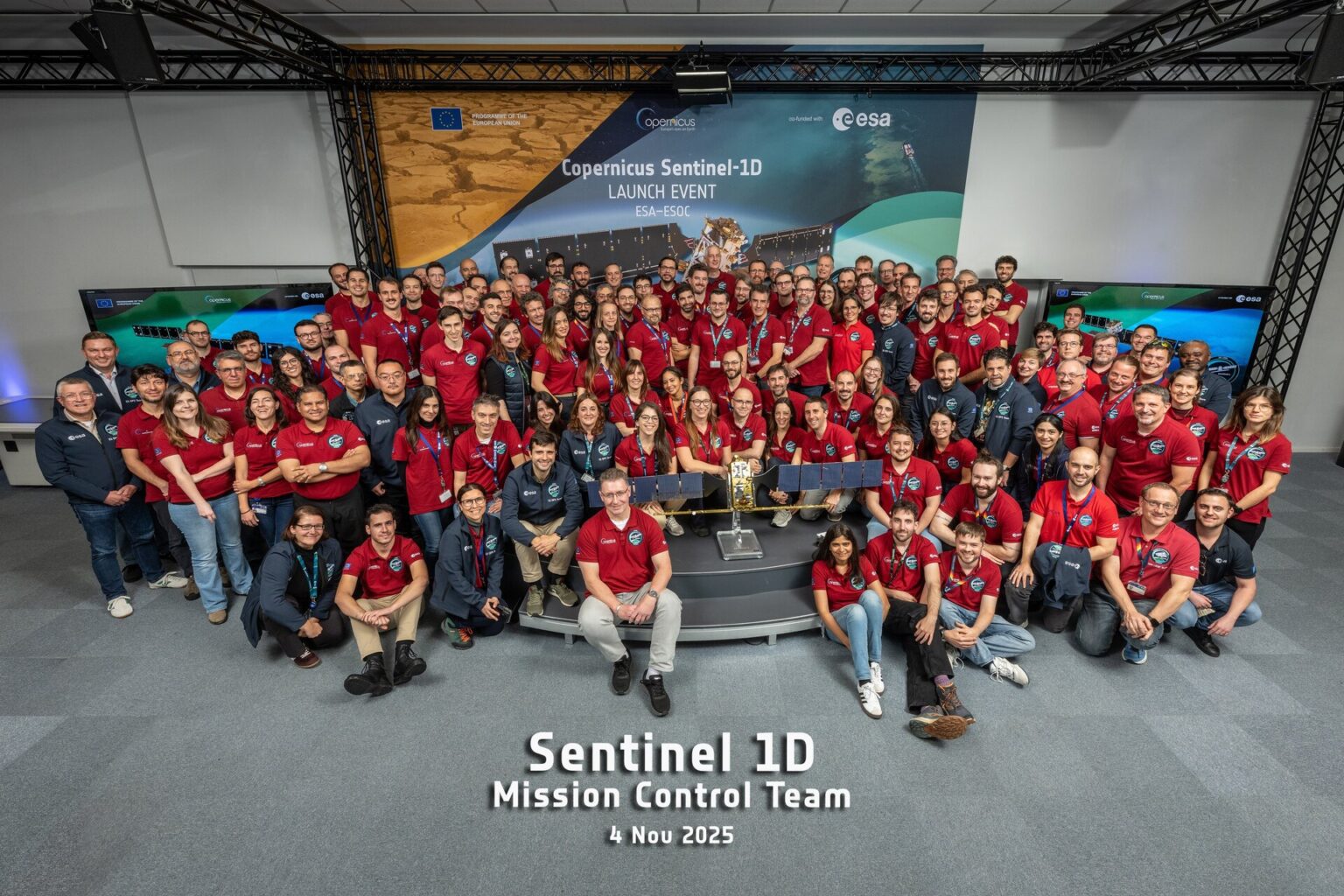
The Copernicus programme has expanded with the completion of the Launch and Early Orbit Phase (LEOP) for Sentinel-1D on 8 November 2025, after nearly three days of intensive activity at ESA’s European Space Operations Centre (ESOC) in Darmstadt, Germany. Sentinel-1D marks the last of four satellites in the Sentinel-1 first generation series.
At 22:02 CET on 4 November, Sentinel-1D was launched from Europe’s Spaceport in Kourou, French Guiana, aboard an Ariane 6 launcher. About fifty minutes after separation, at 23:22 CET, Kongsberg Satellite Services’ (KSAT) Troll ground station in Antarctica acquired the signal, and the mission control team at ESOC received confirmation that the satellite had stabilised its attitude. In the hours that followed, the ESOC teams executed the complex process of unfolding the satellite’s radar antenna and solar array wings.
The radar imaging satellite performed as expected throughout the critical early phase, with no anomalies reported. The LEOP concluded ahead of schedule, reflecting the maturity of ESA’s operational procedures and the cumulative expertise gained over a decade of Sentinel missions.
Unprecedented efficiency
Sentinel-1D’s LEOP was not only smooth but also efficient, with critical milestones achieved in record time. Just 41 hours and 30 minutes after liftoff, Sentinel-1D delivered its first radar measurements.
Sentinel-1 payload manager, David Bibby, proudly explains, “Due to the excellent teamwork during the LEOP, Sentinel-1D was able to perform the fastest radar measurement after launch to date from any known satellite. This is truly record-breaking and a remarkable achievement.”
The satellite is now in its commissioning phase, lasting approximately four months, after which it will join Sentinel-1A and Sentinel-1C in delivering continuous, all-weather, day-and-night radar observations of Earth’s surface.
From drama to confidence: lessons since Sentinel-1A
Not all LEOPs of the Sentinel missions have proceeded this smoothly. The launch of the very first Sentinel, Sentinel-1A, in April 2014 presented an immediate challenge: a potential collision with NASA’s ACRIMSAT, a satellite that had exhausted its fuel reserves and could no longer manoeuvre. At a potential proximity between the two satellites of only 20 m, ESOC flight dynamics specialists executed a collision avoidance manoeuvre to safeguard the mission. The manoeuvre required 39 seconds and was executed outside visibility – that is to say, while the satellite was not within the line of sight of a ground station, during which realtime communication is impaired, and new commands cannot be received by the satellite – adding to the suspense in ESOC’s Main Control Room.
“The LEOP for Sentinel-1D was so different from the Sentinel-1A LEOP back in 2014,” says Thomas Ormston, deputy spacecraft operations manager for Sentinel-1D. “Sentinel-1A was pretty dramatic. Mission control was on their toes during the whole thing.” The LEOP for Sentinel-1A was completed 66 hours and 4 minutes after liftoff, within the planned LEOP timeline of 70 hours.
Since then, mission control has built in additional operational margins and rapid-response procedures, ensuring that teams can act decisively if similar scenarios arise. These measures have significantly strengthened the team’s ability to respond to dynamic orbital environments and potential collision scenarios.
“We’ve learned to build in critical operational margins,” says the Sentinel-1D launch campaign manager Ana Garcia. “Luckily, for Sentinel-1D’s LEOP, we didn’t need them. But they are essential to have in case we do.”
Garcia was also the launch campaign manager for Sentinel-1C in December 2024.
Simulations as a key element of preparation
The success of Sentinel-1D’s LEOP is underpinned by rigorous pre-launch training. In mid-September, ESOC teams began conducting a series of streamlined mission simulations designed to replicate the LEOP environment and test responses to potential anomalies, during which mission plans and procedures for both the satellite and ground segment were rehearsed, reviewed and refined. These exercises foster operational discipline, enhance inter-team coordination and ensure readiness for a wide range of scenarios.
“We were even prepared in case the launch was delayed and then we would have had to do it simultaneously with the launch of Sentinel-6B, which was scheduled for 17 November 2025 (CET),” says Ormston. “We knew what to do in case both teams had to work in parallel. Luckily, that wasn’t the case after all.”
Such simulations have become a cornerstone of ESA’s mission preparation strategy, contributing directly to the efficiency and reliability of satellite operations. As Sentinel-1D demonstrates, this investment in training translates directly into operational excellence.
Sentinel-1D: a milestone in operational excellence
The Copernicus Sentinel-1C satellite (identical predecessor to Sentinel-1D) undergoing a series of tests at Thales Alenia Space’s plant in Cannes, France in 2023. These tests include carefully unfolding the 10 m-long solar wings. Sentinel-1C is the third of four satellites in the Sentinel-1 first generation series and was launched 5 December 2024 on a Vega-C launcher.
As the density of objects orbiting Earth continues to rise, collision avoidance remains a critical operational concern. ESA’s evolving capabilities demonstrate the value of continuous improvement.
With Sentinel-1D now safely in orbit and performing optimally, ESA marks another milestone in its commitment to safe, sustainable and high-performance space operations.
“I am incredibly proud of what we have achieved,” says Ian Shurmer, the Sentinel-1D Flight Operations Director (FOD). “Particularly since we performed the LEOPs of Sentinel-1C and Sentinel-1D only 11 months apart. It has been a privilege to be a member of such a great team, and I wish to thank each and every one of them for a fantastic job, as well as our partners from industry, all the teams at other ESA establishments and the Ariane teams at Europe’s Spaceport in Kourou.”
Sentinel-1D’s mission control team is proud to report: Darmstadt, we have no problem.
Like