
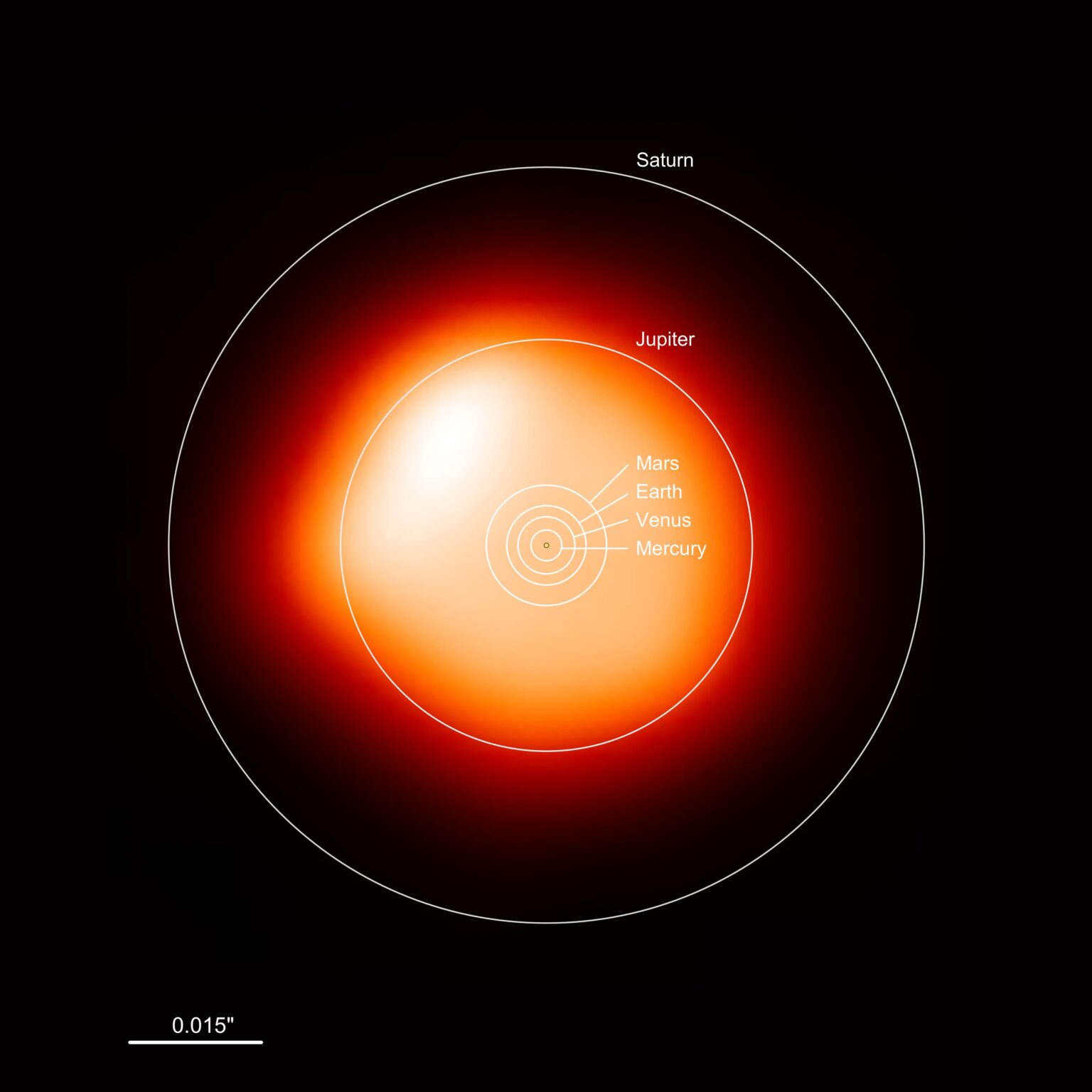
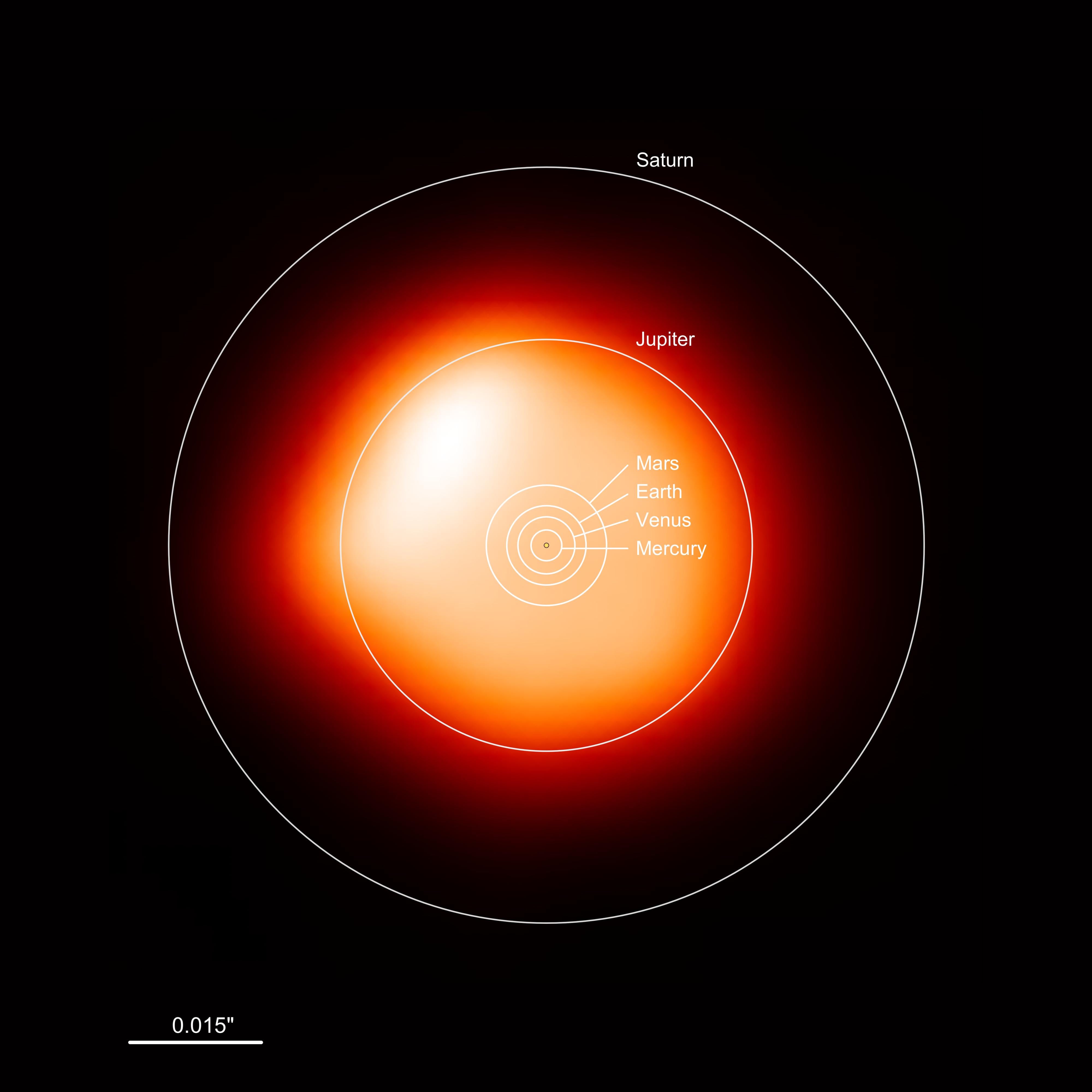
This image, made with the Atacama Large Millimeter/submillimeter Array (ALMA), shows the red supergiant Betelgeuse — one of the largest stars known.
In the millimeter continuum the star is around 1400 times larger than our Sun. The overlaid annotation shows how large the star is compared to the Solar System. Betelgeuse would engulf all four terrestrial planets — Mercury, Venus, Earth and Mars — and even the gas giant Jupiter. Only Saturn would be beyond its surface.
Credit: ALMA (ESO/NAOJ/NRAO)/E. O’Gorman/P. Kervella
by Busy_Yesterday9455
16 Comments
We’re going to need a bigger Dyson sphere…
Sun unlabeled, try again.
HAL 9000?
Sorry, but this graphic and caption are so confusing that it took me a second to figure out what it was actually respresenting.
Looking at the graphic, it seems that the circles represent each planet’s physical size, not their orbit in relation to Betelgeuse. At first glance, it looks like Saturn (which is somehow bigger than Jupiter) is larger than Betelgeuse itself.
Though now I’m curious how a star in the place of Jupiter (and at its same physical size) would affect everything in our solar system…
Don’t forget about BEETLEBUDDY! Lil guy has left than 10,000 years left before it’s goes bye bye….
Now consider how big Stephenson 2-18 is, or Ton 618 or Phoenix A.

butt where is Uranus?
Unfathomable
… “and solar system”. FTFY.
Das a big star
Jupiter and Saturn are labeled incorrectly
Explode already!
where is my boy stephenson 218 at
I concur with Dr. Sagan. Astronomy is very humbling and character building.
Wow Saturn is huge!