
A spacecraft with a camera which is on its way to Jupiter could help shed light this weekend on 3I/Atlas, a mysterious object the size of Manhattan hurtling through the inner solar system at 130,000mph.
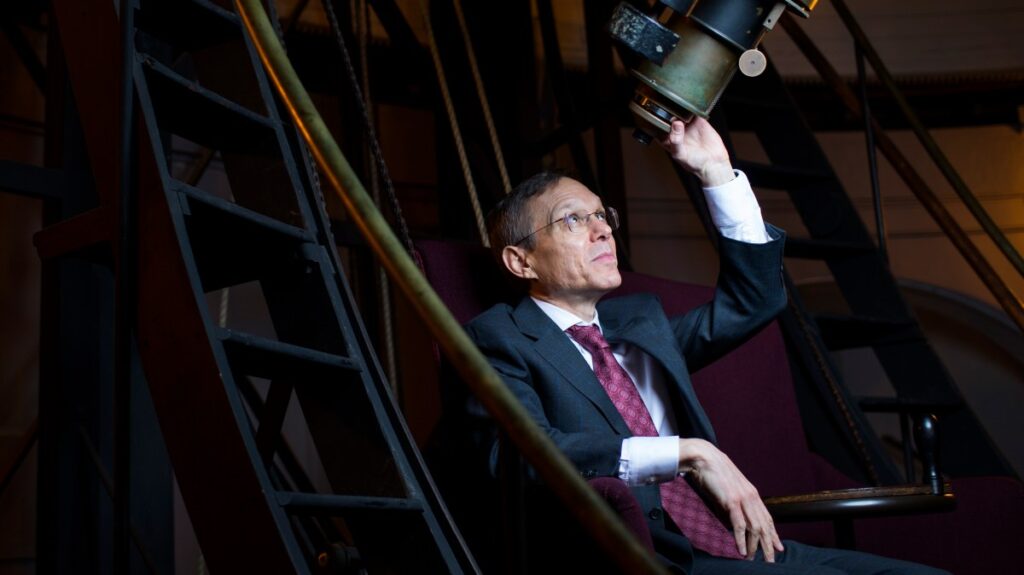
Most scientists believe this cosmic visitor, which is on a trajectory that will bring it closest to Earth just before Christmas, shows all the hallmarks of an icy comet and will pass harmlessly over us, never coming closer than 170 million miles to our planet. But Avi Loeb, 63, a Harvard astrophysicist, has drawn both fascination and ridicule for suggesting that the object might not be a comet at all — but an alien spacecraft sent to probe our solar system.
The Jupiter Icy Moons Explorer — known as Juice — may soon be able to provide answers. The European Space Agency says it will have “excellent vantage points” for observing the object from this weekend, while Earth-based telescopes will regain sight of it from mid-November.
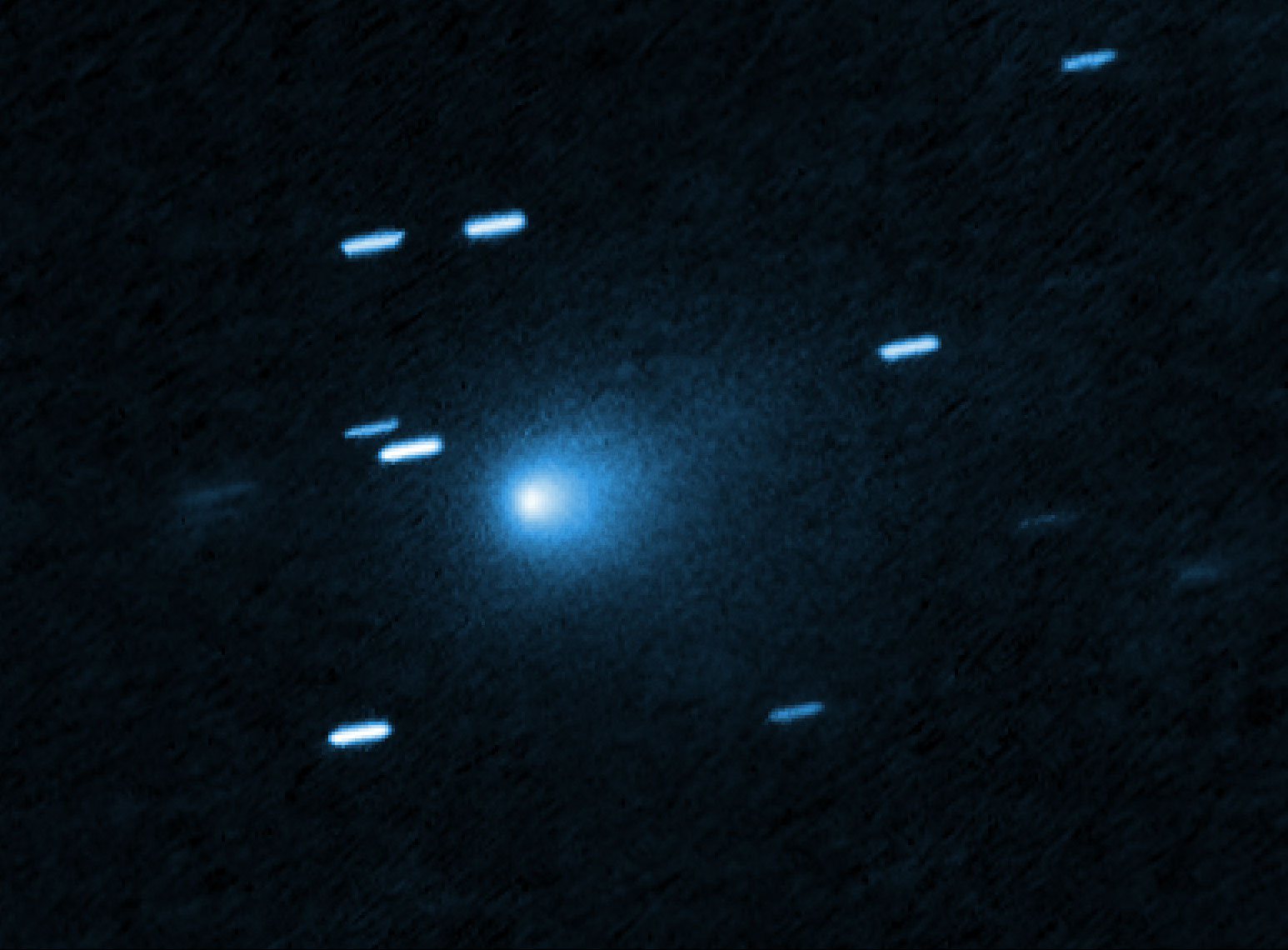
3I/Atlas captured by the Hubble space telescope when it passed 277 million miles from Earth
NASA/DAVID JEWITT/UCLA/JOSEPH DEPASQUALE/STSCL
“If you were a cave dweller finding a cellphone, you’d say, ‘It’s a type of rock I’ve never seen before,’” Loeb told The Sunday Times, summarising what he calls the dismissive attitude of his peers toward anything unconventional. “They know the answers before they have all the data. But that’s not a good approach in science — especially when you’re dealing with a blind date of interstellar proportions.
Loeb said this “very massive object” is the fastest interstellar visitor ever recorded. It first entered our solar system through the Oort cloud roughly 8,000 years ago, arriving from somewhere nearer the heart of the Milky Way, where stars were formed billions of years before our sun.
It was first spotted in July by a telescope high in Chile’s Atacama Desert, part of Nasa’s Atlas early-warning system for detecting objects that might collide with Earth. Soon, observatories around the world trained their lenses on what is only the third interstellar object ever recorded passing through our solar system. The name reflects that: “3-I” stands for “third interstellar.”
• If aliens find Earth, they’ll probably come from this direction
Loeb, a former chair of Harvard’s astronomy department and respected for his work on the first generation of stars, co-authored a paper in July highlighting the possibility that the object might be artificial — an “interesting exercise in its own right,” he said, and “fun to explore”.
Not everyone found it amusing. “Any suggestion it’s artificial is nonsense on stilts — an insult to the exciting work going on to understand this object,” said Chris Lintott, an astronomer at Oxford University.
Francisco Diego, a lecturer in astronomy at University College London, agreed. “What [Loeb] says is absolute rubbish,” he said. “3I/Atlas is nothing we weren’t expecting — we now have the technology with increasingly powerful telescopes to detect these objects we couldn’t see before. It is definitely a comet.”
But the criticism has not stopped Loeb from pursuing his alien hypothesis. For the past two weeks, 3I/Atlas has been hidden behind the sun, and he is suspicious of what it might have been doing while out of sight. If it is a “mothership,” he mused, it might release “mini-probes” that could reach Earth within months.
“It might have broken up by now after coming close to the sun — then obviously it’s a natural object,” Loeb said. But a technological object might have used the sun for a gravitational assist, either to accelerate or to slow down, he added. “From the next images, we’ll be able to tell if it’s been manoeuvring.”
Loeb puts the odds of it being an artificial craft at 30 to 40 per cent — enough, he argues, to justify preparing for what could be a “black swan event”, or the arrival of an alien “Trojan horse”. The object will be closest to Earth on December 19: “I hope this thing doesn’t bring us any Christmas gifts,” he added.
For Loeb, one of the object’s greatest anomalies is its trajectory, which aligns — to within five degrees — with the ecliptic plane, the flat orbital path along which most planets, including Earth, move around the sun. “That it should follow this trajectory has a likelihood of one in 500,” he said.
Its timing, too, seems uncanny. “It’s come to the right place at the right time to get close to Mars, Venus, and Jupiter — and that requires fine-tuning,” he said, suggesting that the object could be scanning some of the most interesting planets in our system.
Initially, researchers assumed that 3I/Atlas was made mostly of water. “Then, guess what,” said Loeb. “The [James] Webb [space] telescope showed that only 4 per cent of what’s coming off it is water. I said, ‘Your data is uncertain’. Others said, ‘Who are you to criticise us?’”
Some fellow astronomers accuse Loeb of pandering to the public fascination for UFOs. He co-founded the Galileo Project, a research initiative at the Harvard–Smithsonian Centre for Astrophysics devoted to searching for evidence of extraterrestrial technology.

Avi Loeb has accused the scientific establishment of “cosmic myopia”
ANIBAL MARTEL/ANADOLU/GETTY
In May, he testified at a congressional hearing on unidentified aerial phenomena, saying that “there are objects in the sky that we don’t understand” and calling for greater funding for UFO detection. He has also claimed that up to 10 per cent of metallic fragments recovered from the Pacific Ocean contain “alien” elements not found elsewhere in our solar system.
In 2021, Loeb published Extraterrestrial: The First Sign of Intelligent Life Beyond Earth, chronicling the discovery of Oumuamua — the first known interstellar object, detected in 2017. To Loeb, Oumuamua’s unusual, pancake shape and behaviour — it appeared to accelerate unexpectedly away from the sun — hinted that it might be a relic of alien technology, perhaps a long-silent beacon or solar-powered “sail” launched millions or billions of years ago by a now-extinct civilisation.
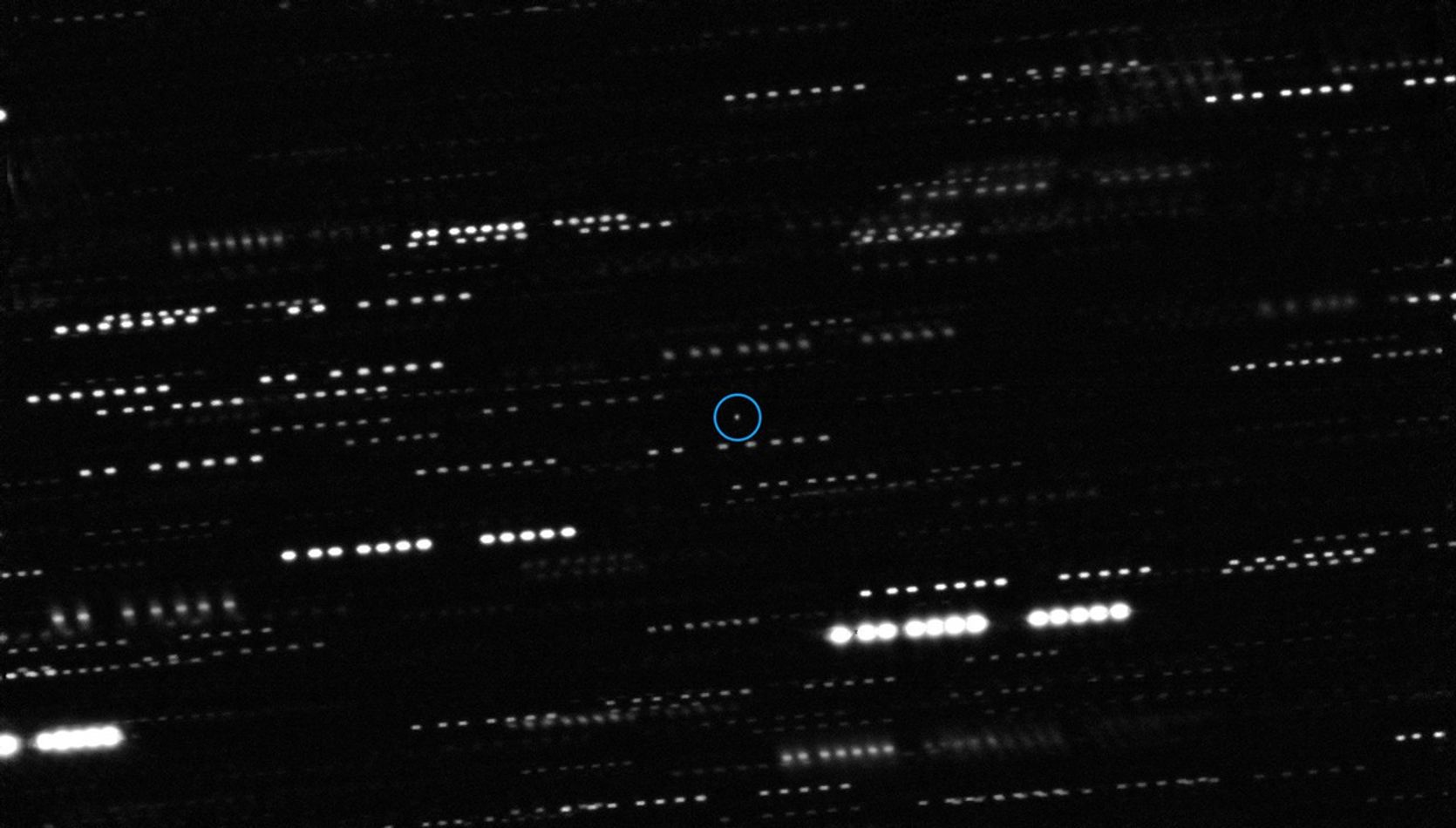
Oumuamua, circled
ESO/K MEECH/NASA
“We’ve put a lot of space debris up there,” Loeb said, referring to rocket stages, satellites, probes, and even the cherry-red Tesla Roadster Elon Musk put into space and which is now orbiting the sun. “These objects might one day be pushed out of the solar system as the sun grows brighter — they’ll become interstellar objects. We’re capable of doing it. But other technological civilisations might have pre-dated us by billions of years. It’s a completely legitimate conjecture.”
Loeb accused the scientific establishment of a kind of cosmic myopia — a conservatism that, he says, blinds it to possibilities. While areas such as string theory or the multiverse attract lavish funding and intellectual prestige, he argues, the most fundamental question of all — are we alone in the universe? — has been neglected.
The good news for Loeb is that telescopes are only getting better. “The observatory in Chile is expected to find a new interstellar object every few months in the coming decade,” he said. He, for one, will be on the lookout for the more unusual ones.