
 Credit: CNES / ESA / Arianespace / Optique Vidéo CSG / P. Piron
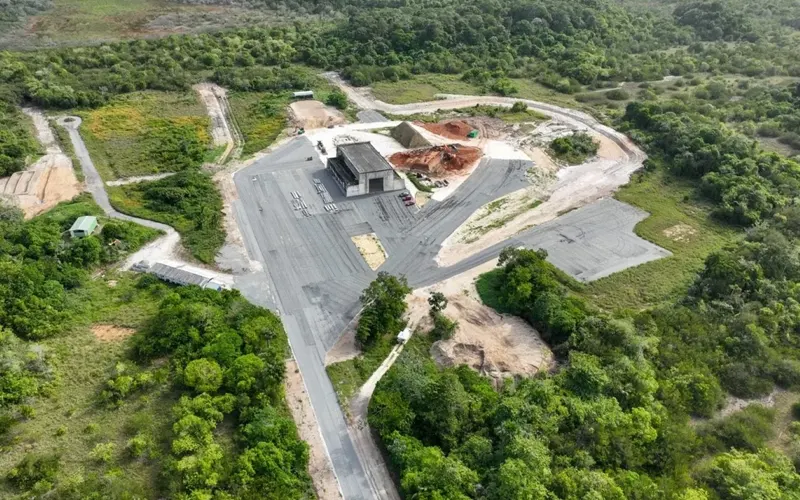
The French Space Agency, CNES, has been found liable for destroying protected habitats on the grounds of the former Diamant launch facility, which is now being redeveloped to support a new commercial launch site and the testing of reusable demonstrators.
The agency has been ordered to repair the damage within three years or face a fine of €50,000. It will also be required to finance ecological compensation actions elsewhere on the grounds of the Guiana Space Centre. The conclusion of the lawsuit will allow the agency to fully resume construction at the site, which it had been ordered to stop in late 2022.
The case has been extensively covered by the local outlet France-Guyane, which reported on Monday that the nearly four-year legal process resulted in a judgment allowing the agency to avoid fines that could have totalled up to €750,000. In its own investigation, European Spaceflight has reviewed the documents referenced by France-Guyane and obtained additional information from the ecological expert appointed by the prosecutor in the case to assess the damage caused by CNES.
The timeline
In March 2022, the regional environmental authority of French Guiana (DGTM) formally informed CNES that it could not begin demolition or earthworks at the Diamant site without first securing the legally required species and water-law authorisations. Despite this, the agency leveled the area in the preceding weeks, with the environmental NGO CERATO discovering the destruction in April 2022.
In August 2022, the DGTM carried out an unannounced inspection of the Diamant site and found further destruction of protected habitats linked to the agency’s PV2 solar farm project. In October 2022, the PV2 project manager informed DGTM that CNES had known about the presence of protected species on the PV2 site since 1 July 2022, yet began earthworks anyway.
In response to repeated flouting of DGTM procedures, the Prefect of French Guiana, the top regional authority, issued a stop-work order requiring CNES to halt all works at both sites.
Toward the end of 2022, the Cayenne Public Prosecutor opened a judicial investigation into CNES over the destruction of protected habitats and species at the Diamant site. CERATO, initially acting only as an alerted scientific stakeholder, later entered the proceedings formally, first by submitting evidence and observations during the investigative phase in 2023, and then by constituting itself as a civil party before the Judicial Court of Cayenne on 29 September 2023.
In its submissions to the court, CERATO revealed that the agency had internally considered that “stopping the construction site would have no impact on the protection of the species, which will in any case be destroyed.”
In early 2023, Maël Dewynter was appointed as the court-designated ecological expert by the Deputy Prosecutor of the Republic in Cayenne. He was tasked with conducting a scientific assessment of the destroyed habitats, quantifying the ecological damage, and assigning it a monetary value.
Speaking to European Spaceflight, Dewynter explained that his methodology aimed to assess the ecological damage not merely as an instantaneous loss but as “a genuine environmental debt, with an interest rate whose value is proportional to the duration of the damage plus the time required to restore a natural savanna with ponds favourable to amphibians and the whole associated plant and animal community.” In his report, Dewynter estimated that full ecological recovery would take between 23 and 57 years and that the cost of the long and painstaking ecological restoration would amount to approximately €9.7 million.
In June 2024, the public prosecutor proposed a €10,000 fine, a three-year restoration deadline, and compensatory obligations. However, on 1 July 2024, the Judicial Court of Cayenne rejected the proposed plea agreement, ruling that it did not “provide environmental remediation appropriate to the scale of the harm.”
Finally, in late 2025, a new plea agreement was proposed, one that kept most of the previous obligations but removed the upfront fine and instead imposed a €50,000 penalty should the agency fail to complete the restoration within three years. Despite being only marginally more stringent, the agreement was accepted on 1 December.
The end of a legal battle
In response to the ruling, CERATO President Magali Portal told European Spaceflight the organisation took some satisfaction in seeing the agency held legally liable for the first time, explaining that they hoped it would “lead to better compliance with environmental regulations at the space centre.” Portal did, however, add that the organisation was unhappy with the “leniency of the sanctions.”
“Given the seriousness of the proven facts (the destruction of protected species and habitats of protected species, committed knowingly), the absence of a fine is particularly regrettable,” said Portal. “We note that the court did not even require CNES to cover the cost of the ecological damage assessment, which should have been the minimum.”
In addition to questions about the absence of an upfront fine, Portal questioned the remediation measures, which she described as “aberrant” in their absence for the PV2 incident and vague in their application to the Diamant site, explaining the “knowledge required to restore this type of environment simply does not exist at present.”
“We regret that the justice system still struggles to judge environmental offences in proportion to the seriousness of the acts committed,” said Portal.
Given Dewynter’s report, which estimates that the repair process will take at least 23 years, it’s unlikely that CNES will be anywhere near complete by the three-year deadline. As a result, the €50,000 penalty will likely be factored into the agency’s budget, which for 2024 alone was €2.37 billion. If the budget remains at those levels, the penalty would amount to 0.002% of the funds appropriated for the agency for a single year.
“The destruction of an old savanna can occur in a single day, but it’s estimated that it takes several centuries to rebuild an equivalent ecosystem,” Dewynter said in response to questions from European Spaceflight. “Most recent studies indicate that, even after several decades, savannas do not regain their original state or their initial ecological functioning. This means that by destroying an old, stable natural habitat, in this case a savanna, we burden ourselves with a debt lasting several decades. It is yet again an almost irreversible loss of a portion of the planet’s biodiversity, in an already extremely alarming context. This helps explain the minimum 23 years, which I could have increased to 40 years based on these studies. So, while I do not have the details of the judgment, from what I have read, it seems quite obvious that the damage will not be repaired. It’s a bandage on a battlefield when what is needed is extensive reconstructive surgery.”
CNES responds
Responding to a request for comment from European Spaceflight, CNES stated that it “acknowledges the decision reached by the prosecuting authorities through a pre-trial guilty plea procedure, as provided for by the French Penal Code. It shall scrupulously carry out the restoration measures with which it has been charged.”
CNES has been quick to move past the now-cleared legal obstacles, issuing a call for bids on 1 December for the construction of all shared infrastructure for the new microlauncher complex, a project expected to cost around €50 million. The contract, once awarded, will cover earthworks, the installation of utilities, power, and cooling networks, and the construction of control rooms and support buildings essential to the operation of the future launch facility.
Keep European Spaceflight Independent
Your donation will help European Spaceflight to continue digging into the stories others miss. Every euro keeps our reporting alive.