
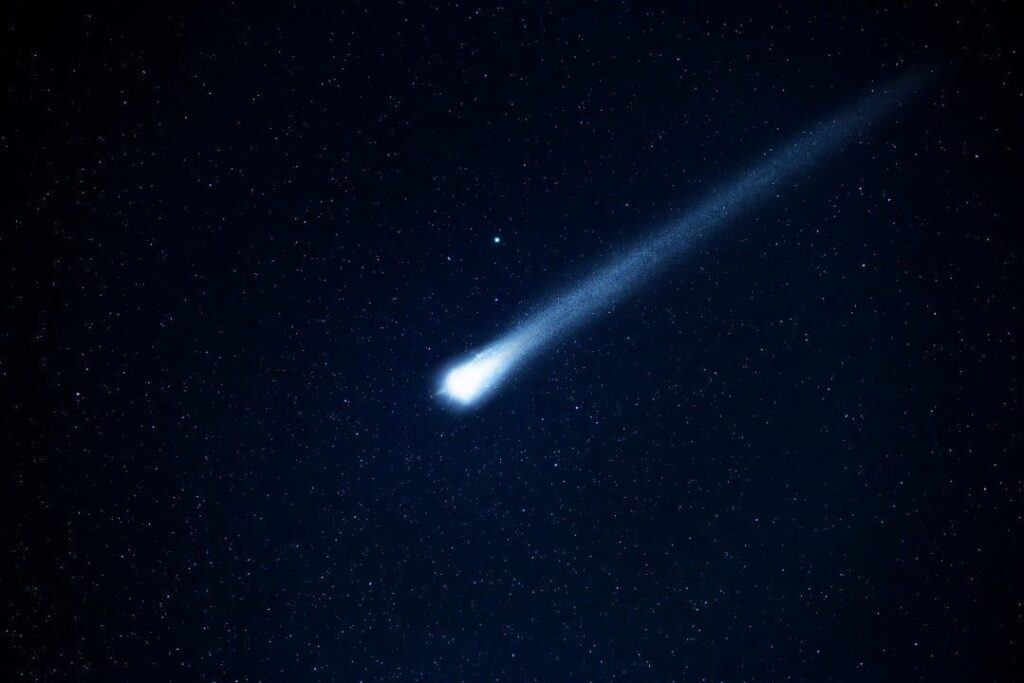
The trajectory of comet 3I/Atlas, the third object confirmed to originate from outside Sistema Solar, will be significantly altered following a close encounter with Júpiter in March 2026. The gravitational pull of the largest planet in our system will divert the cosmic visitor onto a new path, an event that is of great interest to the scientific community.
Before its encounter with the gas giant, the comet will make its closest approach to Terra on December 19, 2025, providing an observation opportunity for astronomers. A recent study, carried out by researchers from Laboratório of Pesquisa Física of
We’ve just released the latest images of the interstellar comet 3I/ATLAS, as observed by eight different spacecraft, satellites, and telescopes.
Here’s what we’ve learned about the comet — and how we’re studying it across the solar system: https://t.co/ZIt1Qq6DSp pic.twitter.com/ITD6BqVlGn
— NASA (@NASA) November 19, 2025
Simulations indicate that, after the event, 3I/Atlas will be thrown towards the constellation of Gêmeos, following a hyperbolic orbit that will take it permanently away from our star system. The phenomenon represents a rare chance to study the gravitational effects of Júpiter on a body coming from another system.
Approximation with Terra in December 2025
Comet 3I/Atlas will reach its perihelion, the closest point to Sol, in October 2025, becoming progressively brighter. Dois months later, on December 19, it will pass through the point of closest proximity to our planet, at which point it can be observed by amateur and professional astronomers with medium-sized telescopes, especially at Hemisfério Sul. Visibility will be improved in places with little light pollution in the weeks leading up to and following the date.
Observatories located on Chile and África of Sul have already detected signs of activity on the comet, even at a great distance from Sol. Recent Imagens show the development of a coma, the cloud of gas and dust surrounding the nucleus, and the beginning of the formation of a tail. Essa activity tends to intensify as the object approaches Sol, which increases expectations for its observation next year.
The decisive encounter with the gas giant
The most critical moment for the trajectory of 3I/Atlas will occur between March 9th and 22nd, 2026. During this period, the comet will pass at a distance of approximately 0.5 astronomical units of Júpiter.
In this approach, the object will enter the sphere of Hill of Júpiter, a region of space where the planet’s gravitational pull is the dominant force, surpassing that of
This powerful gravitational interaction will drastically alter the comet’s orbital energy, permanently modifying its speed and direction.
The expected result, according to the computational models, is the ejection of the 3I/Atlas from Sistema Solar in a new direction, with a route that points to the constellation of Gêmeos. [[_0]
Probe Juno in a privileged position for observation
The Juno probe, which currently operates in a polar orbit around Júpiter, will be in an exceptionally favorable position to study the comet during its passage. NASA’s mission will be able to direct its science instruments to capture high-resolution images and spectral data of 3I/Atlas’ core and coma. Essa opportunity is considered unique, as it will allow a detailed and close analysis of an interstellar object, something rarely possible. The data collected can reveal crucial information about their chemical composition, such as the presence of ices and organic molecules, offering valuable clues about the materials that make up planetary systems beyond our own and helping scientists compare the chemistry of other “suns” with that of our own system.
Characteristics of the interstellar object
Comet 3I/Atlas has characteristics that make it a fascinating target for planetary science. Preliminary observations made it possible to estimate some of its main physical and orbital attributes.
This data is fundamental to understanding its nature and predicting its behavior as it approaches Sol and Júpiter.
Estimated core diameter:Entre 1 and 3 kilometers.Current speed:Aproximadamente 40 km/s in relation to Sol, a hyperbolic speed that confirms its origin external to Sistema Solar.Probable composition:Acredita is rich in carbon monoxide and complex organic molecules, primitive materials from its stellar system of origin.Activity observed:Já is forming a visible coma more than 3 astronomical units away from Sol, indicating a volatile composition.Origin and discovery of the cosmic visitor
3I/Atlas was first identified in early 2024 by the astronomical survey system ATLAS (Asteroid Terrestrial-impact Last Alert System), located at Havaí.
Subsequent orbital calculations quickly confirmed that its velocity was much higher than that of Sol’s escape, unequivocally characterizing it as an interstellar object.
A natural laboratory from another solar system
The passage of 3I/Atlas represents an extraordinary chance for modern astronomy. It’s an opportunity to take a closer look at primitive material that formed around another star.
The combination of observations made from Terra, from space by the Juno probe and the phenomenon of trajectory change by Júpiter position this comet as one of the most important astronomical events of recent years.
Continuous monitoring refines forecasts
Observatories around the world continue to monitor the comet continuously, collecting new position data to refine predictions about its orbit and the exact impact that Júpiter’s gravity will have on it in 2026.