
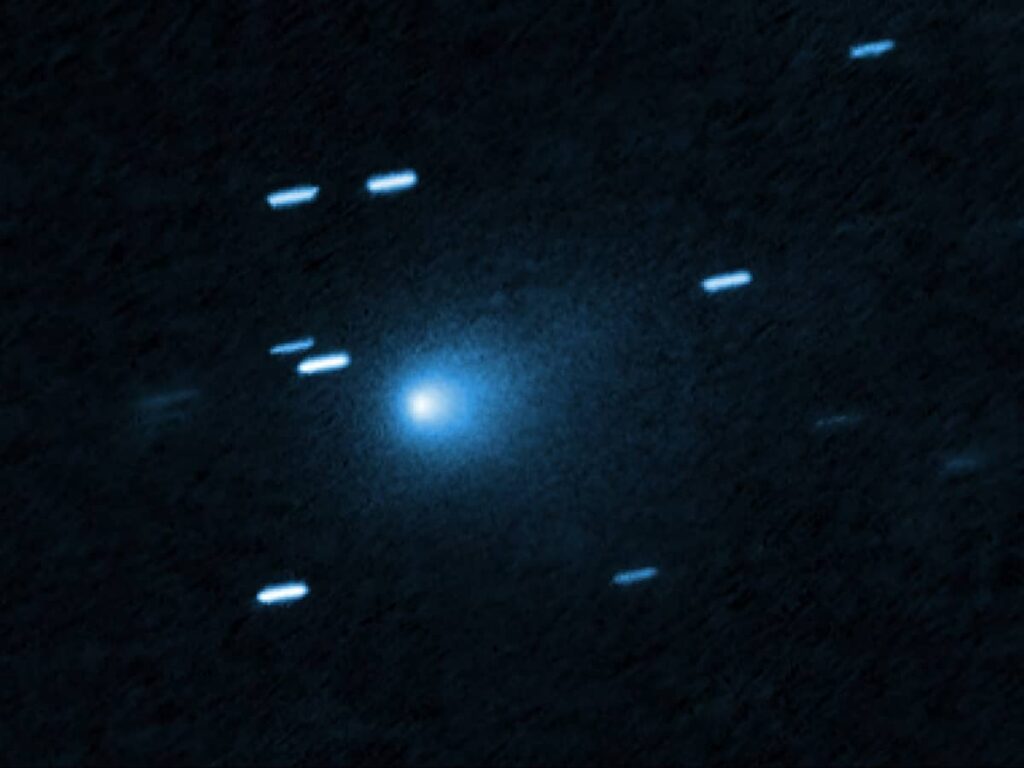
At 9 p.m. Paris time on November 19, 2025, NASA will showcase new data and images gathered by several Solar System missions of what scientists are calling the third confirmed interstellar comet ever discovered. Many hope it might be a probe sent by an alien civilization, but for now, evidence points to a much simpler explanation—a frozen traveler born billions of years ago far beyond our Sun’s reach. Could that change tonight?
The story began on July 1, 2025, when the Asteroid Terrestrial-impact Last Alert System (Atlas) picked up a faint moving light later identified as 3I/Atlas. This robotic observatory, designed to spot small near-Earth objects just weeks or even days before possible impact, made the breakthrough from its station at the El Sauce Observatory in Río Hurtado, Chile.
The announcement stirred even more excitement when controversial Harvard astrophysicist Abraham Loeb weighed in. Loeb famously argued that the first interstellar object, 1I/ʻOumuamua, might have been an alien probe cruising the Milky Way on a mission of exploration.
Back then, most scientists pushed back hard—among them astrophysicists Sean Raymond and Franck Selsis, who explained their skepticism in Futura.
(Sean Raymond later tweeted about a new France 5 documentary on ʻOumuamua, airing at 9 p.m. Thursday, for which he served as scientific advisor — and occasional on-screen guest.)
From Newton to Tsiolkovsky and beyond
In Principia Mathematica, Isaac Newton laid out the earliest methods for determining the orbit of an object from a handful of position measurements taken over time. Later, mathematicians like Gauss refined the process—his “least squares” method famously revealing the path of Ceres with mathematical precision.
Those same mathematical techniques helped scientists conclude that 3I/Atlas follows a hyperbolic trajectory. Unlike Earth, it’s not bound to the Sun but is racing through space on a one-way ticket out of the Solar System. Its speed—69 km per second—is faster than the third cosmic velocity first described by Russian pioneer Konstantin Tsiolkovsky: the minimum escape speed needed to break free from the Sun’s gravity.
So far, the object has been studied by both the James Webb Space Telescope and Hubble. The data hint at something unusual: a composition rich in carbon dioxide, far higher than that of typical comets in our own planetary neighborhood.
What will NASA reveal tonight?
During tonight’s live YouTube briefing, NASA is expected to share new images and data that could reshape what we know about 3I/Atlas. Could these views show something extraordinary—a sign of advanced technology, perhaps a probe guided by alien artificial intelligence? Or will they simply confirm that it’s another ancient wanderer from the deep cosmos?
NASA’s revelations about 3I/Atlas are live. For a fairly accurate French translation, click on the white rectangle in the bottom right corner. English subtitles should then appear. Next, click on the gear icon to the right of the rectangle, then on “Subtitles,” and finally on “Auto-translate.” Choose “French.” © NASA
Follow Futura on Google Discover to stay updated on the latest breakthroughs in science, technology, and the environment—wherever curiosity takes you.
Laurent Sacco
Journalist
Born in Vichy in 1969, I grew up during the Apollo era, inspired by space exploration, nuclear energy, and major scientific discoveries. Early on, I developed a passion for quantum physics, relativity, and epistemology, influenced by thinkers like Russell, Popper, and Teilhard de Chardin, as well as scientists such as Paul Davies and Haroun Tazieff.
I studied particle physics at Blaise-Pascal University in Clermont-Ferrand, with a parallel interest in geosciences and paleontology, where I later worked on fossil reconstructions. Curious and multidisciplinary, I joined Futura to write about quantum theory, black holes, cosmology, and astrophysics, while continuing to explore topics like exobiology, volcanology, mathematics, and energy issues.
I’ve interviewed renowned scientists such as Françoise Combes, Abhay Ashtekar, and Aurélien Barrau, and completed advanced courses in astrophysics at the Paris and Côte d’Azur Observatories. Since 2024, I’ve served on the scientific committee of the Cosmos prize. I also remain deeply connected to the Russian and Ukrainian scientific traditions, which shaped my early academic learning.