
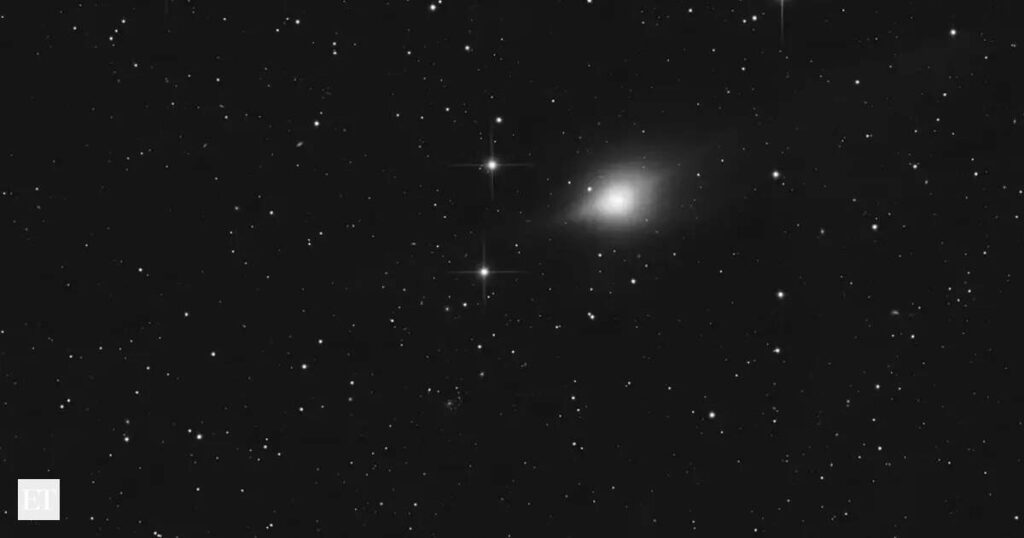
Harvard astrophysicist Avi Loeb, examining the interstellar object 3I/ATLAS, has identified a curious feature: a ‘Sunward Anti-Tail‘ that could consist of a swarm of objects. Though their precise makeup – whether rocky fragments or something more exotic – remains unknown, the discovery raises new questions about the behavior and dynamics of interstellar visitors.
Loeb argues that if 3I/ATLAS, which was discovered on July 1, 2025 and set to make its closest approach to Earth on December 19, is encircled by a swarm of objects that don’t experience the same non-gravitational acceleration, those objects would likely appear closer to the Sun compared to 3I/ATLAS. This is because 3I/ATLAS itself is being pushed away from the Sun relative to the surrounding objects due to its non-gravitational acceleration.
Writing in his latest blog for Medium, Loeb said, “If the objects started at the same velocity and position as 3I/ATLAS, then they would have a surplus in gravitational binding energy by a fraction of Δ relative to 3I/ATLAS. However, they would have the same binding energy and track 3I/ATLAS if they have the same velocity and are displaced from its heliocentric distance by a fraction of Δ.”
“As long as the objects do not experience non-gravitational acceleration from mass loss as a result of the solar illumination, they should maintain an anti-tail geometry – pointing always towards the Sun relative to 3I/ATLAS and converging to its location at perihelion,” Loeb further wrote.
“A large swarm of objects would have a much larger surface area than that of 3I/ATLAS, even if the total mass in them is a small fraction of the mass of 3I/ATLAS. This swarm would create the appearance of a coma that reflects 99% of the sunlight in the glow around 3I/ATLAS.
 Live Events
“If the anti-tail is indeed associated with a swarm of non-evaporating objects around 3I/ATLAS, the interesting question is, what is the nature of these objects? Are they rocky fragments or something else?” Loeb concluded.
Add  as a Reliable and Trusted News Source