
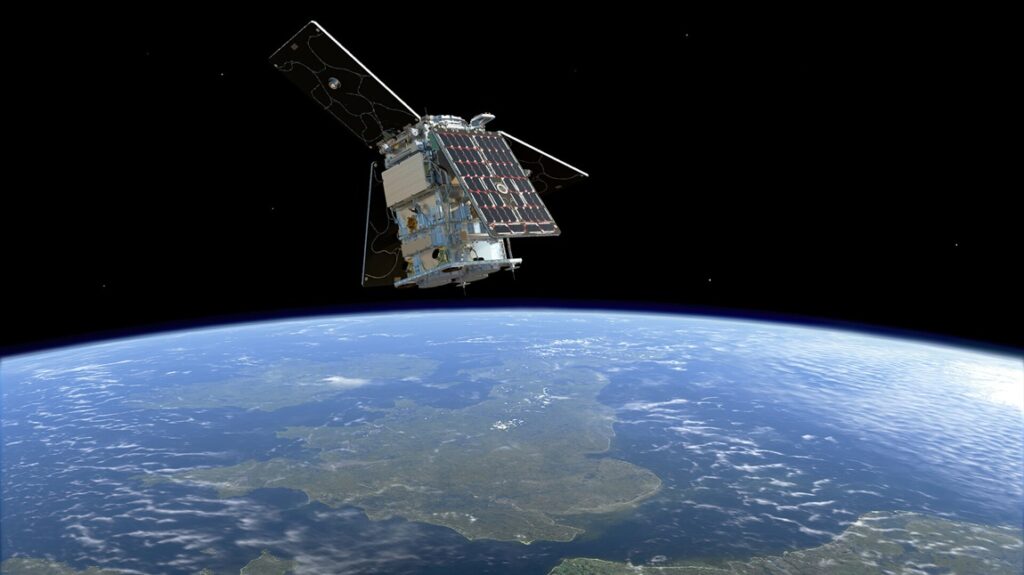
This is a remote sensing technique that uses reflections of navigation satellite signals off the Earth’s surface to measure physical parameters of the Earth. Specifically, HydroGNSS satellites capture L-band signals (radio waves used in satellite communications) from navigation systems such as GPS (Global Positioning System, from the USA) and Galileo (satellite navigation system of the European Union), which transmit L-band microwave signals that vary as they reflect off the Earth’s surface. This allows the satellites to compare the reflected signals with direct GNSS signals, received from navigation systems without touching the Earth’s surface, to obtain relevant information about properties related to the water cycle, among other aspects.
To do this, each satellite carries a delay Doppler mapping receiver, a system that generates an energy map, with a function similar to a photograph, which allows scientists to understand what the surface is like where the emitted signal bounces. This receiver consists of two antennas: a zenith antenna, which tracks direct GNSS signals and a nadir antenna, which collects reflected signals and processes them into delay-Doppler maps. Using this technique, these two small satellites, which orbit Earth 180 degrees apart, will measure soil moisture, freeze–thaw state, inundation and above-ground biomass. This data will not only be vital for advancing our understanding of Earth’s water cycle, but also for supporting applications such as flood prediction and agricultural planning.
Also, by observing the extent of inundation and areas of wetland, HydroGNSS will help reveal wetlands often hidden beneath forest canopies–ecosystems that can act as significant sources of methane. Information on freeze–thaw states will provide insight into the surface radiation balance, energy and carbon exchanges with the atmosphere, and the behaviour of subsurface permafrost in high latitudes. Meanwhile, data on above-ground biomass will contribute to estimates of forest carbon stocks and their role in the global carbon cycle.
“This mission will demonstrate a cost-effective way to monitor key variables of hydrology, the climate and the oceans, with strong impact on our everyday life,” says Estel Cardellach, IEEC researcher at the ICE-CSIC, and pioneer in the study and development of the GNSS reflectometry technique.