
A new analysis of rock and dust from asteroid Bennu has turned up traces of tryptophan, an amino acid more often linked with Thanksgiving dinners than with airless space rocks. The result, drawn from samples NASA’s OSIRIS-REx spacecraft delivered to Earth in 2023 and now described in Proceedings of the National Academy of Sciences, adds another building block of life to Bennu’s growing organic inventory.
Tryptophan Joins Bennu’s Organic Inventory
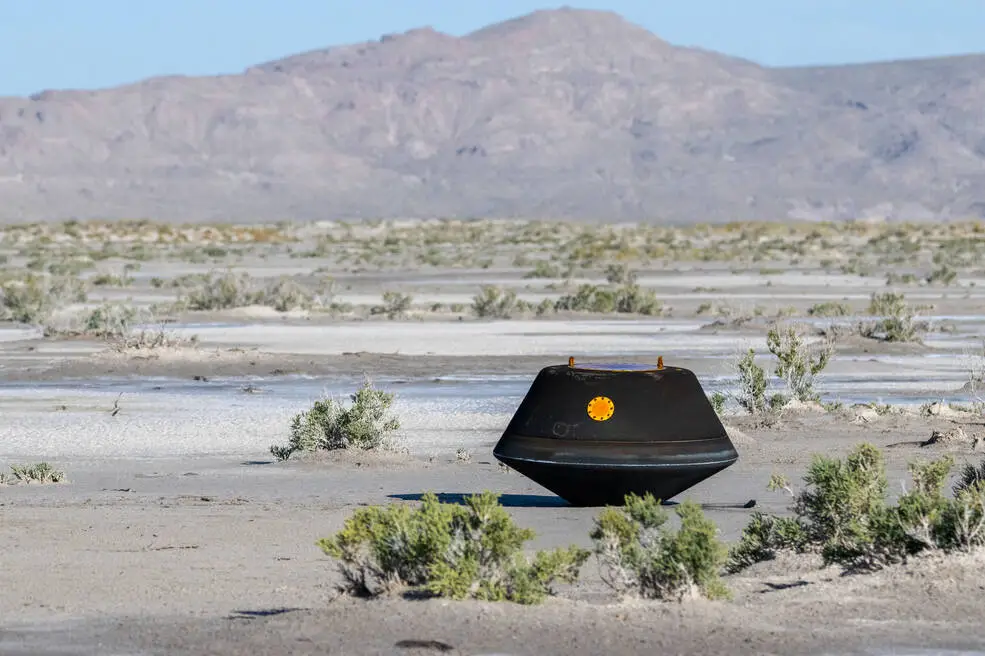
OSIRIS-REx collected material from Bennu in 2020 and ferried nearly 122 grams of dark, carbon rich rubble back to Utah three years later, giving researchers one of the cleanest looks yet at the chemistry of a primitive asteroid. Earlier work on the sample revealed all five nucleobases used in DNA and RNA, along with 14 of the 20 amino acids that Earth’s life uses to build proteins.
The latest work adds tryptophan to that list, marking the first time this relatively complex amino acid has been identified in extraterrestrial material. Researchers describe the signal as tentative, but say it strengthens the case that Bennu carries an unusually complete suite of prebiotic ingredients.
Clues To How Life’s Chemistry Began
On Earth, tryptophan is one of nine essential amino acids that animals must obtain from their diet, and it plays a key role in building proteins and in several biochemical pathways. Finding even a hint of it on an ancient asteroid supports the idea that space rocks supplied a diverse cargo of molecules to the early Earth, rather than just a simple starter kit.
Analyses of Bennu’s minerals point to long lasting interactions between rock and liquid water on the asteroid’s long vanished parent body, likely in the form of salty brines. Those conditions would have provided natural reactors where amino acids, nucleobases and other organics could form, mix and evolve before being locked into the rubble that later became Bennu.
OSIRIS-REx Samples Preserve A Pristine Time Capsule
Because OSIRIS-REx sealed Bennu’s material in space and dropped it directly into a recovery capsule, the grains arrived on Earth far less heated and contaminated than typical meteorites. NASA teams have since stored and handled the sample in carefully controlled clean rooms at the Johnson Space Center to protect fragile organics such as amino acids.
“Asteroids provide a time capsule into our home planet’s history,” said Nicky Fox, NASA’s associate administrator for science, in an earlier statement about the Bennu mission. With hints of tryptophan now on the books, scientists plan more detailed work on individual grains from the collection, hoping to pin down the signal and search for other complex organics that might be hiding in the dark rubble.