
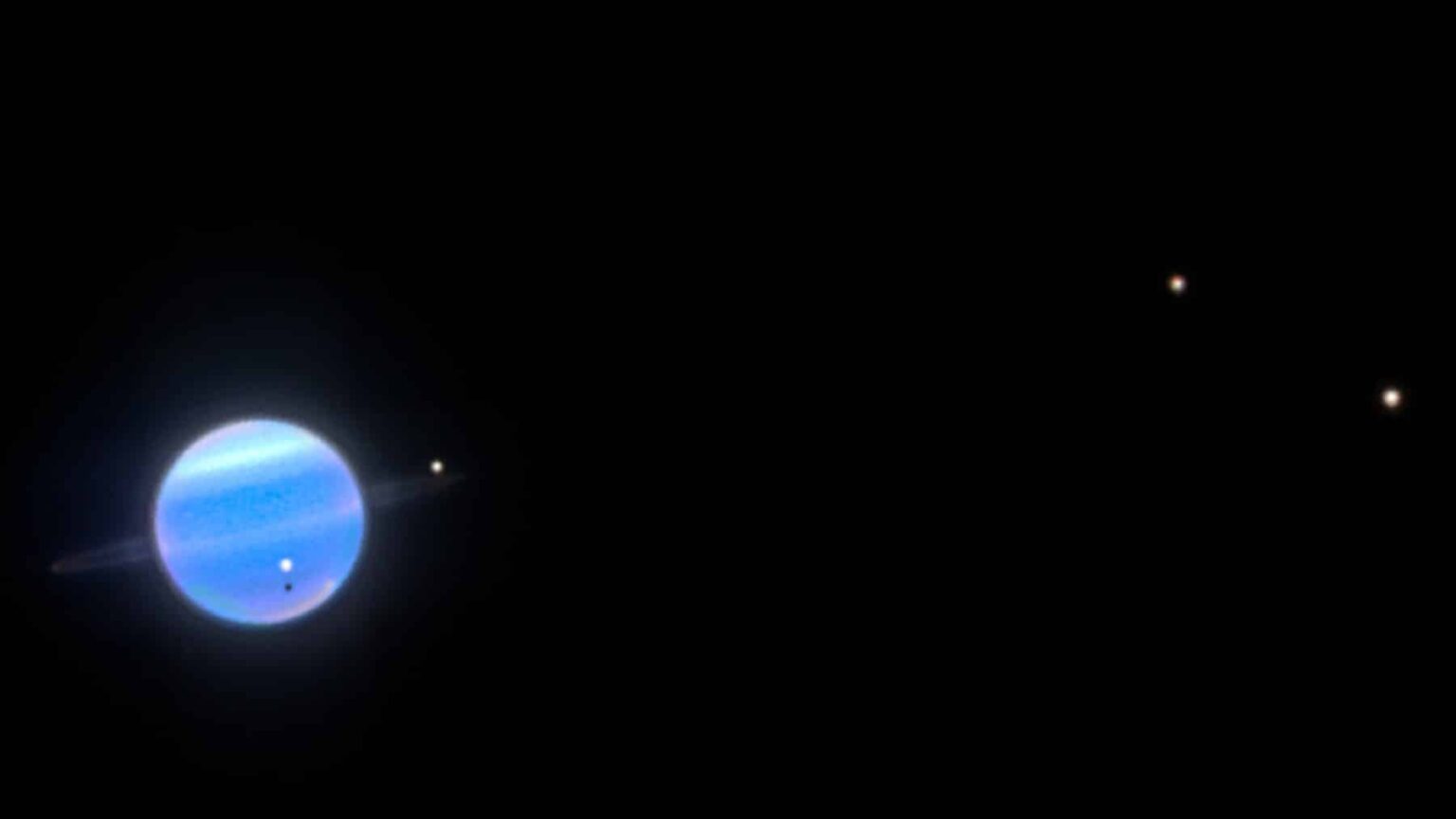
Decades of astronomy have found our solar system to be the same throughout its architecture. Yet, in a discovery, scientists may have found a reason to reconstruct it. This came as a surprise when scientists discovered something invisible and tiny lurking within. In this article, we introduce this newcomer and how it reshapes our solar system.
NASA discovers a new moon 40 years later
About half a century ago, NASA commenced most of its major space expedition programs. Among them was the Voyager program, 1&2, two of the most ambitious space missions. In both, NASA set out a flyby to explore the two giant gas planets within our solar system, Jupiter and Saturn, and a follow-up flyby on our two icy planets, Uranus and Neptune.
After their launch in 1977, the missions remain a success. Both provided NASA with a grand tour of all four giants. Scientists discovered the complex solar atmosphere of Jupiter, the hexagonal storms of Saturn, and the great dark spot at the heart of Neptune. But more than these were the trains of rings and moons on each of these planets.
However, the Voyager 2 spacecraft never flew past Uranus until 1986. This was the first time NASA encountered the strange frozen world of Uranus. Beneath its pale blue sphere is a lopsided magnetosphere that rotates on its side across the solar system. But 40 years down the drain, NASA notices a moon they might have missed back in 1986.
An overlooked Moon steps into frame
The discovery of this new moon was made by a team of scientists led by Maryame El Moutanid. She is a lead scientist from the Southwest Research Institute’s Solar System Science and Exploration Division in Boulder, Colorado. Together with her team, they captured its faint imagery using the James Webb Space Telescope in February 2025.
Designated as S/2025 U1, the new moon had remained unnoticed for nearly 40 years. This was because it was tiny, dark, and observed to move swiftly in an almost invisible manner. The object was discovered orbiting the expanse of Uranus’s ring system. The glow of the rings and their size made S/2025 U1 blend perfectly into the background, like this mysterious traveler found entering our Solar System.
However, at that time, scientists were limited by their technology. But with advanced features like the infrared precision in the James Webb Space Telescope, scientists were able to pinpoint the tiny planet. This new invisible solar system moon is estimated to be just 6 miles (10 km) and would be the 14th moon discovered in Uranus.
Assumptions following the discovery of S/2025 U1
Many scientists have followed up with this finding, assuming a connection of dots. The most popular discourse assumed that S/2025 U1 may explain the subtle variation in Uranus’s ring structure. A similar occurrence is seen in Saturn’s shepherd moons: a system of tiny bodies taking shape under gravitational influence.
NASA maps out new chapter for Uranus
This discovery has been exciting so far for researchers studying Uranus. Many assume the missions of Voyager 2 may have been limited altogether and are calling for a re-exploration of Uranus. Except this time, it would be a targeted mission to survey the ring-moon system in high resolution.
In addition, astronomers are also expecting to perform simulations with supercomputers. This would enable, with the aid of models, the observation of this new invisible solar system moon in detail. Every building block would be simulated with its environment, revealing the intricate architecture of Uranus.
Most importantly, astronomers hope to shed more light on S/2025 U1, to uncover how it was formed, if it was ancient, and if it was a product of Uranus’s ring system. However, discovering this invisible piece of the icy giant has played a role in our understanding of the solar system, just like this new planet discovery in our solar system with strange activities.