

Understanding how our Solar System moves within the Milky Way is exceptionally complex. Now, new observations appear to reveal a trajectory… but they contradict existing simulations quite significantly.
Distant galaxies send out radio signals that can be interpreted to determine their motion. With measurements precise enough, scientists can determine whether a signal is shifting away from us or, on the contrary, moving closer.
This method was used to understand how our Solar System travels through our Galaxy, and the surprising results have been published in Physical Review Letters. The study, led notably by researchers at Bielefeld University in Germany, outlines a scenario in which our Sun is moving three times faster than previous models predicted.
Crucial observations from Europe

The Big Bang serves as the foundation for our entire standard model. © MozZz, Fotolia
The standard model describing the Universe is based on the Big Bang theory, which explains how matter dispersed over time. This involves the expansion of the Universe, a certain rate at which matter spreads, and the formation of the galactic structures we know today.
But this new study takes a different approach by relying on a specific instrument: Lofar, the Low-Frequency Array. This radio telescope is actually a network of about 20,000 antennas distributed across the Netherlands, Germany, Poland, the United Kingdom, Sweden, Latvia, Ireland, and France, including the station in Nançay, in the Cher department.
Thanks to its vast coverage, this European network can gather extensive data on nearby and distant galaxies, as well as their motion relative to us. This is especially useful for this type of analysis, since the goal is to determine our own movement by focusing on a wide variety of sources.
A speed 3.7 times greater than expected
With this method, the researchers were able to adopt a truly statistical approach, avoiding confirmation bias thanks to the multitude of independent observations. Ultimately, the detected signal leaves little room for doubt: the deviation is far stronger than expected. According to the study, our Solar System is moving 3.7 times faster than previously estimated.
The discrepancy is enormous and surprising, especially since it contradicts a model long considered robust. Yet the authors are confident in their results, supported by enough data to confirm the strength of their theory.
Moreover, these new observations could explain certain irregularities recently noticed in quasars, whose signals did not fully match model predictions.
A model still imperfect
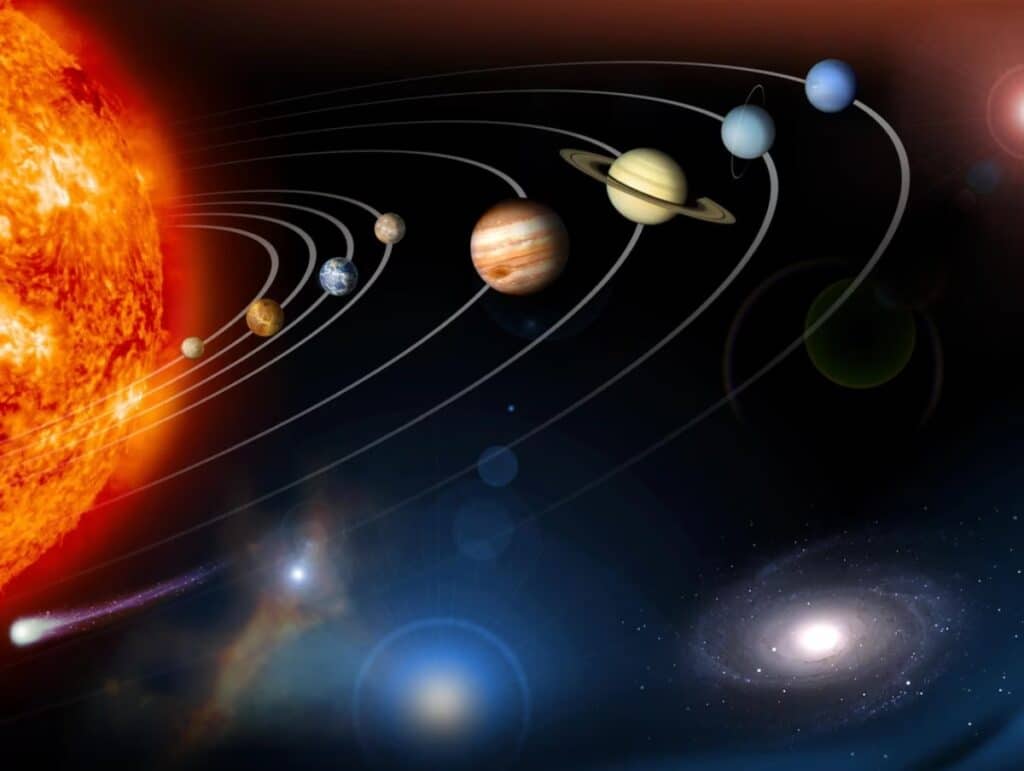
Artist’s impression of our Solar System and its planets (distances and sizes are not to scale). © NASA
If this is true, why such a difference? No need to worry — our Solar System is not suddenly hurtling wildly through the Galaxy. Instead, the explanation likely lies in variations in how matter was distributed across the Universe after the Big Bang.
Models assume this propagation occurred uniformly in all directions, aside from minor irregularities. Yet a finding like this suggests that these variations may be far more significant than previously believed.
In other words, our standard cosmological model may need adjusting, as it relies on assumptions that are a bit too idealised to reflect reality. Researchers hope to refine these conclusions with future observations, notably through the Square Kilometre Array (SKA), another radio telescope even more powerful than Lofar, expected to begin operation around 2027.
Stay connected to the future of science, technology, and the environment wherever you are. By following Futura on Google Discover, you can receive our best articles directly in your personalised news feed.

Hugo Ruher
Science journalist
Science journalist, I am above all passionate about space, which is what inspired me to pursue this specialty. Drawn to science in general, I also closely follow news related to the environment and technology.
After earning a degree from Sciences Po Toulouse, I began working in radio, covering general news, international issues, and even local problems. At the same time, I started a career as a science journalist, first focusing on space and later on environmental topics.
Making complex information simple
A large part of my work involves reading scientific studies published in various journals, texts that are often complex or downright indigestible! My goal is to extract information from them and make it accessible to a broader, non-expert audience. This ambition is what truly drives me.
This path has led me to write for teen magazines like Cosinus, highly specialized publications such as Industrie & Technologies, as well as more mainstream outlets like Numerama or Le Monde.
In addition to that, I also sometimes write about topics that are a bit more “lightweight.” The digital world, ranging from the use of social media to AI, and even the culture around video games—are areas that I find fascinating and worth covering with a serious approach.