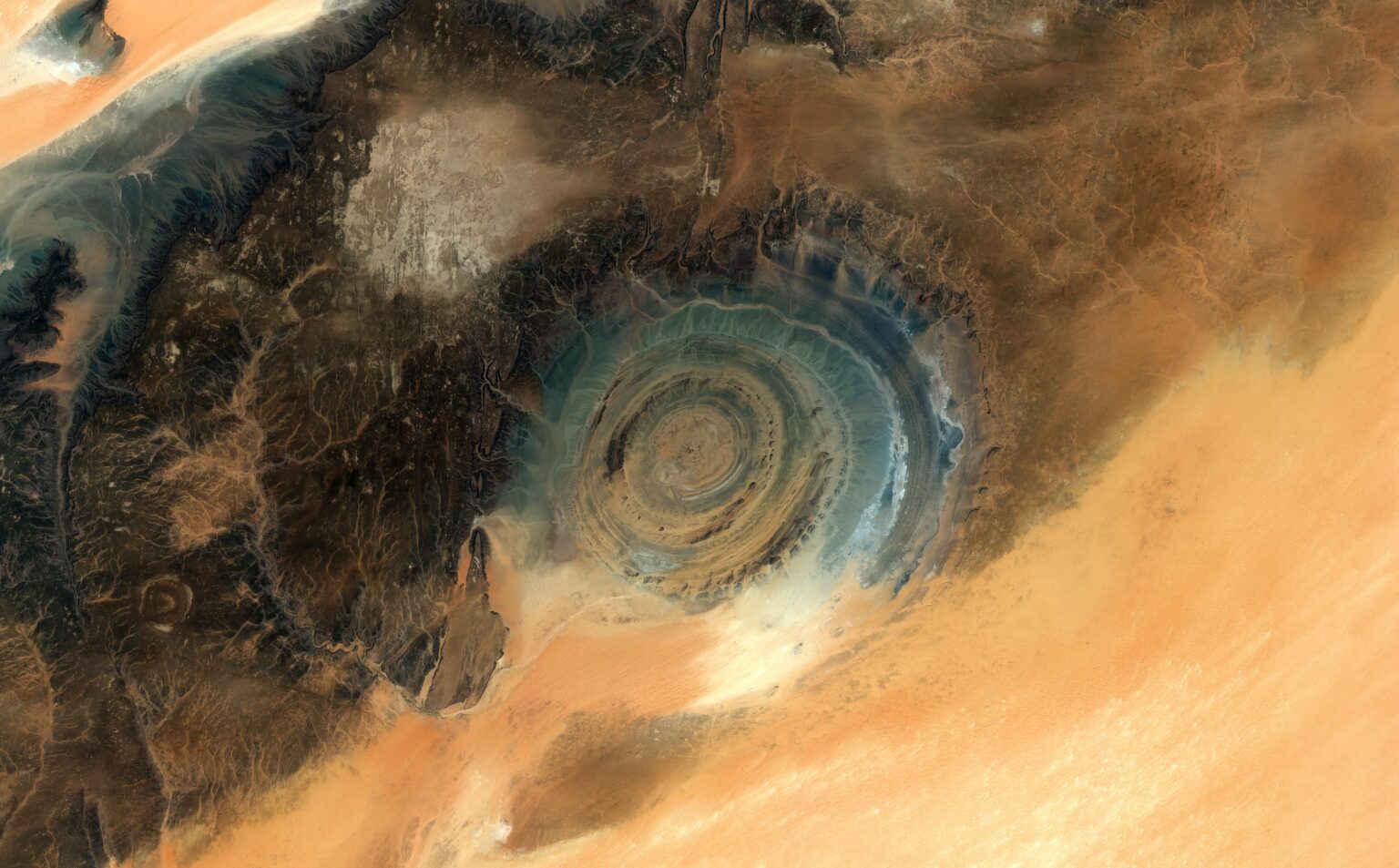
This giant feature looks out from a sea of golden sand in the Adrar Region of northern Mauritania. Once thought to be the site of a meteor impact, the Richat Structure is now believed to have been caused by a process of uplift of a large dome of molten rock that, once at the surface, was shaped by wind, sand and water erosion. Geologists agree that the structure is at least 100 million years old.
The layered formation consists of a series of concentric rings and resembles a bull’s eye from space, so is also known as the eye of the Sahara or the eye of Africa.
The Richat Structure, 50 km in diameter, is easier to observe from space than from the ground, and has been a familiar landmark for astronauts since the earliest manned missions.


1 Comment
Image from here
[https://www.esa.int/ESA_Multimedia/Images/2025/11/Earth_from_Space_Eye_of_the_Sahara](https://www.esa.int/ESA_Multimedia/Images/2025/11/Earth_from_Space_Eye_of_the_Sahara)
The [Copernicus Sentinel-2 mission](https://www.esa.int/Applications/Observing_the_Earth/Copernicus/Sentinel-2) captures a spectacular geological wonder in the Sahara Desert of Mauritania: the Richat Structure.
This giant feature looks out from a sea of golden sand in the Adrar Region of northern Mauritania. Once thought to be the site of a meteor impact, the Richat Structure is now believed to have been caused by a process of uplift of a large dome of molten rock that, once at the surface, was shaped by wind, sand and water erosion. Geologists agree that the structure is at least 100 million years old.
The layered formation consists of a series of concentric rings and resembles a bull’s eye from space, so is also known as the eye of the Sahara or the eye of Africa.
The Richat Structure, 50 km in diameter, is easier to observe from space than from the ground, and has been a familiar landmark for astronauts since the earliest manned missions.