
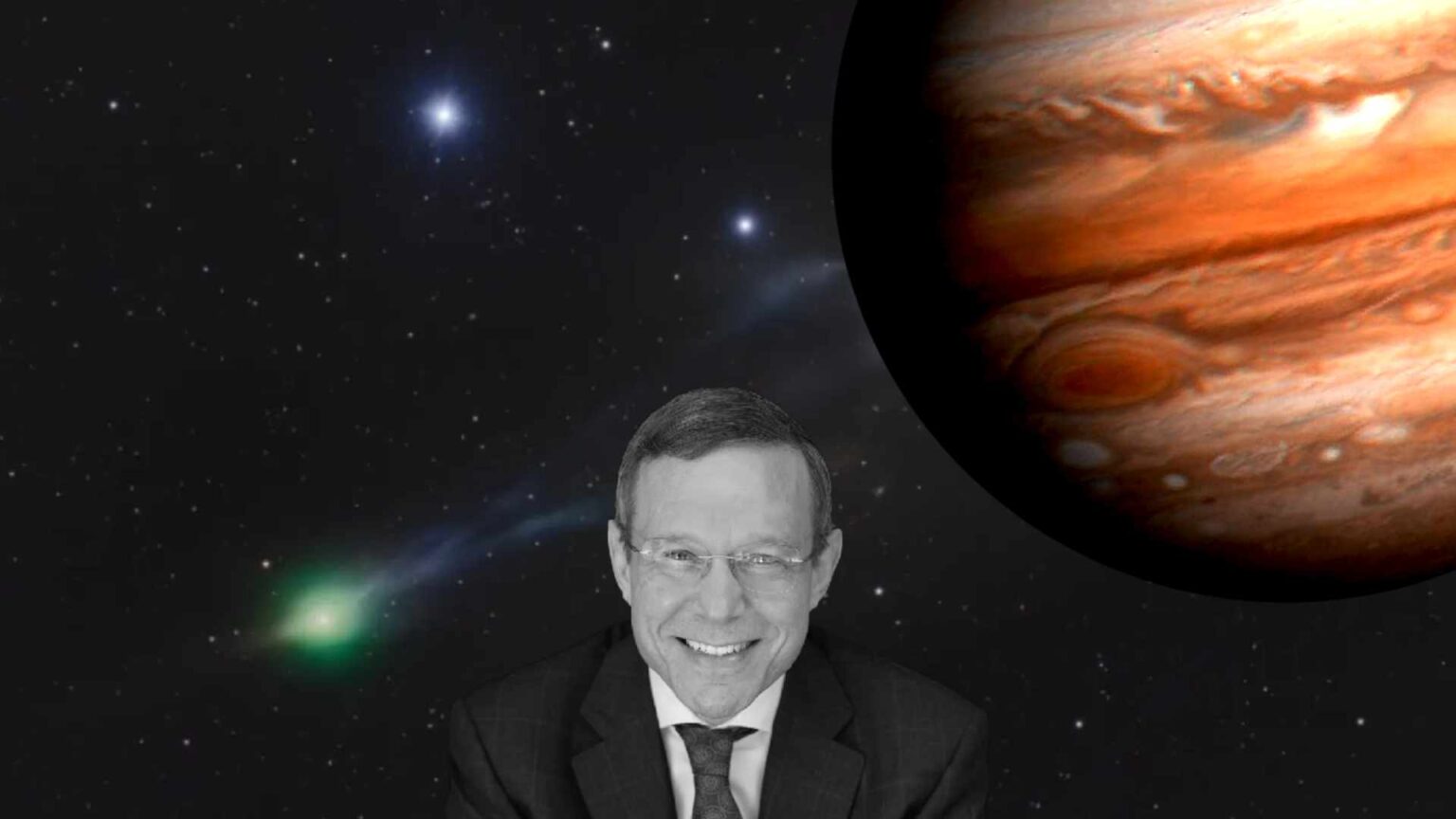
Is Jupiter gonna be 3I/ATLAS’s next pit stop? Harvard astrophysicist Avi Loeb speculates that given its current trajectory, the interstellar object may approach the Hill radius of the gas giant. This essentially means it will be free of the Sun’s gravitational pull. Which, in effect, perchance the object is an alien reconnaissance craft, might drop probes on Jupiter during its closest flyby in March 2026.
Why Jupiter and not Earth? Loeb speculates that if the 3I/ATLAS is indeed a probe by an ETI (extraterrestrial intelligence), then realistically they might have only been able to detect the largest planet in the solar system on the edge of the milky way galaxy. While one can pick apart several holes in this conjecture, the Harvard researcher’s contention remains the same –
If the rare coincidence between the perijove distance of 3I/ATLAS and the Hill radius will materialize, it might flag a technological signature.
Earlier, he sent his observation and calculations regarding the perijove maneuver to Davide Farnocchia of NASA’s JPL Horizons. While there was no reply, NASA quietly revised with a “new model for the radial dependence of the non-gravitational acceleration,” using “an inverse square dependence on distance from the Sun.”
Loeb explains, “This new model replaces the steeper radial dependence associated with the previous model used by NASA’s JPL Horizons.” This places 3I/ATLAS slightly out of its originally calculated path towards Jupiter’s Hill radius.
Avi Loeb further quips
The insistence of the Vatican on the Earth being at the center of the solar system did not change the orbit of the Earth around the Sun. For the same reason, the new model of JPL Horizons will not change the actual trajectory of 3I/ATLAS. We will know whether the perijove distance agrees with the Hill radius in the coming months thanks to data collected as 3I/ATLAS approaches its perijove on March 16, 2026. In particular, astrometric data from the spacecraft Juno, Juice or Psyche will be very useful for settling the issue.
He adds,
Within the diameter of Jupiter’s orbit around the Sun, the coincidence between the perijove distance and the Hill radius has a statistical likelihood smaller than 0.00004. In case the non-gravitational acceleration was needed to achieve this match, the rare coincidence will constitute the most remarkable anomaly of 3I/ATLAS so far.
Updates on the Non-gravitational Acceleration of 3I/ATLAShttps://t.co/RL5Da0c4Is
— Galileo Project (@GalileoProject1) November 28, 2025
See Also: 3I/ATLAS: Harvard Astrophysicist Avi Loeb Unpacks The Clearest Captured Images Of The Exocomet