
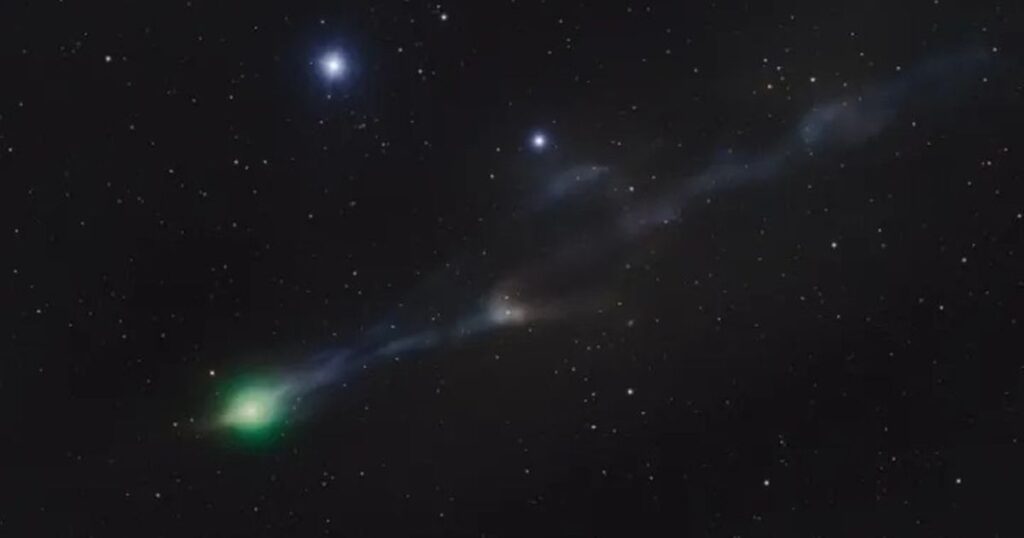
Harvard University professor Avi Loeb has been adamant that the mysterious rock in our Solar System is some sort of alien – his latest comments are a bit less controversial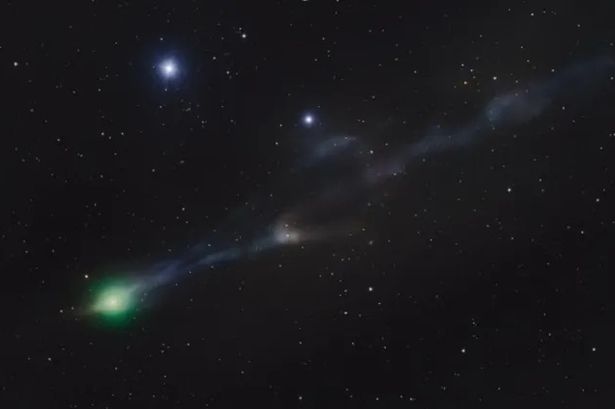 An astonishing image of 3I/ATLAS taken on November 26 (Image: Julien de Winter)
Unless you’ve been living under a rock these past few months, you can’t have missed the hullaballoo created by 3I/ATLAS.
The rogue comet, which entered our Solar System on July 1, has been closely monitored by boffins across the world. Not least of these is theoretical physicist Avi Loeb, of Harvard University, who has led speculation that 3I/ATLAS could actually be an alien spaceraft spacecraft.
However, experts at NASA dismissed any such notion and said it was nothing more than a comet from another star system. Still, Professor Loeb has recently noticed that the comet – or whatever it may be – is in fact changing in a couple of ways.
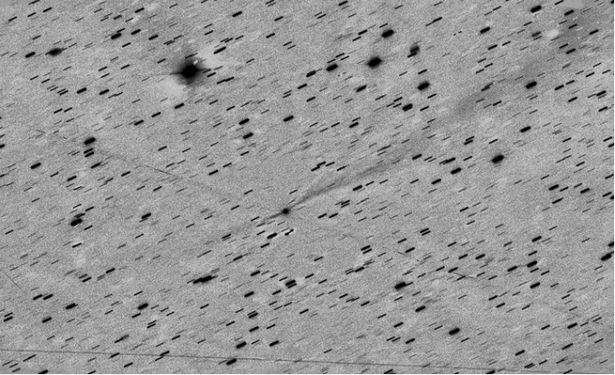 A stacked image of 3I/ATLAS based on 20 exposures of 100 seconds each(Image: M. Jäger, G. Rhemann, and E. Prosperi)
However, the brain box is not always the clearest when it comes to writing down his observations for the average Earthling, it must be said.
In a post on Medium today, called ‘Updates on the Non-gravitational Acceleration of of 3I/ATLAS’, he ‘explained’: “On October 30, 2025, the value of the radial acceleration component A1 — normalized at a heliocentric distance of the Earth-Sun separation (=1 au), was listed as 1.6×10^{-6} au per day squared.
“By November 24, the coefficient A1 was reduced by a factor of 4 to a value of 4×10^{-7} au per day squared.”
Erm, okay, that makes perfect sense, professor. But you can always trust us at the Daily Star, readers, to untangle any words jumbled up like spaghetti into something more understandable.
He’s essentially saying that 3I/ATLAS has and is slowing down – but that’s not all from the space boffin.
 Avi Loeb reckons 3I/ATLAS is an alien (Image: Chris Michel, National Academy of Sciences)
Professor Loeb also said in his blog: “There is strong evidence that 3I/ATLAS became brighter near perihelion than the smooth 1/r² model would predict.”
In layman’s terms, it means that 3I/ATLAS got brighter than expected when it was closest to the Sun, with the ‘1/r² model’ being an estimate on how bright something should appear the closer it gets to the Sun.
Earlier this week, the renowned professor also said that the trajectory of 3I/ATLAS suggests it will deploy satellites to spy on Jupiter for an advanced alien “civilisation”.
He reckons it will close enough to the Solar System’s biggest planet to deploy satellites on March 16 next year and that rock’s path could be used to “seed” probes into the orbit of the gas planet.
3I/ATLAS will be 53.445 million kilometers (over 33.209 million miles) from Jupiter just before St Patrick’s Day next year, according to NASA calculations.
For the latest breaking news and stories from across the globe from the Daily Star, sign up for our newsletters.