
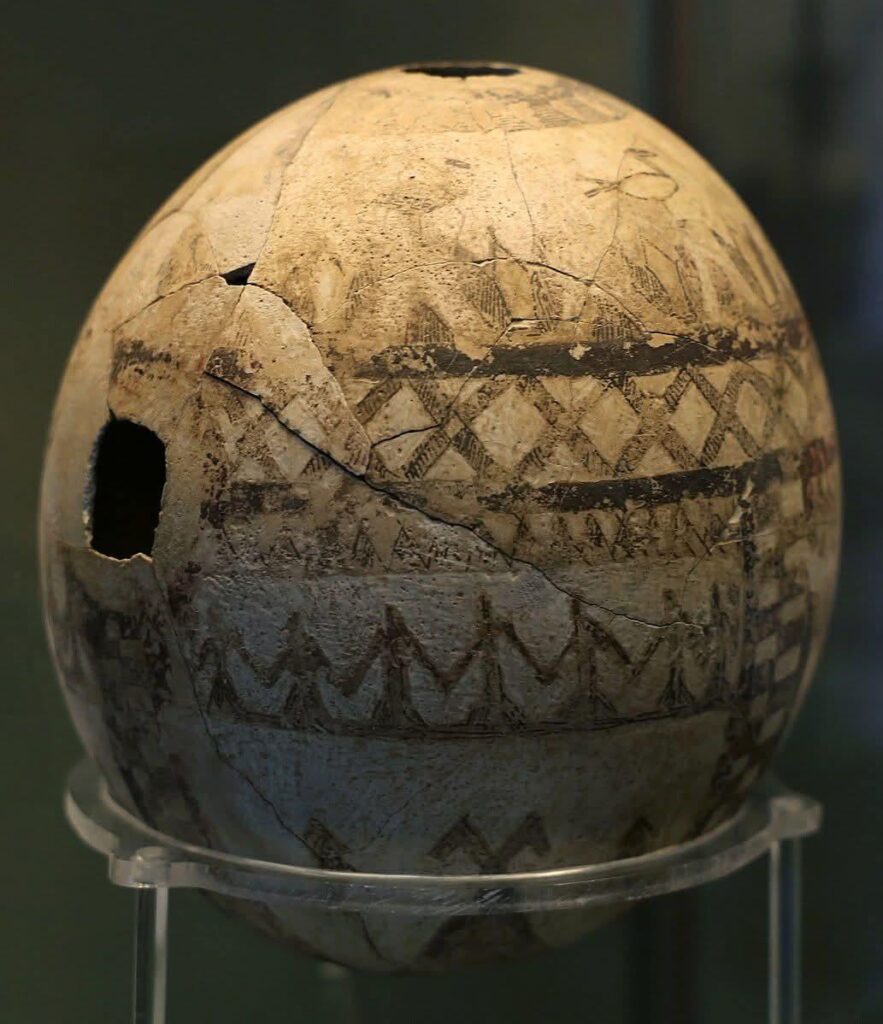
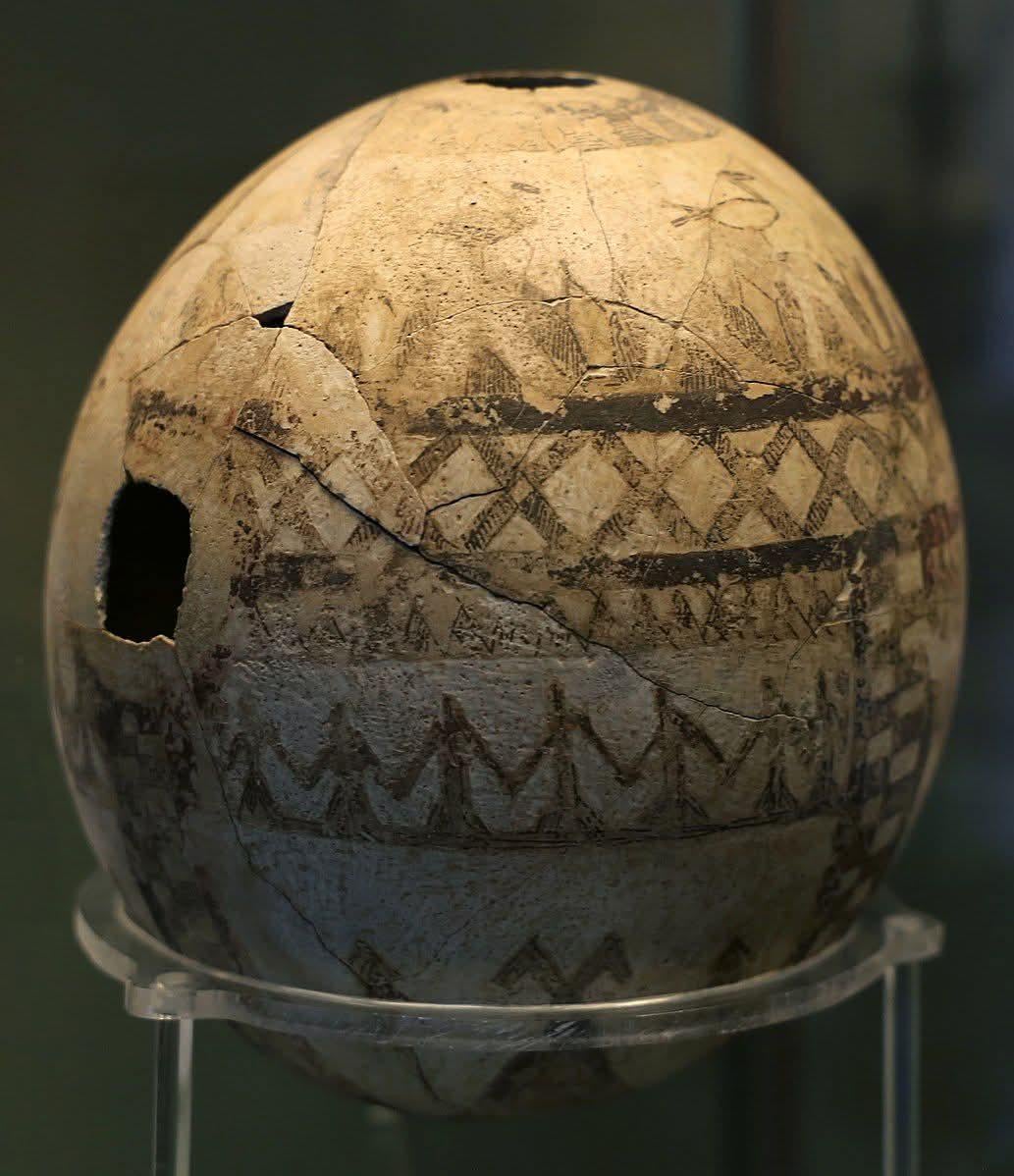
Photo: Ostrich egg decorated by Etruscan craftsmen with geometric motifs, from the Tomb of the Golden Pectoral of Monterozzi, Arcatelle, 650 BC.
Collections of the National Archaeological Museum (Tarquinia), Rome. Italy.
Ostrich eggs were highly prized in ancient times; they were luxury items used in everyday life and in funerary objects, frequently found in elite tombs.
They symbolized resurrection, eternal life, and fertility, and were used as containers, bowls, and decorative objects.
In Ancient Egypt, ostrich eggs were common funerary offerings from as early as the Predynastic period (Naqada I culture, c. 4000 BC).
The ostrich feather was also the emblem of Ma'at, the goddess of truth and justice.
Egyptians believed that the world originated from a cosmic egg, a symbol of creation and renewal.
An anti-wrinkle beauty mask, composed of ostrich egg, milk, oil, flour and clay, was in use among the Egyptians, as we read in the Ebers papyrus (XVIII dynasty), they mixed boiled eggs and tortoise shells with resin to obtain a deodorant lotion for the body.
Ostrich eggs were also significant in Mesopotamia, found primarily in elite funerary contexts during the Bronze and Iron Ages (third-first millennia BC).
Assyrian royal texts mention the hunting and trapping of ostriches, and eggs found at sites like Ur show evidence of extensive trade networks linking the region to the wider Mediterranean.
Greeks believed that Helen, a woman of exceptional beauty, was born from an egg, along with her brothers Castor and Pollux.
The Roman physician Galen of Pergamon, in the 2nd century AD, praised the nutritional and medicinal properties of eggs.
He recommended, for example, ostrich egg juice to strengthen a particularly weak stomach and stimulate the appetite.
For hair care, the use of egg yolk was recommended, as can be seen in some recipes from the Roman era, in combination with other ingredients such as, for example, vinegar and iris flowers.
The Etruscans, in Iron Age Italy, also placed ostrich eggs in their tombs, a practice likely influenced by trade with the Punic Phoenicians and Greeks.
Eggs held a strong cyclical symbolic meaning in Etruscan culture, representing life, the afterlife, and fertility.
Whole eggs were found in tombs, such as the famous Isis Tomb at Vulci, where they had been decorated in Phoenicia.
Ostriches were not native to Italy, so the eggs were acquired through long-distance trade networks, highlighting their value as exotic luxury goods.
by International-Self47