
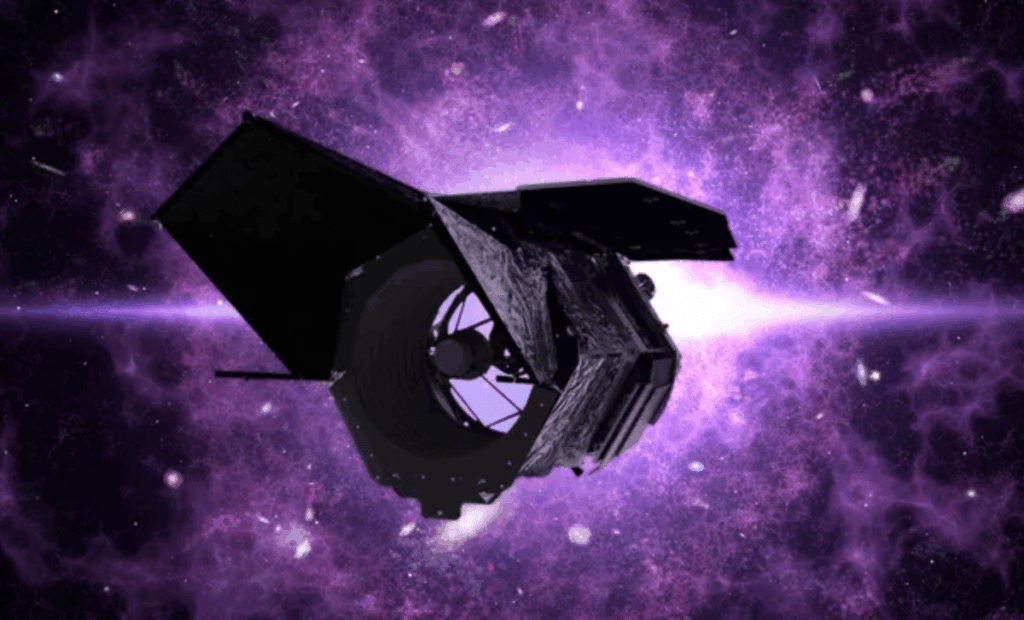
NASA’s Nancy Grace Roman Space Telescope, scheduled for launch between 2026 and 2027, is already surprising scientists with its groundbreaking capabilities. Designed to explore the mysteries of dark matter and energy, the telescope is set to offer unexpected insights into the very stars that host exoplanets. According to new findings published in The Astrophysical Journal, Roman’s advanced asteroseismology features could change how we understand stellar lifecycles and their planetary systems.
A New Era in Stellar Seismology
The Roman Space Telescope is not just another astronomical tool; it represents the next frontier in stellar seismology, the study of seismic waves rippling across stars’ surfaces. Thanks to its large field of view—100 times broader than Hubble’s—Roman will be able to observe a staggering number of stars in unprecedented detail. Asteroseismology is crucial for learning about the inner workings of stars, and Roman’s ability to detect seismic waves on the surfaces of over 300,000 red giants will offer valuable data for astrophysicists. As Trevor Weiss, study leader at California State University, Long Beach, explained, “With asteroseismic data we’ll be able to get a lot of information about exoplanets’ host stars and that will give us a lot of insight on exoplanets themselves.”
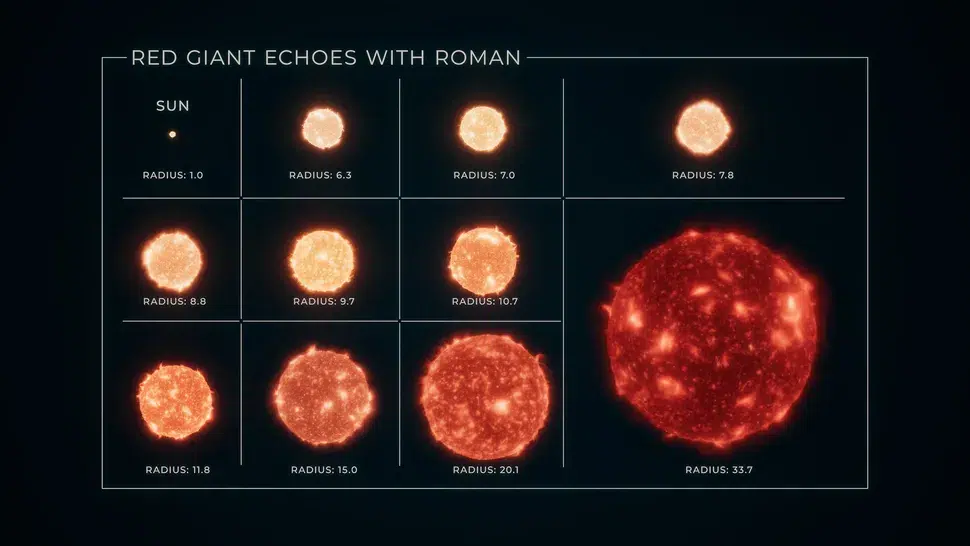 Examples of the size of red giants as measured by asteroseismology. The Sun is included to provide context. (Image credit: NASA/STScI/Ralf Crawford (STScI).)
These measurements will offer insights into stellar mass, size, and age—key properties that inform our understanding of the planets that orbit these stars. By analyzing oscillations, Roman will enable astronomers to make unprecedented inferences about the conditions that might make a planet habitable or reveal the fate of planetary systems over time. According to findings published in The Astrophysical Journal, Roman’s capabilities in asteroseismology will allow scientists to compile the largest asteroseismic dataset ever collected, advancing our understanding of both stars and the exoplanets they host.
Gravitational Microlensing and Exoplanet Discovery
One of Roman’s core missions is to conduct the Galactic Bulge Time-Domain Survey, focusing on the dense region of stars in the Milky Way’s center. This survey will employ gravitational microlensing, a technique where massive objects (like planets) bend light due to their gravitational field, making them detectable even if they’re far from their star. This approach allows scientists to find exoplanets by observing the way starlight is distorted when a planet passes in front of a background star.
Roman’s design, optimized for exoplanet discovery, will provide rich data not only on individual planets but also on the planetary systems they belong to. As Marc Pinsonneault of Ohio State University noted,
“Asteroseismology with Roman is possible because we don’t need to ask the telescope to do anything it wasn’t already planning to do. The strength of the Roman mission is remarkable: it’s designed in part to advance exoplanet science, but we’ll also get really rich data for other scientific areas that extend beyond its main focus.”
This dual approach will significantly enhance our ability to detect planets in the habitable zones of stars.
Expanding Our Understanding of Galactic Evolution
Roman’s scientific potential stretches beyond exoplanet discovery. By investigating the stars of the Milky Way’s bulge—home to the supermassive black hole Sagittarius A*—Roman will also provide insights into the history of our galaxy. The bulge is composed of some of the oldest stars in the galaxy, many of which have already evolved into red giants. Studying these stars will offer astronomers a better understanding of galactic evolution and the past conditions that led to the formation of our solar system.
The telescope’s observations will allow scientists to measure the age and properties of red giants, shedding light on how such stars evolve and what this implies for the future of planetary systems. As the stars in the bulge have often evolved from more massive stars that burn their fuel faster, understanding their oscillations will help us piece together the timeline of star formation in the Milky Way.