
THE United Nations has officially confirmed the Earth’s planetary defences will be tested by the bizarre 31/ATLAS comet that conspiracy theorists are convinced is an alien spacecraft.
Today a global team of scientists are set to launch a two-month campaign which will see them track the supposed comet as it nears our planet.
Sign up for The US Sun newsletter
Thank you!
Striking snaps of the asteroid have been taken by amateur stargazersCredit: Facebook
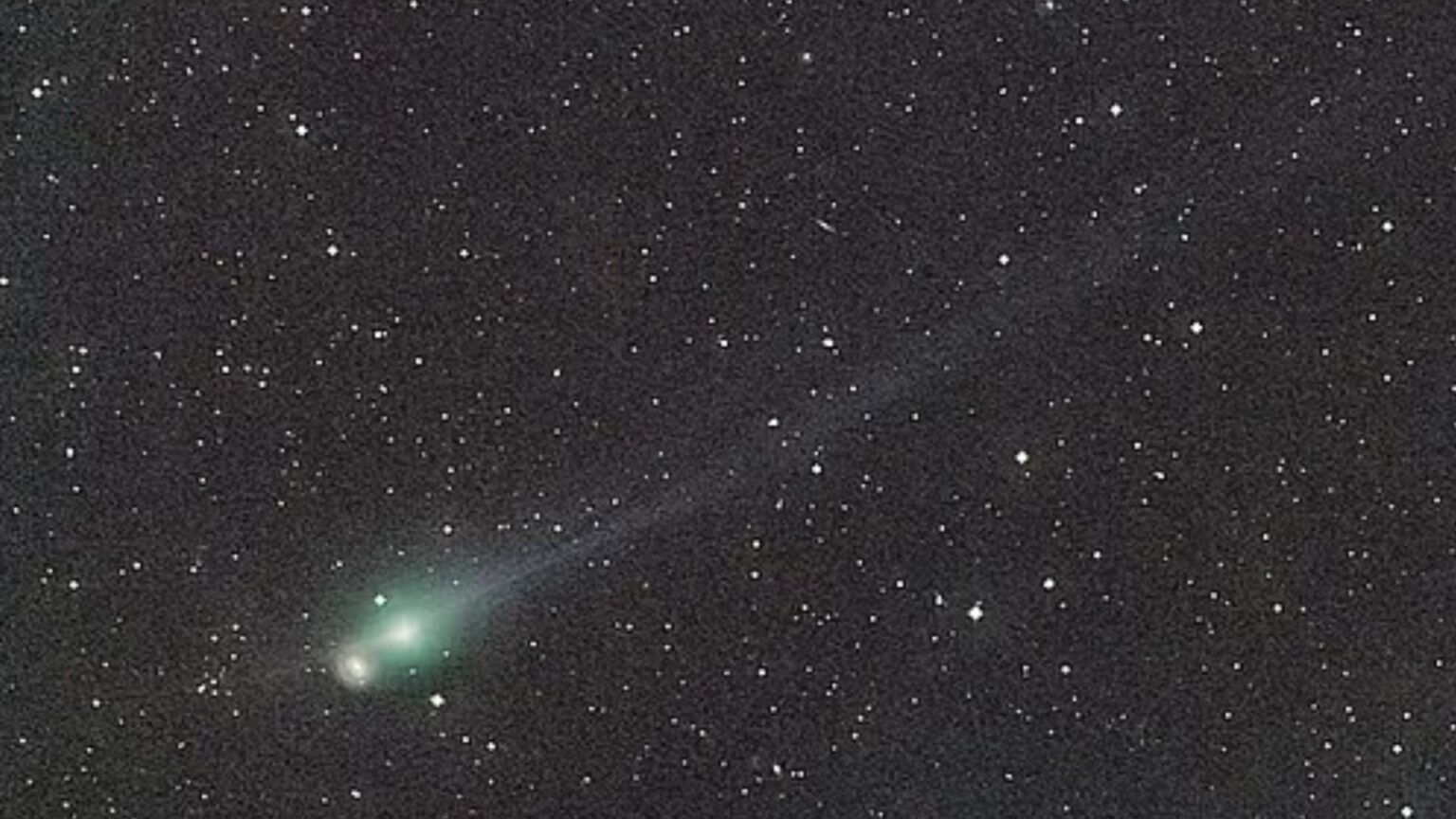
Stunning snaps reveal a glowing “head” named a coma as well as a narrow tail which stretches for over 600,000 milesCredit: Facebook
The International Asteroid Warning Network (IAWN) is treating this as a major drill in preparation for potential future asteroids that could plague the Earth.
31/ATLAS will be reach the closest point to Earth on December 19, however authorities have claimed it’s not projected to be a threat.
Striking new images of the interstellar object have been released, with critics insisting the images provide a significantly better insight than NASA‘s.
These stunning snaps reveal a glowing “head” named a coma as well as a narrow tail which stretches for over 600,000 miles.

UP IN FLAMES
Moment Ukraine blows up secretive Russian laser plane in blow to Putin

SPACE LIFE HOPE
Moss survives 9 MONTHS in space – raising hopes humans could live on Mars
They were taken by Harvard professor, Avi Loeb, captured on November 22 and November 24.
The Earth’s visitor is mysteriously pointing in the direction of the sun instead of away from it in typical comet fashion.
31/ATLAS, which is estimated to be over seven billion years old, has been photographed appearing in a cone-like shape, covered in a green glowy blur.
Some of the rare images were captured by amateur stargazers using small telescopes around the world, including Japan, Spain and Chile.
NASA are adamant the comet came from another solar system and they were slammed at their press conference last week, where they were expected to provide close-up imagery of the object.
At the time, the comet was approximately 19 million miles away and using a HiRISE camera on board the Mars Reconnaissance Orbiter NASA delivered a shoddy black and white image with little definition.
The snaps presented by the space agency are allegedly not even of the comet but of the chemical elements released into space by 31/ATLAS.
Crazed conspiracy theorists have taken to social media claiming the US government are deliberately being vague by presenting poor quality images, to stop the public from being able to spot the alien spacecraft.
Loeb, the Harvard professor, confessed the sharpest image of the meteor was snapped by Paul Craggs of Canada on November 21.
Critics have slammed NASA’s shoddy snaps after amateur stargazers posted theirs onlineCredit: Reuters
Conspiracy theorists believe the asteroid is really an alien on a specific course through our solar systemCredit: Facebook
He is also spearheading the extra-terrestrial theory- believing the “alien” is on a specific course through the solar system.
The head of the Galileo Project, a scientific research group looking for signs of alien life, has allegedly pointed out 12 anomalies with the meteor which cannot be explained by scientists.
Some of these include cometary tail pointing in the wrong direction, the object turning blue near the sun, and a collection of course changes that defy the laws of gravity.
31/ATLAS was first discovered in July and IAWN, which the United Nations Office for Outer Space Affairs operates, will follow the comet until January as if it was a real threat.
IAWN said in a statement: “Comet 3I/ATLAS presents a great opportunity for the IAWN community to perform an observing exercise due to its prolonged observability from Earth and high interest to the scientific community.”
NASA and the UN have assured the public the object is an asteroid and activating the Earth’s defences is in fact a normal drill.
Yet some people were still sceptical, one X user said: “When every telescope from Mauna Kea to Chile is being synced on one object, that’s not a drill.”
The asteroid was first spotted on 1 July by the Asteroid Terrestrial-impact Last Alert System (ATLAS) telescope in Río Hurtado, Chile.
The space agency, NASA, is currently developing the world’s first Earth shield, and while you may expect this to be a round sci-fi-esque dome, it’s far from it.
The shield is actually a combination of telescopes, radar systems, satellites, and machine learning systems.
This mission aims to create an automatic dart system where a spacecraft would detect a threat and deflect it.

FA LA LA LA FEUD
Vendors push back as holiday market roasted for $24 ‘room temp hot cocoa’

BAG A BARGAIN
5 best stocking stuffers from Walmart’s Black Friday hitting stores today
Foreign agencies including the European Space Agency (ESA) and the Japan Aerospace Exploration Agency (JAXA) have partnered with NASA to combat this threat.
The success of the Earth shield system, which has allegedly been through rigorous testing, will be tested on December 29.
What do we know about 31/ATLAS?
31/ATLAS was discovered by scientists back in July and with it nearing Earth, space agencies have decided to test their defensive measures.
IAWN will be observing the comet from November 27 to January 27 2026.
31/ATLAS will be closest to Earth on December 19.
The asteroid is over seven billion years old, making it older than our solar system by three billion years.
31/ATLAS is the third interstellar object to grace our solar system.
The meteor is covered in ice, which give it the “fuzzy” appearance through a telescope.
Its current trajectory suggests it originated from the Milky Way’s ‘thick disk’ – a field of ancient stars.
The Earth’s visitor is estimated to be the size of Manhattan.
Its travelling at an approximate speed of 125,000 mph.
Its mass is roughly 33 billion tonnes.
Unlike the previous two interstellar objects to enter our solar system, 3I/ATLAS appears to be travelling on a steep path through the galaxy.