
Your support helps us to tell the story
From reproductive rights to climate change to Big Tech, The Independent is on the ground when the story is developing. Whether it’s investigating the financials of Elon Musk’s pro-Trump PAC or producing our latest documentary, ‘The A Word’, which shines a light on the American women fighting for reproductive rights, we know how important it is to parse out the facts from the messaging.
At such a critical moment in US history, we need reporters on the ground. Your donation allows us to keep sending journalists to speak to both sides of the story.
The Independent is trusted by Americans across the entire political spectrum. And unlike many other quality news outlets, we choose not to lock Americans out of our reporting and analysis with paywalls. We believe quality journalism should be available to everyone, paid for by those who can afford it.
Your support makes all the difference.Read more
Nearly 100 years after it was first theorised, a scientist may have captured an image of dark matter for the first time.
Using Nasa’s Fermi Gamma-ray Space Telescope, Professor Tomonori Totani from the Department of Astronomy at the University of Tokyo gathered what he claims is the first direct evidence of the invisible matter that makes up 85 per cent of the universe.
The mysterious substance was first proposed by the astronomer Fritz Zwicky in 1933 as a way of explaining the gravitational influence needed to prevent a galaxy cluster from spinning apart.
Dubbed dark matter, it does not emit, reflect or absorb light, nor does it interact with electromagnetic forces, making it nearly impossible to observe.
Despite its illusive properties, it has been a subject of intense research as it could help explain how galaxies form, as well as give insights into the universe’s overall structure.
It had been speculated that dark matter could produce light in extremely specific circumstances: when particles of dark matter “self-annihilate” when they interact with each other.
One way of observing this would be through a gamma-ray telescope, as the interaction would produce photons of gamma rays.
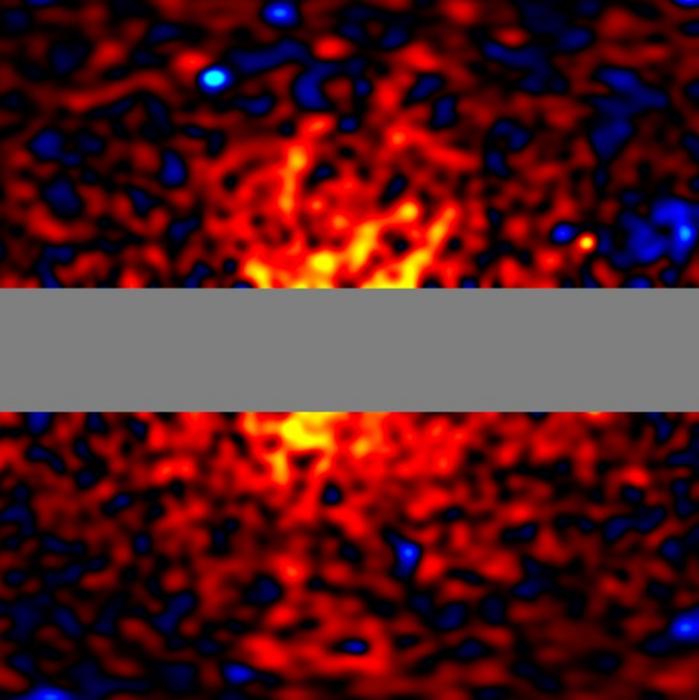
By training Nasa’s Fermi Gamma-ray Space Telescope on the centre of our universe – a region where dark matter is theoretically concentrated – Professor Totani claims to have detected the specific gamma rays.
open image in gallery
Gamma-ray intensity map excluding components other than the halo, spanning approximately 100 degrees in the direction of the Galactic centre (Tomonori Totani, The University of Tokyo)
“The gamma-ray emission component closely matches the shape expected from the dark matter halo,” Professor Totani said.
“If this is correct, to the extent of my knowledge, it would mark the first time humanity has ‘seen’ dark matter. And it turns out that dark matter is a new particle not included in the current standard model of particle physics.
“This signifies a major development in astronomy and physics.”
His results were published in a study on Wednesday, though they still need to be independently verified by other researchers.
The study, titled ‘20 GeV halo-like excess of the Galactic diffuse emission and implications for dark matter annihilation’, was published in the Journal of Cosmology and Astroparticle Physics.