
Two French researchers, Alain Blanchard and Even Coquery, may have found a way to distinguish between the theory of dark matter and the MOND theory in explaining the universe of galaxies revealed by Hubble. At the very least, they uncovered astrometric data in Gaia—precise measurements of stellar velocities throughout the Galaxy—that could seriously challenge MOND while reinforcing the existence of dark matter, as they explained in their interviews with Futura.
About 2,100 years ago, the Greek astronomer, geographer, and mathematician Hipparchus (Ἵππαρχος, c. 190–120 BCE) developed some of the first quantitative models of the motions of the Moon and the Sun, accurate enough to predict eclipses. He also advanced trigonometry and created a star catalog far more complete than any before him.
Roughly twenty-one centuries later, and in his honor, Hipparcos (HIgh Precision PARallax COllecting Satellite) was launched by Ariane on behalf of the ESA—a mission designed to measure the positions, parallaxes, and proper motions of more than 2.5 million stars in the Milky Way.
In this edition of Space, we journey to the stars: astronomers using the European Gaia space telescope have compiled a catalogue of one billion stars in the Milky Way, paving the way for decades of new discoveries. ©ESA
It was followed by the ESA’s Gaia mission, built to produce a catalog fifty times more precise and expanded to one billion stars. Gaia launched in December 2013, began scientific operations in 2014, observed for more than ten years, and stopped gathering new scientific data in January 2025.
Analyses of the full dataset are ongoing. Gaia’s measurements have implications reaching far beyond the Milky Way—from exoplanets and distant quasars to tests of alternatives to Einstein’s general relativity.
Twenty-one centuries after Hipparchus, astrophysicist Alain Blanchard—professor at the University of Toulouse and co-author of a landmark introduction to cosmology—asked his intern, Even Coquery, to analyze Gaia’s data.
Dark Matter: To Infinity and Beyond Sight – Alain Blanchard, TEDxINSAToulouse. © TEDx Talks
As Futura explained in an earlier article, their collaboration led to a paper now available on arXiv.
Their conclusions may be revolutionary: they could weaken major versions of MOND—an alternative to dark matter proposed in the 1980s—and leave the dark matter hypothesis even stronger.
The following is their joint interview.
We begin with Alain Blanchard.
Futura: At the beginning of your work, you deal with ordinary baryonic matter—the protons and neutrons we all know—which make up the stars of the Milky Way, as well as the rotation curve of stars in our Galaxy.
Alain Blanchard: Exactly. We began by modeling the gravitational field produced by the baryonic matter distributed across the Galaxy’s disk and bulge. By estimating the mass of individual stars and their distribution, we can compute the Galaxy’s baryonic mass. Potential theory then allows us to calculate its gravitational field and, using standard Newtonian mechanics, predict the resulting stellar motions.
Our calculations show that beyond a certain distance from the galactic center, stellar velocities should decrease. But this is not what we observe. The rotation curve becomes flat beyond the central regions—a phenomenon also seen in nearby spiral galaxies like Andromeda.
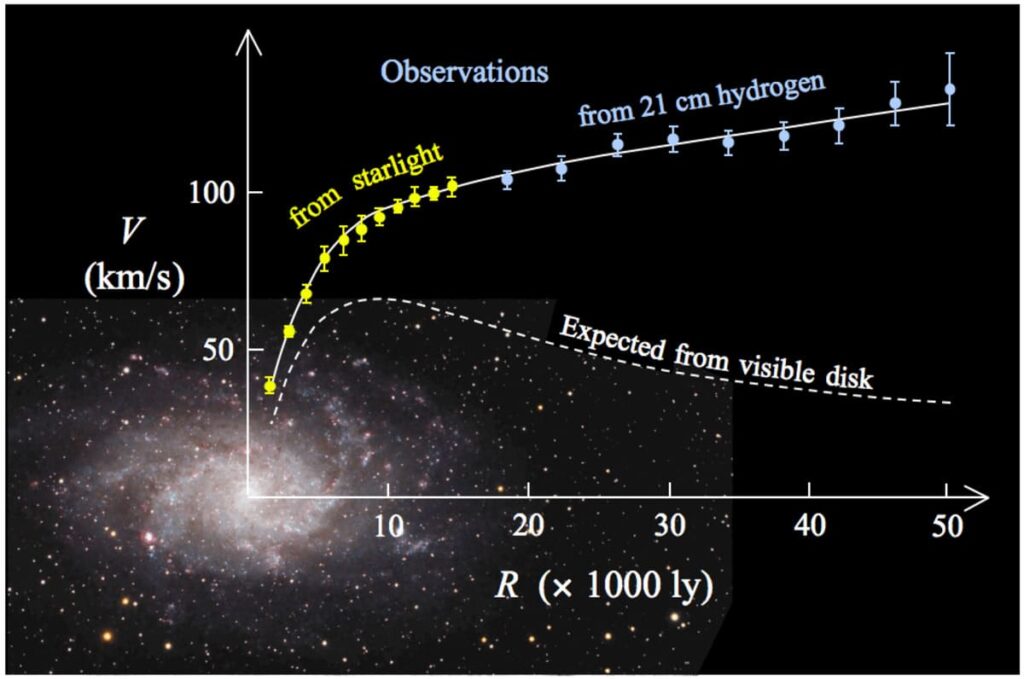
This diagram shows, in dotted lines, the rotational velocities of stars (starlight) in a galaxy, deduced from the distribution of these stars in the disk. Observations do not validate this deduction. Indeed, stars detected in visible light rotate faster, as do the hydrogen clouds identified by the famous 21 cm line. Velocities are given here in km/s and distances in thousands of light-years (ly in the diagram). © Wikipedia, Public Domain
Futura: This discovery, made decades ago—most notably by Vera Rubin—helped lead to the hypothesis of hidden mass distributions, meaning a hypothetical form of dark matter still unknown on Earth?
Alain Blanchard: Yes. By adding a spherical halo of this matter around every spiral galaxy, we can explain the rotation curves. But we must remain cautious regarding the Gaia-based rotation curve and the standard halo description.
The analytic halo profile originally came from early simulations of galaxy formation and the cosmic web. These simulations matched large-scale structures well but left puzzles. They included only dark matter—due to limited computational power and because dark matter was believed to dominate.
Dark matter–only simulations predict too many small satellite galaxies, but modern simulations that include baryonic physics can correct this.
In the mid-1990s, simulations by Navarro, Frenk, and White produced a validated halo profile: the NFW model.
We showed that an NFW model fits Gaia’s Milky Way rotation curve. But baryonic physics complicates the interpretation, so agreement should be viewed with caution.
Futura: And what exactly is the issue with the rotation curve?
Alain Blanchard: Gaia’s full dataset—ten years of observations—has not yet been released. Only part of the fourth catalog (66 months of data) is public. The full catalog is expected in December 2026, and the final mission-wide catalog in late 2030.
The rotation curves we used come from independent groups whose expertise in correcting Gaia’s biases is not on par with the mission team. To draw firm conclusions, we need an official rotation curve published by the Gaia collaboration itself.
Futura: But you’re already reaching conclusions that raise questions?
Alain Blanchard: Absolutely. While we cannot yet definitively choose between MOND and dark matter, MOND appears to be in trouble.
First, the Milky Way’s rotation curve is not truly flat at great distances. Assuming the standard baryonic distribution, MOND alone cannot reproduce the curve, whereas NFW can.
Second, if we allow both the Galaxy’s baryonic mass and MOND’s characteristic constant (a₀) to vary freely, the fit demands unrealistically high baryonic mass and an a₀ far smaller than the supposedly universal value inferred in other galaxies.
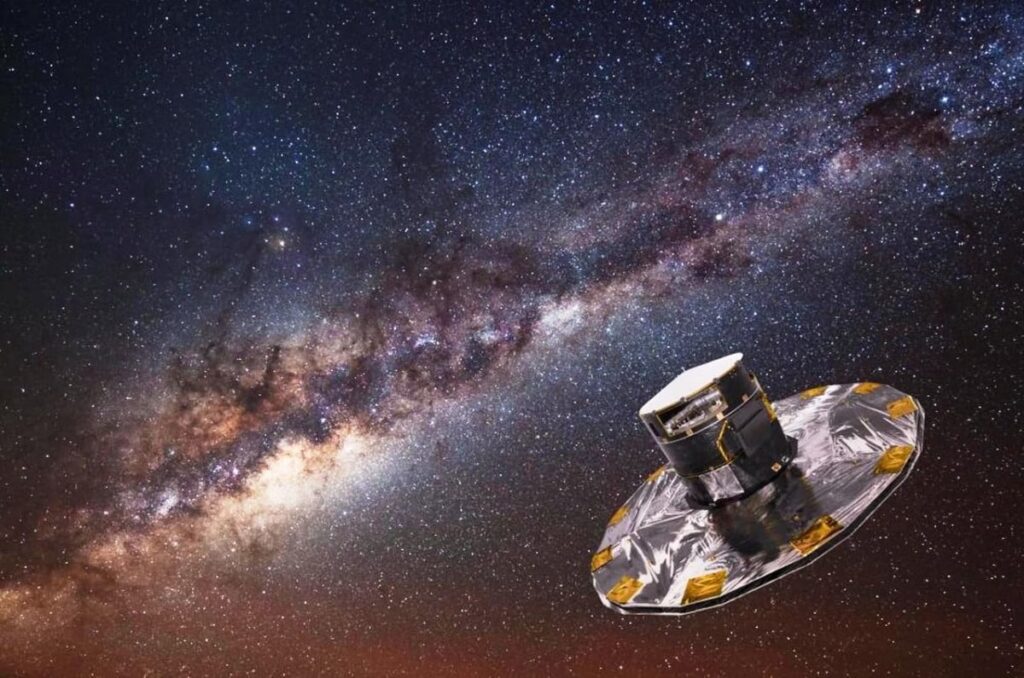
This is an artist’s rendering of our galaxy, the Milky Way, based on data from ESA’s Gaia space telescope. © ESA Gaia DPAC, Stefan Payne-Wardenaar, CC BY-SA 3.0 IGO
Here is the interview with Even Coquery.
Futura: How did you come to work with Alain Blanchard?
Even Coquery: I was looking for an internship in 2024 while in my second year at École Centrale de Lyon. I knew someone in planetary science at the Institute for Research in Astrophysics and Planetology in Toulouse and asked whether an internship in cosmology might be possible there. Fortunately, Alain Blanchard was offering one.
It lasted three months, and as is common in astronomy today, I relied heavily on Python.
Futura: What was your reaction to the results?
Even Coquery: We were thrilled, although not entirely surprised—because the project’s aim from the beginning was to use Gaia’s data to test MOND and dark matter. Alain was hoping for a discovery in this direction.
Futura: How did the scientific community react?
Even Coquery: We received many emails soon after the paper appeared on arXiv in July 2024—though not yet from major MOND theorists like Mordehai Milgrom.
Some supporters of dark matter congratulated us; others thought the work was unnecessary because, in their view, MOND was already refuted. MOND defenders, of course, raised criticisms.
We must remain cautious: debates about Gaia’s data continue. Two more catalogs are planned through 2030, and their analyses could bring surprises.
Futura: Will you be involved in analyzing these future datasets?
Even Coquery: For now, that is not my plan. I’m currently completing a master’s degree in theoretical physics at ENS Lyon.

Laurent Sacco
Journalist
Born in Vichy in 1969, I grew up during the Apollo era, inspired by space exploration, nuclear energy, and major scientific discoveries. Early on, I developed a passion for quantum physics, relativity, and epistemology, influenced by thinkers like Russell, Popper, and Teilhard de Chardin, as well as scientists such as Paul Davies and Haroun Tazieff.
I studied particle physics at Blaise-Pascal University in Clermont-Ferrand, with a parallel interest in geosciences and paleontology, where I later worked on fossil reconstructions. Curious and multidisciplinary, I joined Futura to write about quantum theory, black holes, cosmology, and astrophysics, while continuing to explore topics like exobiology, volcanology, mathematics, and energy issues.
I’ve interviewed renowned scientists such as Françoise Combes, Abhay Ashtekar, and Aurélien Barrau, and completed advanced courses in astrophysics at the Paris and Côte d’Azur Observatories. Since 2024, I’ve served on the scientific committee of the Cosmos prize. I also remain deeply connected to the Russian and Ukrainian scientific traditions, which shaped my early academic learning.