
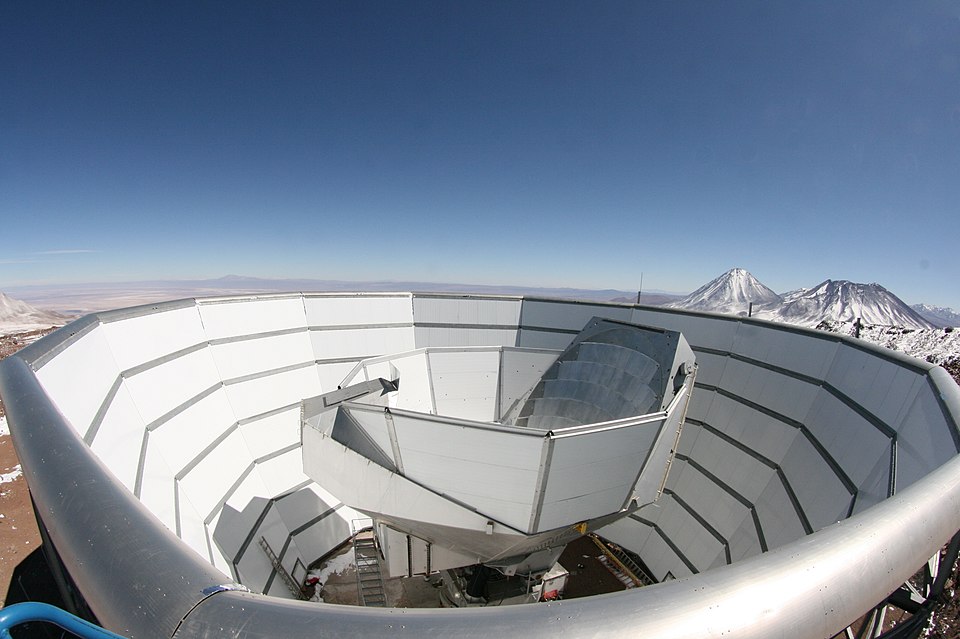
The Atacama Cosmology Telescope has completed its work. The sixth and final release of its data was recently published. This data may be the key to solving one of the greatest mysteries of modern science – the Hubble tension.
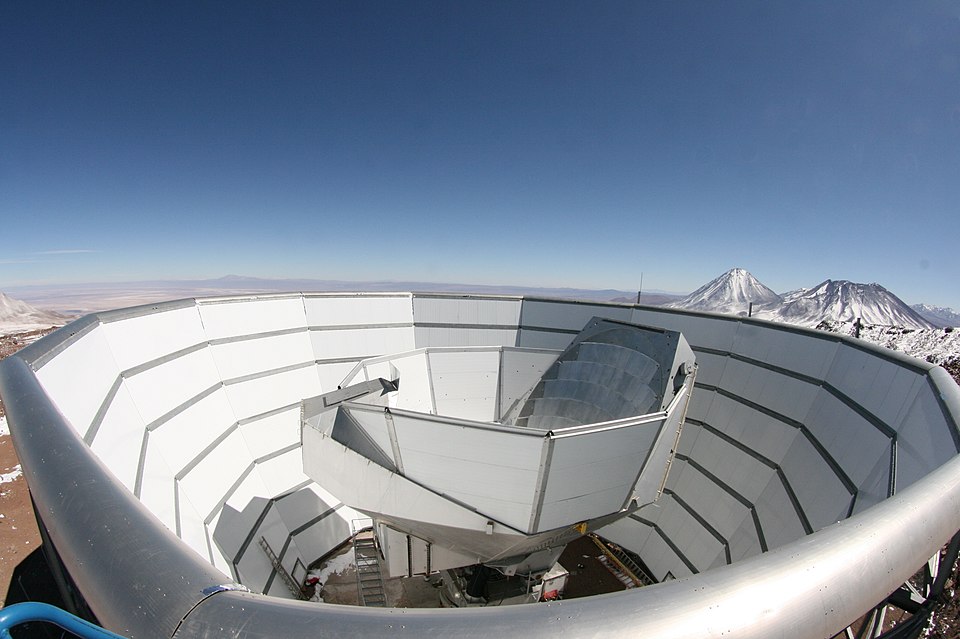 Atacama Cosmology Telescope. Source: Wikipedia
The end of the Atacama Cosmology Telescope
For nearly 20 years, the Atacama Cosmology Telescope has been peering into the distant past of the universe, revealing its secrets to scientists. However, the mission of this instrument has now come to an end. But scientists are actually excited about the latest and most complete release of its data, published in the Journal of Cosmology and Astroparticle Physics, because it may well be the key to a new chapter in understanding the evolution of everything we see around us.
This refers to the so-called Hubble tension, which means that the value of one of the most important physical constants gives different results when measured by different methods. This refers to the Hubble constant, a quantity that measures how fast our universe is expanding.
The classic method of measuring it is to determine the speeds and distances to nearby galaxies using a special class of stars called Cepheids, which are found in them. But it can also be obtained from relic radiation – light that reaches us from the time when the universe was just born.
Neither of these methods provides extremely accurate results, but the problem is that the difference between them is too great to be confidently explained by inaccuracy. It gives rise to numerous theories that scientists have been debating for decades, and that could help solve the problem of more accurate mapping of relic radiation and its comprehensive study.
Map of relic radiation
And that is precisely why the Atacama Cosmology Telescope was created. It accurately determines the intensity of relic radiation in different areas of the sky. It is uneven, which indicates that even in the early stages of its existence, our universe was heterogeneous, and this is associated with even more cosmological concepts and unsolved mysteries.
In addition, the Atacama Cosmology Telescope measured the polarization of the cosmic microwave background with high precision. This is a characteristic that shows how electromagnetic waves are aligned in a single plane. It can tell us a lot about the conditions under which photons were formed and what they encountered on their way.
In fact, such measurements have been carried out before. This was done by the European Planck telescope, launched in 2009, and it is on its data that the modern understanding of Hubble tension is largely based. However, its data was incomplete; in particular, it studied the polarization of relic radiation rather superficially.
The main result of the Atacama Cosmology Telescope’s work is that this instrument, which has a dish diameter of 6 m compared to 1.5 m for Planck, has obtained a much more accurate picture of the early universe and, at the same time, confirmed its general conclusions.
The inconsistency does indeed exist; it is not an artifact and is exactly as previously established. At the same time, new data has already refuted about 30 different theories that could explain what is happening, which is good, because when there are too many of them, it is even worse than when there are none.
Researchers hope that the telescope’s findings will enable them to construct an extremely accurate picture of what happened in the early universe, which will ultimately allow them to overcome Hubble’s tension.
Provided by: phys.org