
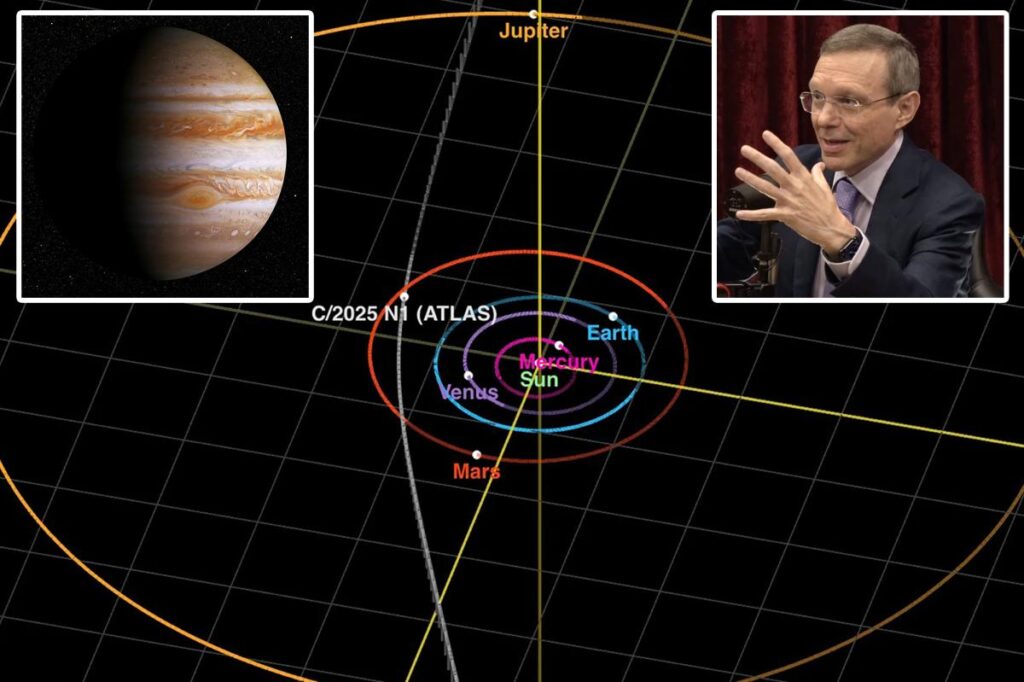
Is the gas giant about to have a close encounter of the 3I kind?
Harvard scientist Avi Loeb claims that 3I/ATLAS’ bizarre trajectory could suggest that it’s sending “satellites” to Jupiter to gather intel for an “extraterrestrial civilization.”
Loeb told The Post that 31/ATLAS could be using its time near Jupiter on March 16, 2026, to “seed” additional probes onto the gas giant.
“It comes exactly at the right distance from Jupiter for Jupiter’s gravity to dominate,” said Avi Loeb. “So, if it wants to release some probes near Jupiter, that’s where it needs to be.” The Joe Rogan Experience
In a new blog on Medium, the astrophysicist speculated Jupiter could have attracted ATLAS because it was “bigger” than Earth and other neighboring planets in our solar system, and therefore acted like an intergalactic signal beacon.
Loeb said that for the comet to do recon on Jupiter, it would have to move into a region where Jupiter’s gravity dominates over the Sun’s — called the Hill radius. That area contains stable spots where objects can hold position with very little fuel, making them prime real estate for advanced satellites.
As the researcher pointed out, ATLAS appears to be following this exact path.
Loeb found it an “extraordinary coincidence” that during the interstellar entity’s closest approach to Jupiter on March 16, it will be at a minimum distance of 53.445 million kilometers (over 33.209 million miles) from Jupiter, based on calculations by NASA’s Jet Propulsion Laboratory.
That’s strikingly close to the Hill Radius, which is situated just 53.502 million kilometers (33.244 million miles).
Loeb believes that Jupiter might be a more enticing target due to its size. Artsiom P – stock.adobe.com
“It comes exactly at the right distance from Jupiter for Jupiter’s gravity to dominate,” Loeb told News Nation. “So, if it wants to release some probes near Jupiter, that’s where it needs to be.”
He also calculated that 3I/ATLAS may have even executed an in-flight maneuver during its monthlong passage near perihelion — the object’s closest approach to the Sun — to ensure it was within proper range.
“The non-gravitational acceleration introduced a small course correction of exactly the magnitude needed to bring the minimum distance of 3I/ATLAS from Jupiter to the value of Jupiter’s Hill radius,” he declared. “3I/ATLAS would have missed the edge of the Hill sphere otherwise.”
Loeb added that if ATLAS were indeed alien technology, “it might have fine-tuned its trajectory with the help of [artificial] thrusters” — alluding to the comet’s so-called “jet structure.”
Unfortunately, ATLAS arrived at perihelion behind the Sun, making it invisible to Earthly observatories, and thereby preventing us from seeing whether the comet executed such a maneuver, or if it released probes at that time.
Trajectory of 3I/ATLAS with positions of the planets on November 22, 2025. NASA/JPL
Loeb said he hoped that “objects orbiting Jupiter after the passage of 3I/ATLAS could be identified by the Juno spacecraft or by other human-made orbiters around Jupiter.”
This would have major implications for finding out the cosmic interloper’s intentions, per Loeb. “If we find technological satellites of Jupiter that we did not send, it would imply that Jupiter is of interest to an extraterrestrial civilization,” Loeb wrote.
The scientist wrote that “not finding similar gadgets near Earth” could also deliver a major blow to our “ego,=” as it would indicate not only are we not the center of our solar system, but aren’t even the center of our “cosmic neighborhood.”
As for why ATLAS would prefer the volatile gas giant to the inhabited Earth, Loeb wrote that this was potentially “because the human species arrived late to the party — only a few million years ago.”
On the contrary, Jupiter — the biggest planet in the Solar system — “was visible to the senders of 3I/ATLAS when the mission was launched billions of years ago,” the scientist speculated.
However, the likelihood of 3I/ATLAS embarking on a Jupiter recon mission is relatively low — at least compared to other possibilities, per Loeb.
In fact, the researcher ranked it the least likely in a list of 6 major ATLAS anomalies with “no explanation” that he posted on his blog on Sunday.
More probably anomalies, per the essay, included ATLAS’ anti-tail that points toward the sun rather than away as is typical of comets, suggesting it could be a beam of light used to sweep tiny meteors out of the spacecraft’s path.
Most concerning was ATLAS’ orientation toward the planets in our solar system — which Loeb suggests could’ve been by design.
NASA’s official position, which the agency reiterated during its anticipated photo release in Maryland last week, remains that 3I/ATLAS is a comet.