
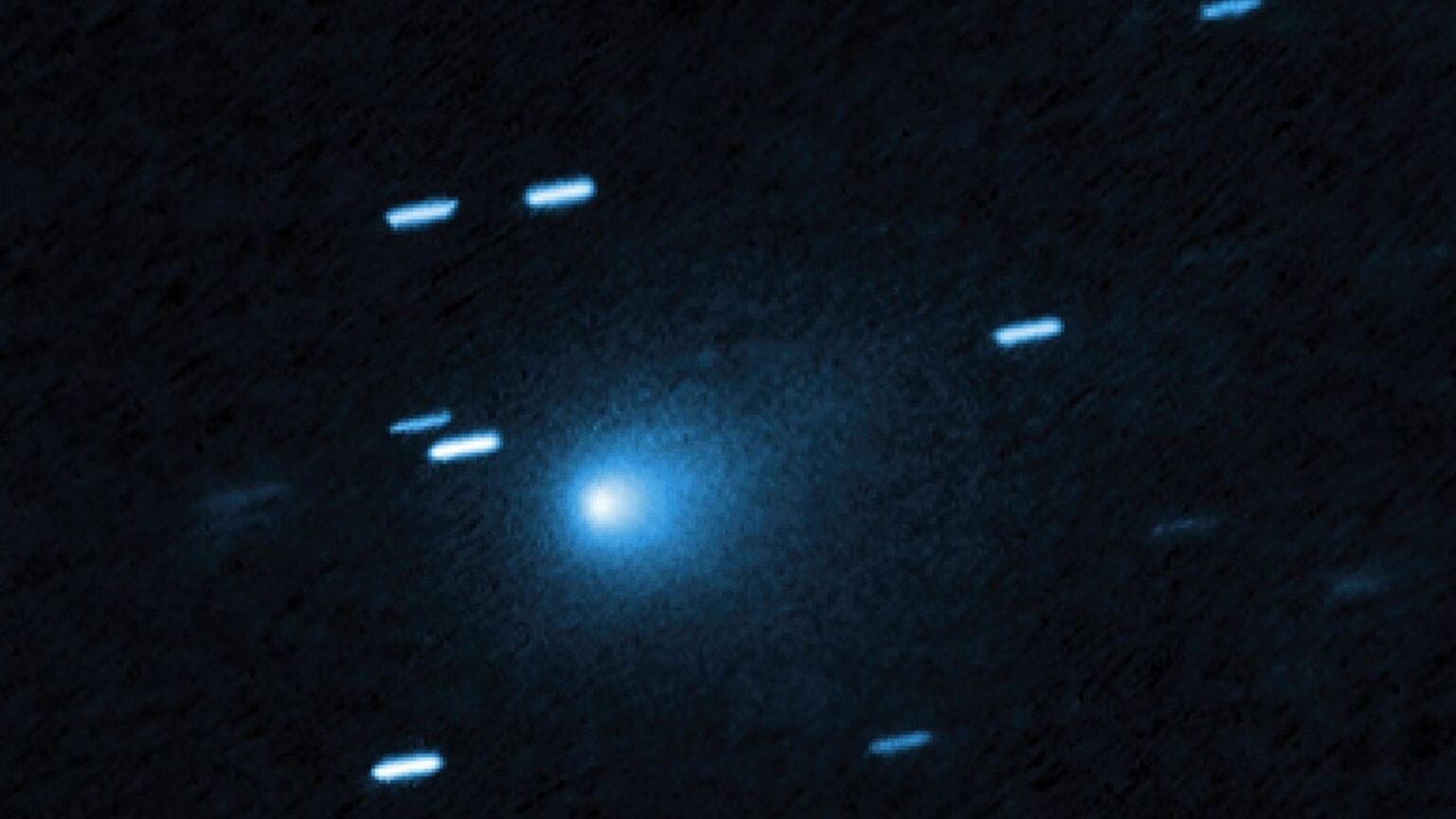
NASA’s New 3I/ATLAS Images Reveal Stunning Activity During Its Approach From Mars
Image: NASA, ESA, David Jewitt UCLA); Image Processing: Joseph DePasquale (STScI
The scientific community stands at a precipice, looking out at a universe that may be far more populated than conservative estimates suggest. Data concerning the interstellar object 3I/ATLAS is no longer dealing with simple coincidences; rather, analysts are facing a statistical cascade that challenges the natural explanation for the object traversing the solar system.
It is becoming increasingly difficult to dismiss these peculiarities as mere chance without ignoring the mathematical reality staring back at observers. The data strongly suggests an exceptional observation, necessitating the rigorous cataloguing of the anomalies of 3I/ATLAS in ascending order of likelihood.
The Uncanny Orbital Precision of 3I/ATLAS
The most striking evidence of possible intent lies in the object’s orbital mechanics, which display a level of precision that makes the probability of these occurrences being random vanishingly small.
Jupiter Encounter Coincidence: With a probability (P) of 0.00004, the forecasted perijove distance of 3I/ATLAS during its encounter with Jupiter on 16 March 2026 is 53.445(±0.06) million kilometres. This figure is almost identical to Jupiter’s Hill radius of 53.502 million kilometres. This non-trivial match was enabled by non-gravitational acceleration near perihelion. Such a rare coincidence suggests that 3I/ATLAS may intend to release technological devices as artificial satellites of Jupiter, possibly at the Lagrange points L1 and L2 at the Hill radius—regions where orbital corrections and fuel requirements are minimal.Fine-Tuned Arrival: With P=0.00005, the arrival time was fine-tuned to bring the object within tens of millions of kilometres from Mars, Venus, and Jupiter. Crucially, it remained unobservable from Earth at perihelion.Designed Trajectory: Additionally, the retrograde trajectory of 3I/ATLAS (P=0.002) is aligned to within 5 degrees with the ecliptic plane of the planets around the Sun, suggesting the trajectory may have been designed.Industrial Origins and Signatures of Technology
The physical constitution and activity of the object offer equally compelling data that contradict the profile of a natural rock.
Excessive Mass and Speed: The nucleus of 3I/ATLAS (PArtificial Composition: The gas plume surrounding 3I/ATLAS (PAnti-Tail and Shielding: The object displayed a sunward jet, or anti-tail (PPropulsion and Thrusters: Other minor anomalies (PThe Need for New Data
The probability for the combined occurrence of multiple independent anomalies is the product of their individual probabilities. This list demonstrates that 3I/ATLAS is an extremely rare and mysterious object, particularly if it is, in fact, a natural comet as argued by NASA officials on 19 November 2025.
What data is needed now? Spectroscopic measurement of the speed and composition of the jets would reveal whether they stem from the sublimation of pockets of ice on the surface of a rock or from technological thrusters.
The universe is speaking in the language of mathematics and physics; the crucial point is whether analysts are brave enough to translate the message without the filter of past assumptions. As 3I/ATLAS continues its journey, commitment to evidence over dogma must remain steadfast.