
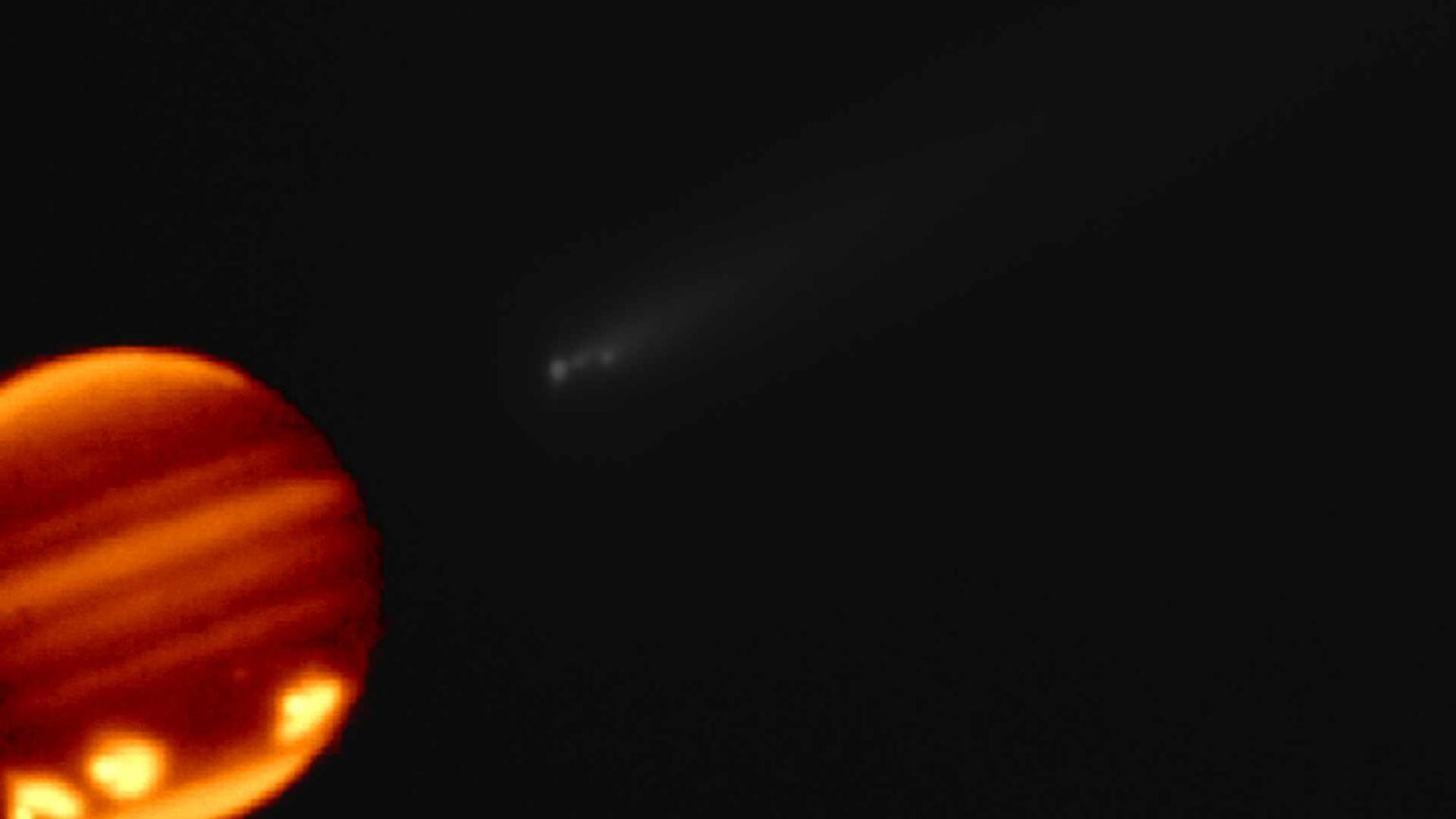
Even as interstellar interloper 3I/ATLAS is all the buzz right now, with wild speculations on its origin, few would recall a sort of black swan event much publicized in 1994. A comet that crashed into the solar system’s largest planet.
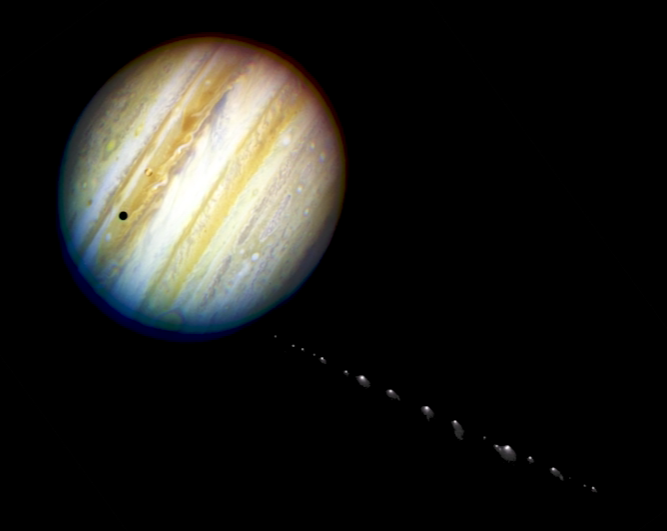
Image: NASA
Comet Shoemaker-Levy 9’s impact on Jupiter was the first ever extraterrestrial impact on a solar system planet to be observed and recorded for posterity in 1994. It was unlike a 2-hour Hollywood movie. The event spanned a period of at least 2 years since the comet’s fragmentation. Discovered in 1993, by an astronomer trio, David Levy, Carolyn Jean Spellman Shoemaker, and her husband, Eugene M. Shoemaker, found the Shoemaker-Levy 9, aka SL9, orbiting around Jupiter. Calculations estimated that the active comet captured by Jupiter’s gravity would have been orbiting the planet for 2-3 decades. In July 1992, the tidal force of Jupiter broke apart SL9 when it passed within the Roche limit of the planet. SL9 was broken into at least 21 fragments, with the largest at least 2 km in diameter.
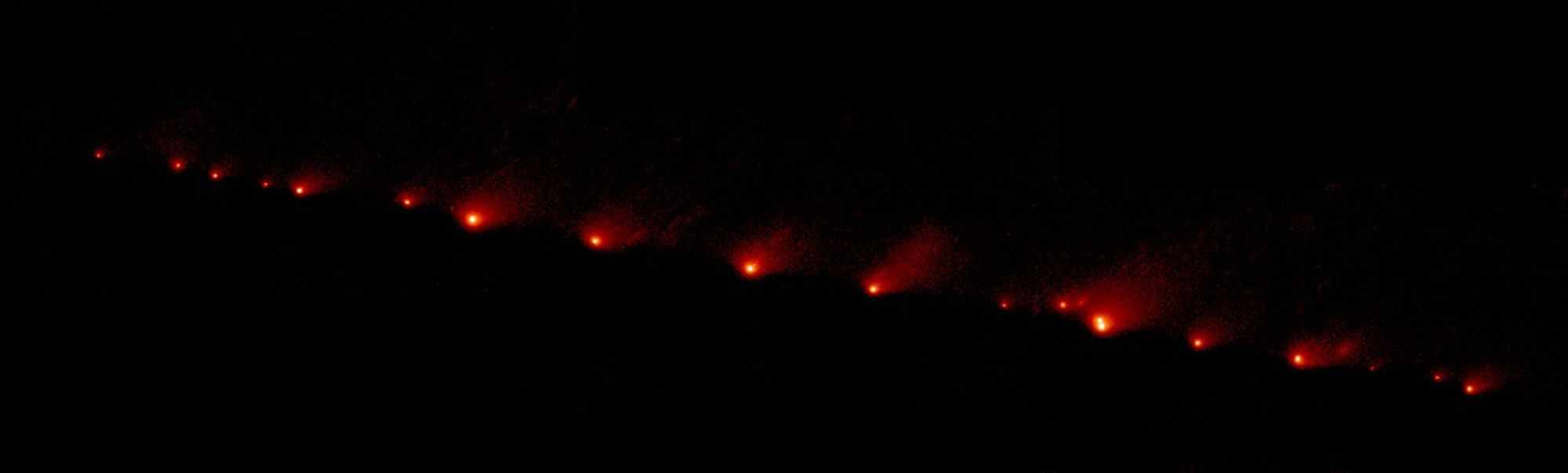 Image: NASA
The impacts that started on July 16, 1994 ended on July 22, 1994, were captured by NASA’s Galileo orbiter that was enroute to Jupiter as SL9 fragments collided with the southern hemisphere of the planet at a speed of 60 km/second. The spectacular impacts were more visible than the famed Great Red Spot of the planet for months.
Will the bizarre and baffling exocomet 3I/ATLAS meet the same fate? After brushing past Earth at a distance of 170 million miles, the comet will fly by Jupiter in spring 2026 at a distance of 33 million miles. Seems safe.
See Also: 3I/ATLAS: NASA Explains Why The Fuzzy Interstellar Comet Picture By HiRISE As Amateurs Produce Better Pics
Here’s what Harvard astrophysicist Avi Loeb speculates in his latest blog: the interstellar object will approach Jupiter the closest on March 16, 2026.
If 3I/ATLAS is technological in origin, it might have fine-tuned its trajectory with the help of thrusters so as to arrive at Jupiter’s Hill radius.
If 3I/ATLAS were to deposit devices within the Hill sphere of Jupiter on March 16, 2026, these devices would need to fire their engines in order to cancel out the high speed of 3I/ATLAS relative to Jupiter, which is 65.9 kilometers per second. The escape speed from Jupiter’s gravitational potential well at H=53.5 million kilometers is just 2.2 kilometers per second.
Any new objects orbiting Jupiter after the passage of 3I/ATLAS, could be identified by the Juno spacecraft (as discussed here) or by other human-made orbiters around Jupiter.
So Professor Loeb speculates that if the comet is an alien spy probe, it might be interested in Jupiter by launching devices into the planet. We’ll only have to wait for a few more months to witness.
See Also: 3I/ATLAS: Harvard Astrophysicist Avi Loeb Explains If Exocomet’s Earth Flyby Before Christmas Means Doomsday
Cover: NASA & The Virtual Telescope Project