
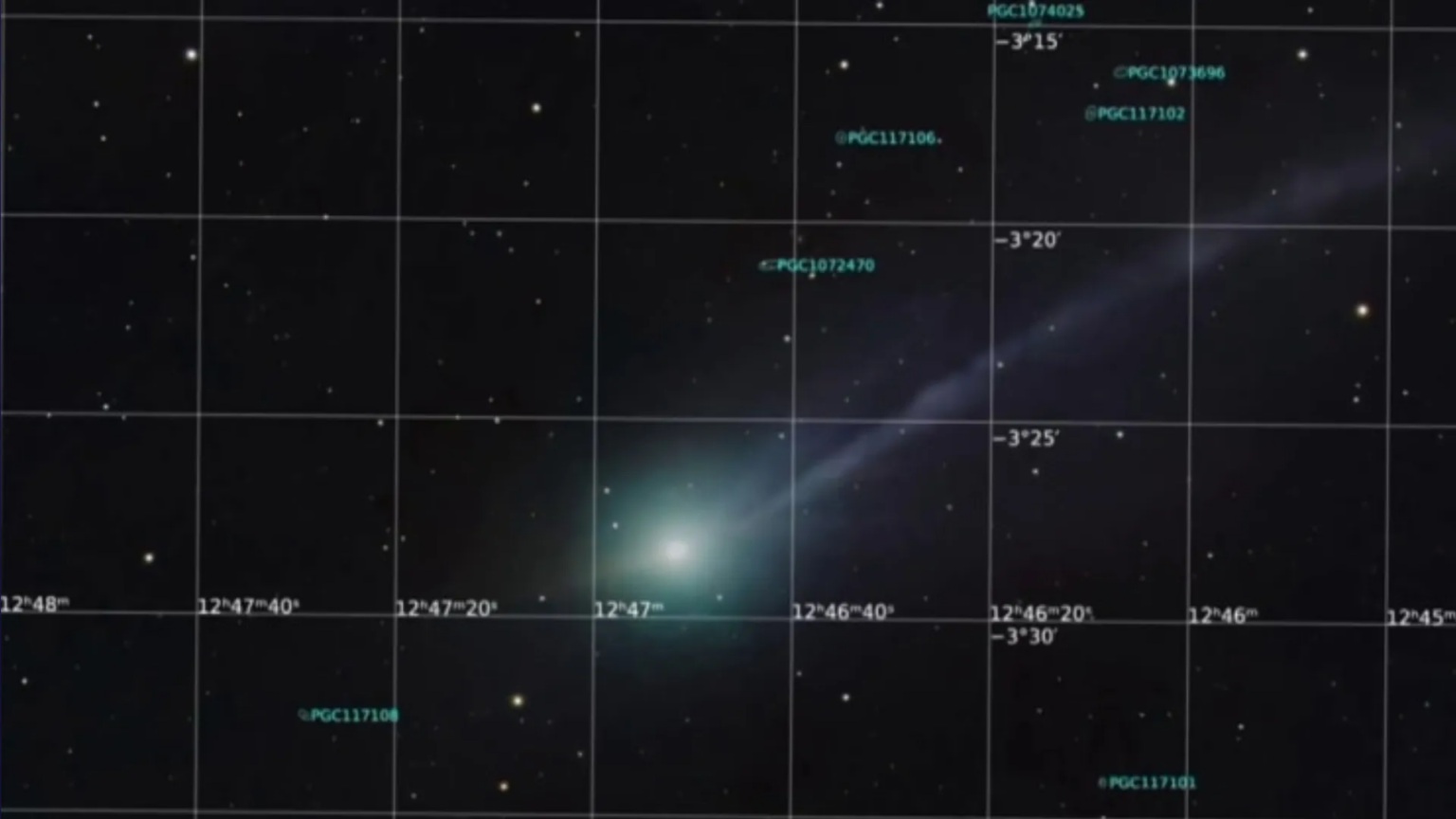
A rare interstellar visitor is making its way through our solar system, and NASA scientists say it offers an extraordinary chance to study material that formed around another star. The object, known as 3I/ATLAS, is only the third confirmed interstellar object ever detected, making its appearance a major scientific event.
3I/ATLAS was discovered on July 1, 2025, by the NASA-funded ATLAS survey telescope in Chile. Its hyperbolic trajectory confirms it originated outside our solar system and will exit again — a one-time pass that will never repeat.
Early research shows the comet carries unusually high levels of carbon dioxide compared to water, a rare chemical makeup not commonly found in comets formed around our Sun. This suggests 3I/ATLAS was created in a completely different environment, giving scientists an opportunity to compare how other star systems build comets and planetary materials.
Studies also indicate the object may be between 7 and 14 billion years old, possibly predating our 4.6-billion-year-old solar system. Its extreme age adds another layer of intrigue to this already exceptional discovery.
NASA is using several spacecraft to study the comet during its brief visit. The Mars Reconnaissance Orbiter captured images as 3I/ATLAS passed near Mars, while the MAVEN orbiter gathered ultraviolet data to help examine its composition. Because interstellar objects are so scarce, each observation provides valuable new insight.
 NASA images of 3i Atlas
NASA emphasizes that 3I/ATLAS poses no threat to Earth. Its closest approach will occur on December 19, when it will remain about 1.8 astronomical units away, or more than 270 million miles.
With its remarkable chemistry, ancient origins, and interstellar path, 3I/ATLAS is giving scientists a rare glimpse into the building blocks of distant worlds — a brief visit from far beyond our cosmic neighborhood.