
Features
3I/ATLAS’s characteristics, color, speed, and direction are all consistent with what we expect from a comet.
3I/ATLAS has an icy nucleus and a coma, which is a bright cloud of gas and dust that surrounds the comet and is emitted at increasing rates as the comet approaches the Sun.
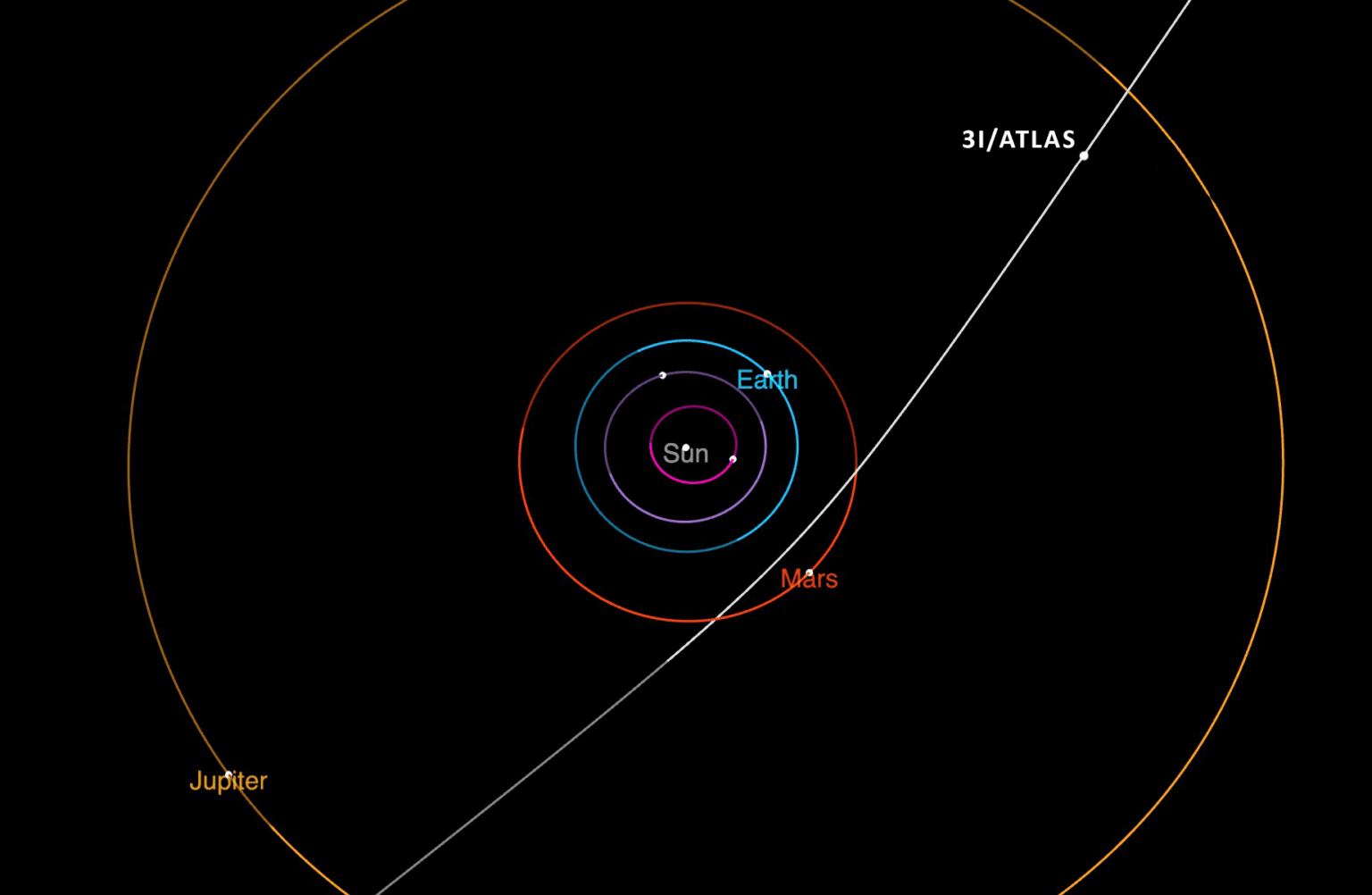
3I/ATLAS is on what’s called a hyperbolic trajectory, which means it is moving too fast to be bound by the Sun’s gravity and, therefore, is not following a closed orbital path around the Sun. It is simply passing through our solar system.
3I/ATLAS came closest to the Sun on Oct. 30, 2025, at a distance of about 130 million miles (210 kilometers), or 1.4 astronomical units (AU), just outside the orbit of Mars. At that time, Earth was on the opposite side of the Sun.
3I/ATLAS is scientifically important because its differences from the comets in our solar system may provide insight into the composition of other solar systems.