
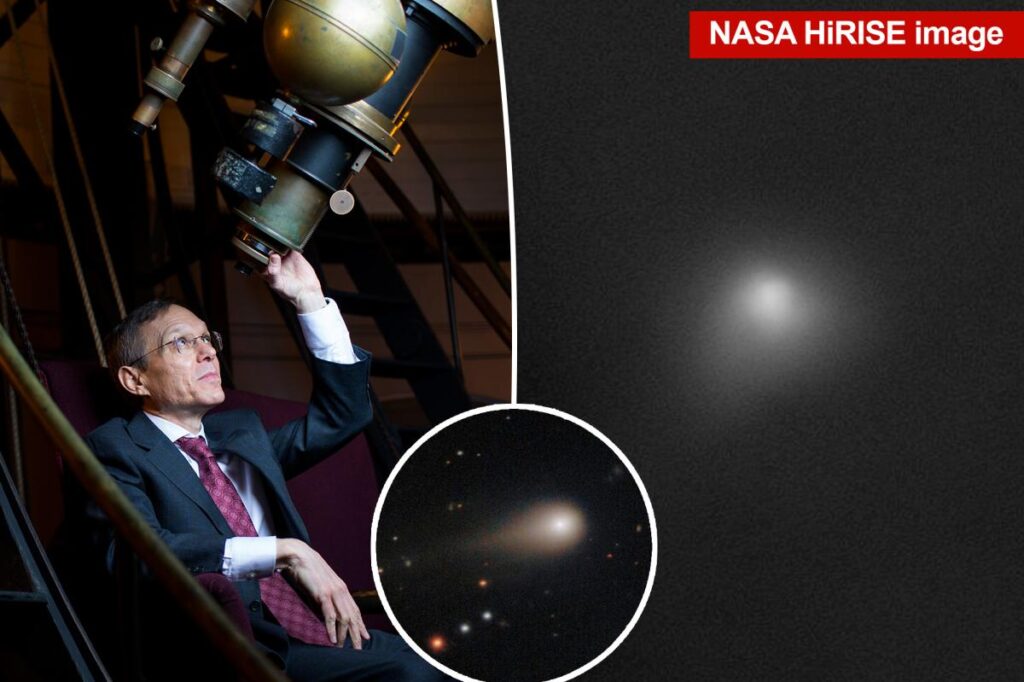
He thought they were being real NAS-holes.
Scientist Avi Loeb slammed NASA’s so-called jaw-dropping hi-res photos of the interstellar entity, calling them “fuzzy” and claiming that they do nothing to disprove that the alleged comet could be an artificial spacecraft. He aired his grievances in a new post on Medium.
The astrophysicist told the Post that he is currently awaiting future data on the entity, which can be used to “search for any additional objects that came out of 3I/ATLAS, be it fragments of ice for a natural object or mini probes for a technological object.”
“The image taken by the HiRISE camera onboard the Mars Reconnaissance Orbiter on October 3 and available here, shows a fuzzy ball of light,” Loeb wrote. “Due to spacecraft jitter during the observation period, the light from 3I/ATLAS is smeared by several pixels. In the coming days, I will analyze this data quantitatively to extract the most important information out of it.” The Washington Post via Getty Images
The new images, unveiled Wednesday during a conference at NASA’s Goddard Space Flight Center in Greenbelt, Maryland, reportedly showed the tiny, glowing orb encircled by a hazy halo of gas and dust, hurtling through space at a staggering 153,000 miles per hour.
The footage, which was the result of a collaboration between over 20 mission teams, included snaps from the Mars Reconnaissance Orbiter’s HiRISE camera and its MAVEN Mars orbiter cameras in early October, when 3I/ATLAS flew by Mars.
The space agency claimed that the images’ release had reportedly been delayed by a government shutdown, which ended last week — although Loeb previously accused NASA of willfully withholding the footage to obfuscate inconvenient truths about its origins.
Meanwhile, NASA Associate Administrator Amit Kshatriya doubled down on the opinion that 3I/ATLAS is of cometary provenance, declaring, “This object is a comet. It looks and behaves like a comet, and all evidence points to it being a comet. But this one came from outside the solar system, which makes it fascinating, exciting and scientifically very important.”
An image from the High Resolution Imaging Science Experiment (HiRISE) camera aboard NASA’s Mars Reconnaissance Orbiter shows the interstellar comet 3I/ATLAS on October 2, 2025. via REUTERS
Loeb, however, was not as impressed with the interstellar slideshow, claiming that the so-called highest-resolution photos were not clear enough to make that determination.
“The image taken by the HiRISE camera onboard the Mars Reconnaissance Orbiter on October 3 and available here, shows a fuzzy ball of light,” he wrote. “Due to spacecraft jitter during the observation period, the light from 3I/ATLAS is smeared by several pixels.”
He added, “In the coming days, I will analyze this data quantitatively to extract the most important information out of it.”
Elsewhere, the scientist slammed NASA for repeating its official mantra that ATLAS was a comet.
“NASA’s representatives should have emphasized what we do not understand about 3I/ATLAS rather than insist that it is a familiar comet from a new birth environment,” wrote the scientist.
Loeb believed that all will be revealed when ATLAS (not pictured) makes it closest pass of our planet in December. AP
He ripped NASA’s assertion that the comet was behaving naturally by shedding gas and dust and responding to gravity, claiming that a “spacecraft” that amassed frozen gases by traveling through the frozen deep space environment could have also “developed an outer layer of dust mixed with ices that sublimate when illuminated by sunlight.”
This NASA image, obtained on November 19, 2025, shows an annotated version, with the trajectory and scale bar, of the interstellar comet 3I/ATLAS, captured by the High Resolution Imaging Science Experiment (HiRISE) camera on NASA’s Mars Reconnaissance Orbiter spacecraft on October 2, 2025. NASA/AFP via Getty Images
Loeb also claimed that the conference failed to address ATLAS’ anomalous proportions — which he speculates could be at least 33 billion tons — as well as its bizarre trajectory through the planets around the sun, which Loeb previously suspected could be evidence that it was an alien craft sent to do reconnaissance on us.
“We should not ‘judge a book by its cover,’ because we all know about the Trojan Horse which appeared unthreatening to the guardians of the City of Troy,” declared Loeb. “When monitoring an interstellar visitor, we should not fall prey to traditional thinking but scrutinize new interpretations.”
He reportedly summed up NASA’s so-called arrogance with quotes from Sherlock Holmes.
“Sherlock Holmes noted: ‘There is nothing more deceptive than an obvious fact,’” Loeb said. “He also observed: ‘It is a capital mistake to theorize before one has data. Insensibly, one begins to twist facts to suit theories, instead of theories to suit facts.’ I wish NASA’s representatives shared this wisdom.”
Loeb wrote that in the “coming weeks, larger ground-based telescopes as well as the Hubble and Webb telescopes will be able to characterize the jets of 3I/ATLAS by measuring their composition, speed and mass loading rate.”
“These details will inform us without a doubt whether the jets are produced by natural pockets of ice that are warmed by sunlight or by technological thrusters,” he said. He added that they will perhaps also pinpoint any objects that broke off ATLAS, whether “fragments of ice” or “mini probes.”
He said that “we should know the answer” when 3I/ATLAS will make its closest approach to Earth on Dec. 19 — at which point the entity will be zipping by at about 167 million miles away.