
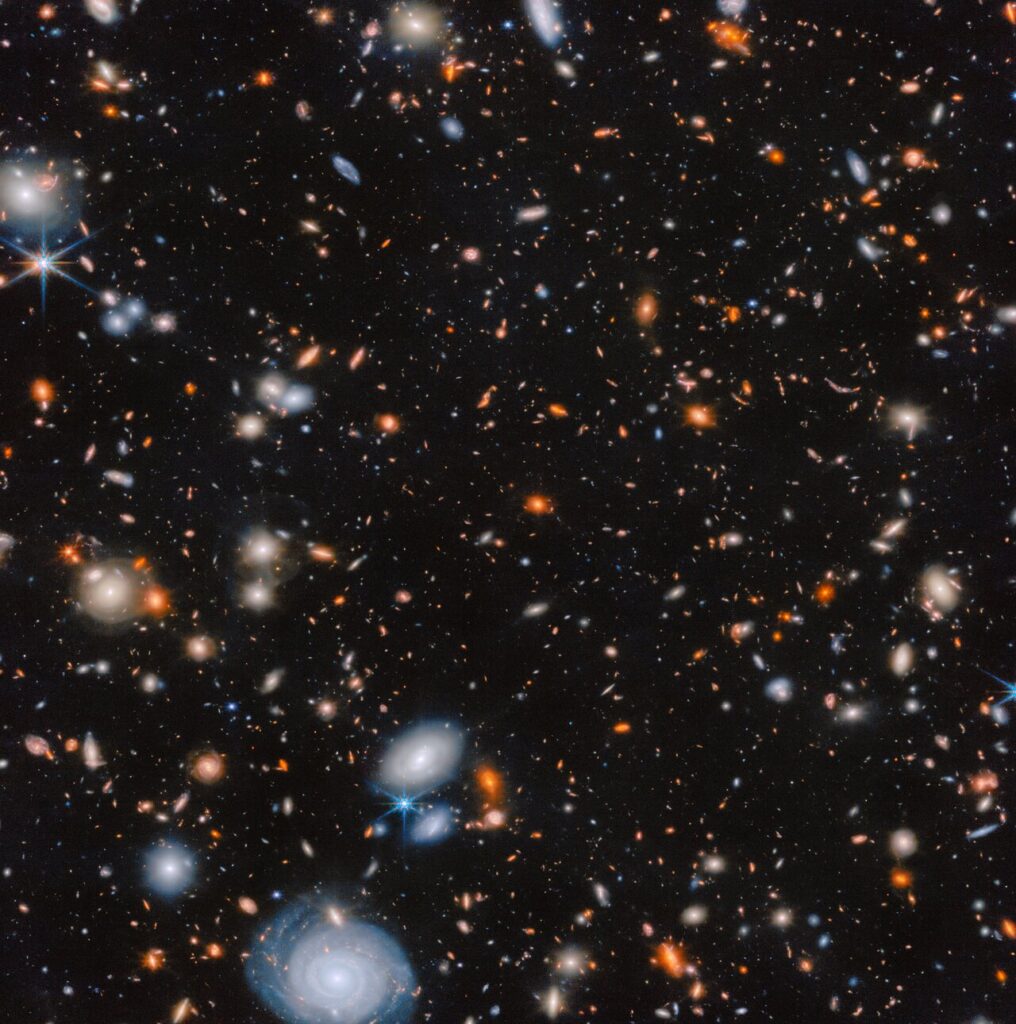
Using the James Webb Space Telescope (JWST), astronomers were able to confirm the existence of an actively growing supermassive black hole at the edge of the Universe. It existed only 570 million years after the Big Bang.
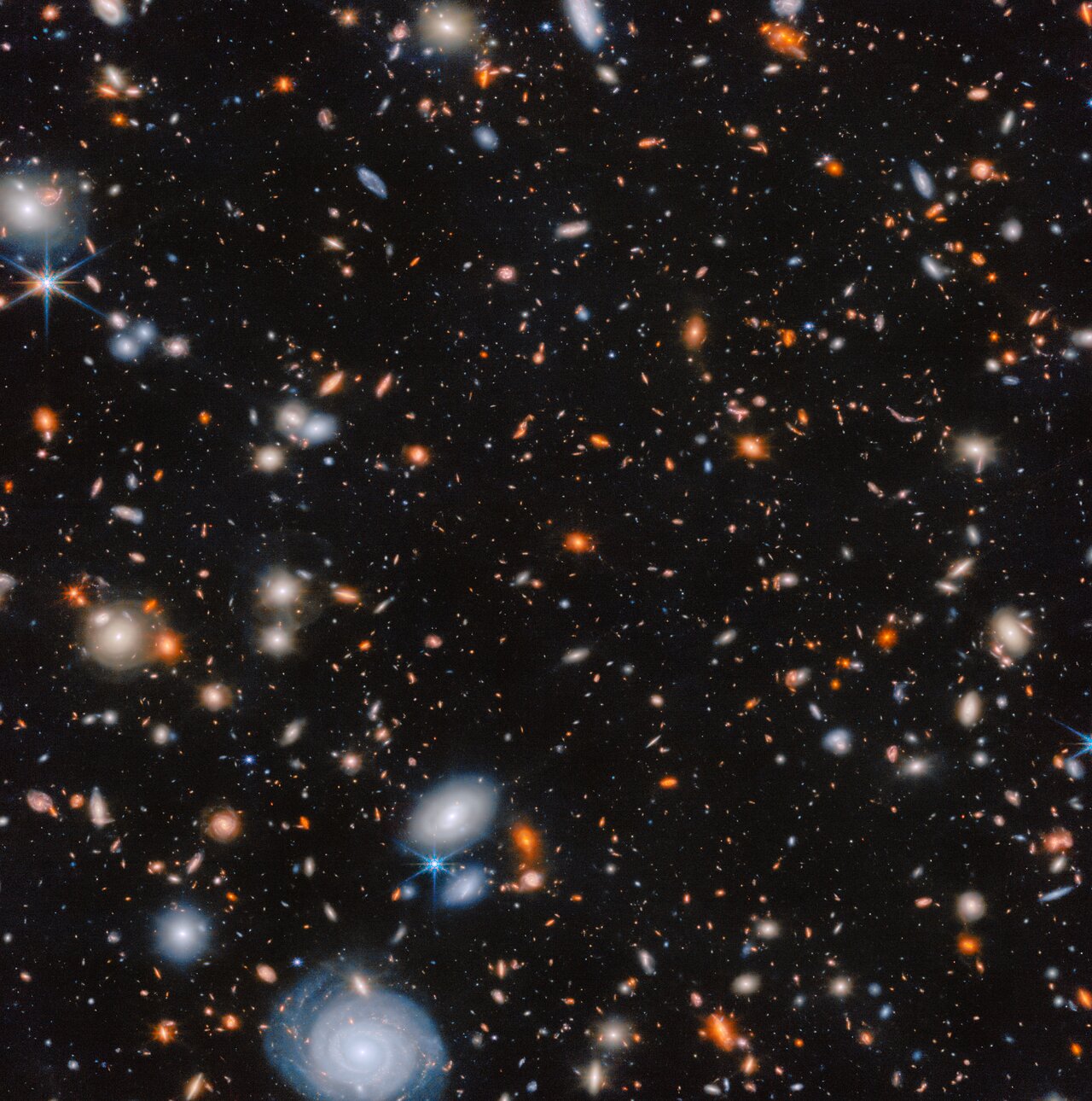 The region of the sky where the galaxy CANUCS-LRD-z8.6 is located. Source: ESA/Webb, NASA & CSA, G. Rihtaršič (University of Ljubljana, FMF), R. Tripodi (University of Ljubljana, FMF)
During its first three years of operation, JWST discovered a large number of extremely distant and strikingly red objects. They were named “little red dots.”
The nature of the red dots has been the subject of debate in the scientific community. Some researchers believed that they were a type of active galactic nucleus, while others suggested that JWST had detected giant protostars that could only have existed in the early Universe. However, new data supports the first interpretation.
The target of the observations was an object designated CANUCS-LRD-z8.6. It existed at a time when our Universe was less than 600 million years old. JWST was able to determine that this object was a compact galaxy. It is in the early stages of its evolution and contains a small amount of heavy elements.
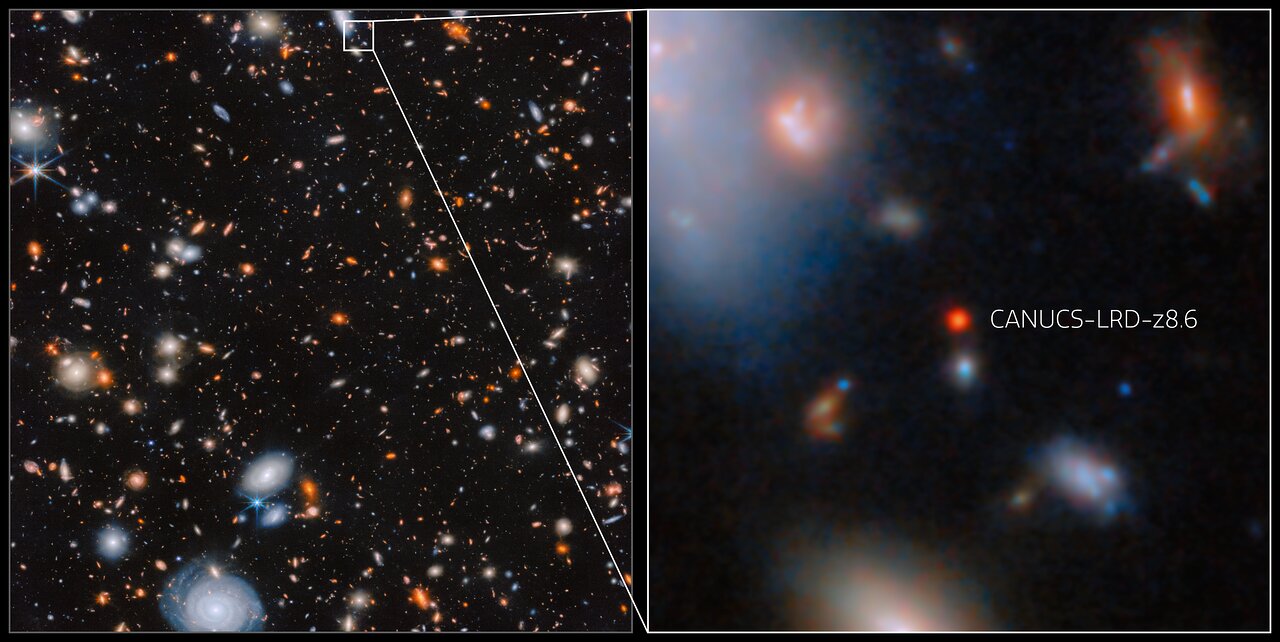 Left: The region of the sky where the galaxy CANUCS-LRD-z8.6 is located. Right: The galaxy CANUCS-LRD-z8.6. Source: ESA/Webb, NASA & CSA, G. Rihtaršič (University of Ljubljana, FMF), R. Tripodi (University of Ljubljana, FMF)
Analysis of the CANUCS-LRD-z8.6 spectrum revealed the presence of gas that is highly ionized by energetic radiation and rapidly rotating around the central source. These features are key characteristics of a supermassive black hole in the process of actively absorbing matter.
Accurate spectral data made it possible to estimate the mass of the black hole, which turned out to be unusually large for such an early stage of the Universe’s development. At the same time, it is growing faster than existing models predict. This suggests that black holes in the early Universe may have grown much faster than the galaxies in which they are located.
According to the researchers, the discovery raises a number of questions about the processes that allowed such massive objects to appear so quickly, and calls into question many of the existing models. They intend to continue observing CANUCS-LRD-z8.6 using JWST, as well as the ALMA radio telescope complex, to study the cold gas and dust in the galaxy and refine the properties of the black hole.
According to Esawebb