
 Press enter or click to view image in full size
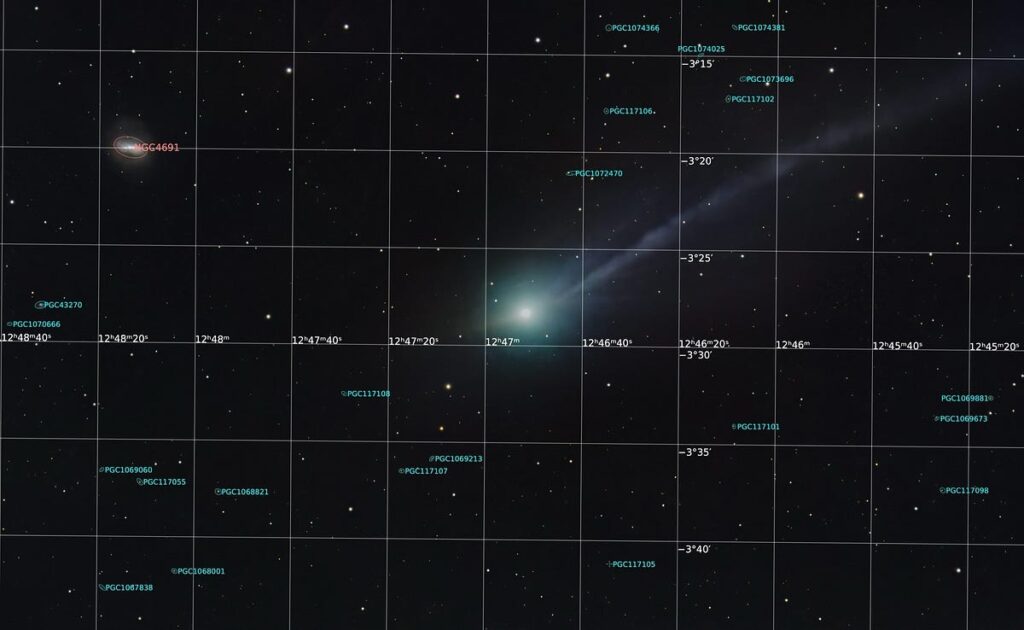
An image of 3I/ATLAS, combining 24 exposures of 60 seconds each with a 0.2-meter telescope (Celestron EdgeHD 800) in New Mexico, USA between 11:53–12:23 UTC on November 16, 2025. The image shows multiple jets both towards and away from the Sun. The sunward direction is pointing to the lower left corner. (Credit: Satoru Murata)
As I explained in an interview with Peter Doocy on “The Sunday Briefing” of Fox News yesterday (accessible here), the foundation of science is based on the humility to learn, not the arrogance of expertise. When comet experts argued that 3I/ATLAS must be a familiar water-rich comet as soon as it was discovered on July 1, 2025, they behaved like artificial intelligence systems which reflect their training data sets. For decades, the data set that established comet expertise included icy rocks in the solar system. My point is simple. Humanity launched technological objects to space and we must add them to the training data set of comet experts when studying interstellar objects.
On January 2, 2025, the Minor Planet Center — officiated by the International Astronomical Union to catalog space objects, identified a “near-Earth asteroid”. A day later, the officials realized that this “asteroid” follows the trajectory of the Tesla Roadster car, launched to space by SpaceX in 2018 as a dummy payload on the Falcon Heavy rocket. They immediately removed the object from their asteroid catalog, realizing that it is not a rock but rather a car.
Elon Musk is probably not the most accomplished space entrepreneur in the Milky-Way over the past 13.8 billion years. There are about a hundred billion stars like the Sun in the Milky-Way, and roughly a tenth of them host a habitable Earth-size planet. If you roll the dice on billions of Earth-Sun analogs, surely you could get more accomplished space entrepreneurs on some exo-planets. Most stars are billions of years older than the Sun, and during a billion years our Voyager spacecraft with its 1970s technologies can reach the opposite side of the Galactic disk. This implies that there was plenty of time for interstellar artifacts, potentially more advanced than Voyager or the Tesla Roadster car, to reach the Solar system from interstellar space. Would comet experts recognize these visitors as technological artifacts if their training data set includes only icy rocks?
I do not think so.
To broaden the perspective, I identified the following twelve anomalies of 3I/ATLAS:
1. Its retrograde trajectory is aligned to within 5 degrees with the ecliptic plane of the planets around the Sun, with a likelihood of 0.2% (see here).
2. During July and August as well as in early November of 2025, it displayed a sunward jet (anti-tail) that is not an optical illusion from geometric perspective, unlike familiar comets (see here).
3. Its nucleus is about a million times more massive than 1I/`Oumuamua and a thousand times more massive than 2I/Borisov, while moving faster than both, altogether with a likelihood of less than 0.1% (see here and here).
4. Its arrival time was fine-tuned to bring it within tens of millions of kilometers from Mars, Venus and Jupiter and be unobservable from Earth at perihelion, with a likelihood of 0.005% (see here).
5. Its gas plume contains much more nickel than iron (as found in industrially-produced nickel alloys) and a nickel to cyanide ratio that is orders of magnitude larger than that of all known comets, including 2I/Borisov, with a likelihood below 1% (see here).
6. Its gas plume contains only 4% water by mass, a primary constituent of familiar comets (see here).
7. It shows extreme negative polarization, unprecedented for all known comets, including 2I/Borisov, with a likelihood below 1% (see here).
8. It arrived from a direction coincident with the radio “Wow! Signal” to within 9 degrees, with a likelihood of 0.6% (see here).
9. Near perihelion, it brightened faster than any known comet and was bluer than the Sun (see here).
10. It exhibits sunward and anti-solar jets which require an unreasonably large surface area in order to absorb enough sunlight needed to sublimate enough ice to feed the mass flux of these jets (as calculated here).
11. Near perihelion it exhibits non-gravitational acceleration which requires massive evaporation of at least 13% of its mass (as calculated here), whereas preliminary images indicate that the object maintained its integrity and did not break up (as discussed here).
12. Its tightly-collimated jets maintain orientation across a million kilometers in multiple directions relative to the Sun despite its measured rotation.
In ignoring these anomalies, comet experts miss two important opportunities.
First, the public loves to view science as work in progress rather than a finished product. Collecting evidence is a learning experience akin to the work of a detective. It sometimes unravels a sobering truth that was not anticipated since nature is more imaginative than we are. This was certainly the case when quantum mechanics was discovered a century ago and revealed a physical reality that was counterintuitive to Albert Einstein.
Despite lessons from history, present-day scientists minimize the risk to their reputation by not sharing error-corrections from data and conversing with the public only once they know the final answer. In this risk-averse intellectual climate, they inform the public of their final findings in press conferences where they behave like lecturers in the classroom. The audience is made aware of what it needs to know. By minimizing the risk to their reputation, scientists promote the impression that science is an occupation of the intellectual elite.
But the truth is that the mainstream of science is routinely wrong. Einstein argued between 1935 and 1940 that quantum mechanics does not have “spooky action at a distance” and that black holes or gravitational waves do not exist. The popular idea of supersymmetry was ruled out by CERN’s Large Hadron Collider. In addition, after four decades of occupying centerstage in mainstream theoretical physics — string theory is no closer to making unique predictions that can be tested experimentally.
Through my communications about 3I/ATLAS, I convey the notion that science is work in progress. Anomalies offer a multitude of interpretations that are tested by new data that can rule out all but one of them. I receive hundreds of emails from fans every day and many parents write that their children wish to become scientists after seeing me speak in podcasts or on television.
Second, the mainstream defined the search for microbes as the highest priority in the 2020 US Decadal Survey of Astronomy and Astrophysics, converging on the allocation of more than ten billion dollars to the Habitable World Observatory and sidelining the search for technological signatures. Even if microbes are far more abundant on exoplanets, it might be easier to identify technological signatures. It therefore makes most sense to hedge our bets and invest billions of dollars in the simultaneous search for both technological and primitive lifeforms.
The public is much more passionate about the search for aliens than the search for microbes. Taxpayers fund science and scientists are should not sideline the public’s interest when defining research priorities.
Remarkably, interstellar objects offer a new opportunity for both the search for primitive and technological lifeforms. We can land on an interstellar rock and return a sample of it to Earth, just as the OSIRIS-REx mission did with the asteroid Bennu. The returned sample may reveal the building blocks of life from another star. But in case the interstellar object happens to be a technological artifact, our learning opportunities would be far greater. The fundamental question after landing on a spacecraft with buttons on its surface would be whether to press any of these buttons.
ABOUT THE AUTHOR
Press enter or click to view image in full size(Image Credit: Chris Michel, National Academy of Sciences, 2023)
Avi Loeb is the head of the Galileo Project, founding director of Harvard University’s — Black Hole Initiative, director of the Institute for Theory and Computation at the Harvard-Smithsonian Center for Astrophysics, and the former chair of the astronomy department at Harvard University (2011–2020). He is a former member of the President’s Council of Advisors on Science and Technology and a former chair of the Board on Physics and Astronomy of the National Academies. He is the bestselling author of “Extraterrestrial: The First Sign of Intelligent Life Beyond Earth” and a co-author of the textbook “Life in the Cosmos”, both published in 2021. The paperback edition of his new book, titled “Interstellar”, was published in August 2024.