
From 1986 to 2023
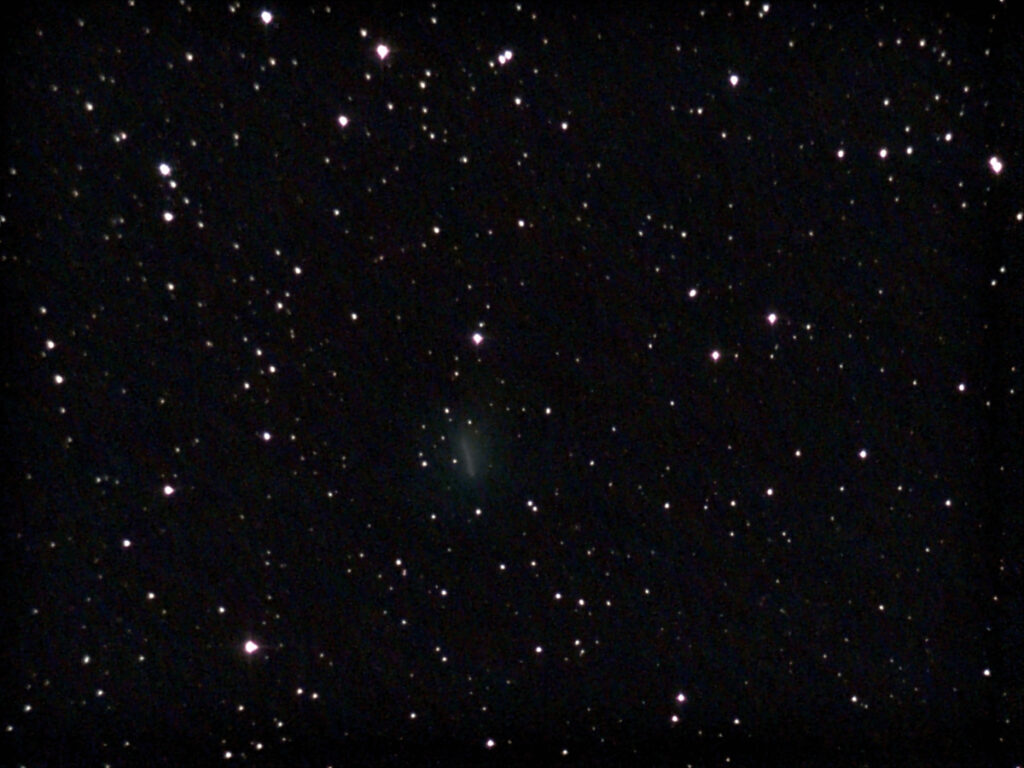
From early fall 2023 to winter 2024, Unistellar and AFA observers collected nearly 6 months of photometric measurements of Hartley 2, which measure the comet’s brightness. Despite the crowded background, these coordinated observations allowed scientists to build a detailed lightcurve — a record of how the comet’s brightness evolved over time.
By comparing the 2023 lightcurve with those from previous apparitions, researchers were able to track how Hartley 2’s activity has changed over more than three decades, since its discovery in 1986.
Hartley 2 Is Fading Fast
After considering the data from previous apparitions and accounting for the comet’s observing geometry (e.g., distance and viewing angle) in 2023, astronomers studying Hartley 2’s brightness noticed a clear and ongoing decline in its activity throughout the years. Their new paper reveals that the comet’s peak brightness is decreasing by about 0.59 ± 0.11 magnitudes each orbit — roughly a 42% drop every 6.5 years. With this information, they figure that during the 2017 apparition, Hartley 2 was technically no longer “hyperactive” by the community’s standards. The trend continued through 2023, marking over 30 years of steadily dimming.
This fading cannot be explained simply by changing geometry. Instead, the most likely explanation is volatile depletion — Hartley 2 is slowly running out of easily accessible ices. Other possibilities, such as fragmentation or a dust mantle forming on the surface, are less likely but still possible.
If Hartley 2’s brightness continues dimming each year at the same 42% rate, it could reach its “nuclear magnitude” — appearing essentially inactive —during its expected 2112 apparition. More realistically, the decline will level off as the remaining active patches become harder to deplete, meaning the comet may linger in a weakly active state much longer.