
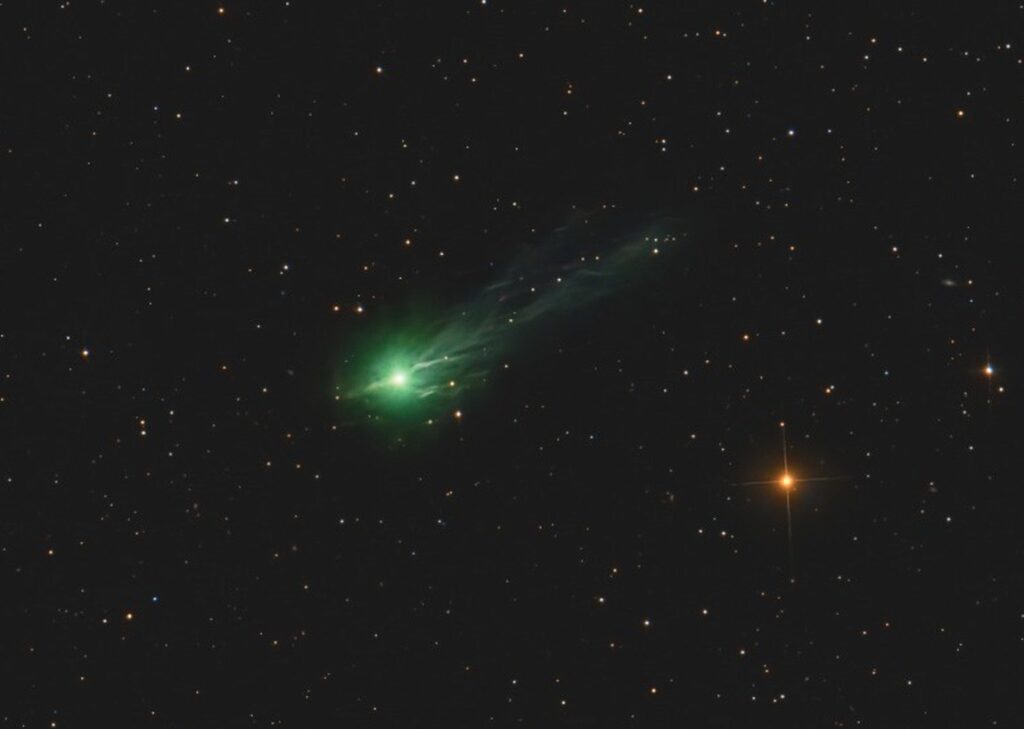
The European Space Agency (ESA) used the TGO spacecraft in Martian orbit to refine the position of interstellar comet 3I/ATLAS. This data increased the accuracy of its location forecast by a factor of 10.
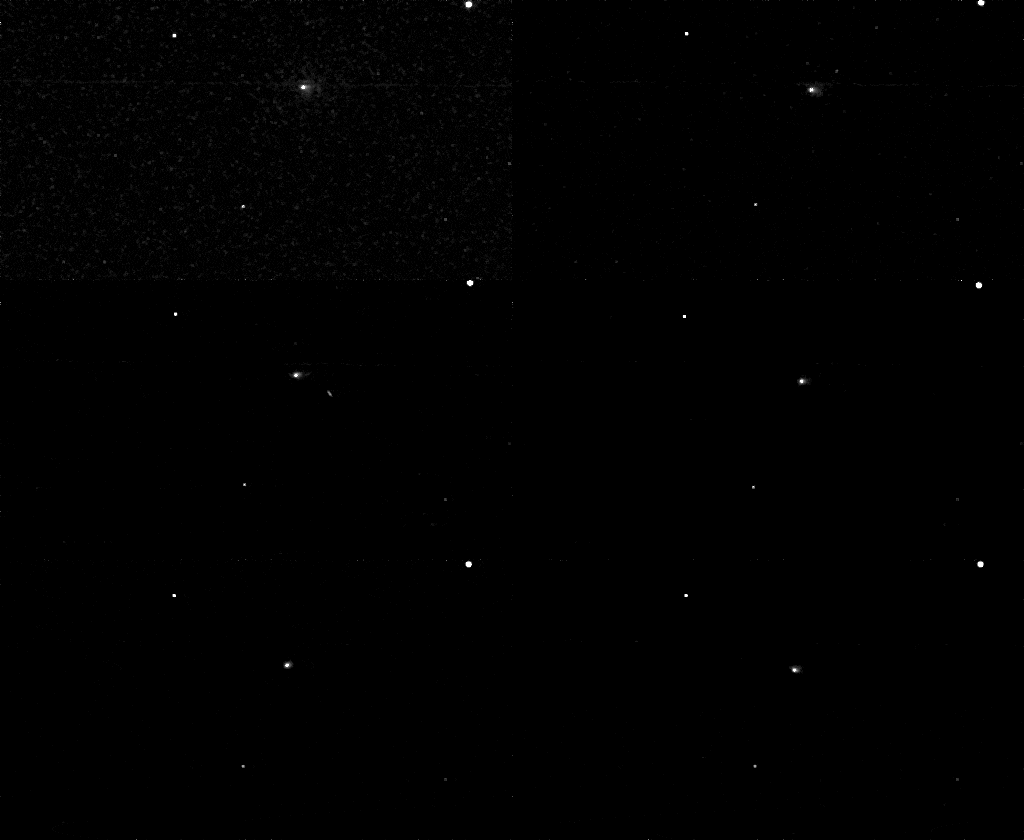 Animation of the motion of interstellar comet 3I/ATLAS compiled from images taken by the TGO spacecraft. Source: ESA/TGO/CaSSIS
In early October, comet 3I/ATLAS flew past Mars at a distance of 29 million km. Scientists from ESA decided to take advantage of this opportunity and used the TGO spacecraft orbiting the Red Planet to observe the interstellar visitor.
It was not an easy task. The TGO instruments were designed to observe the Martian surface, not a tiny object in the sky. Scientists also had to take into account the fact that the TGO is in orbit around Mars and the position of the spacecraft is constantly changing.
In total, TGO observed the comet between October 1 and October 7, 2025. Since it was surveying from a different angle than ground-based telescopes, it was possible to triangulate its data with ground-based observatories, which in turn allowed for a much more accurate prediction of the comet’s trajectory. Although scientists initially expected a slight improvement, the accuracy increased tenfold, significantly reducing the uncertainty in determining the location of the interstellar object.
According to ESA, these observations marked the first time that astrometric measurements obtained from a spacecraft orbiting another planet were formally submitted and accepted into the Minor Planet Center (MPC) database. This database serves as a central repository for data on observations of asteroids and comets, systematizing data collected by various telescopes, radar stations, and spacecraft.
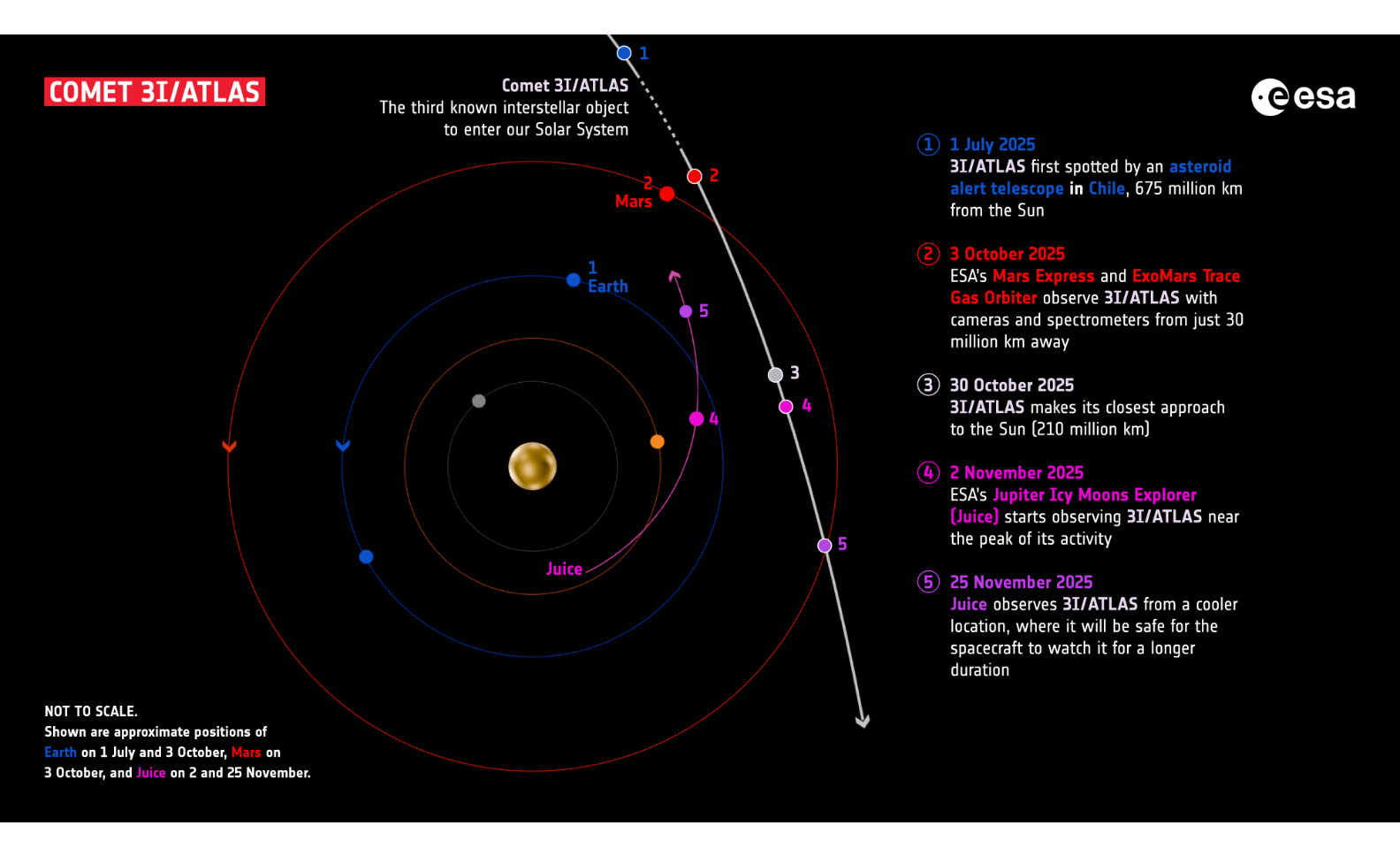 ESA observation plan for interstellar comet. Source: ESA
Although 3I/ATLAS poses no threat to Earth, the TGO observations also served as a valuable exercise for the planetary defense system. Astronomers regularly track asteroids and comets approaching our planet in order to issue warnings if necessary. As the “rehearsal” with 3I/ATLAS shows, in such cases it can be useful to compare data from Earth with observations from another location in space. Spacecraft can also be closer to asteroids or comets, which adds even more value to them.
As for the interstellar comet, the JUICE interplanetary spacecraft is currently participating in its observation. The data it collects will be transmitted to Earth in February 2026.
According to ESA