
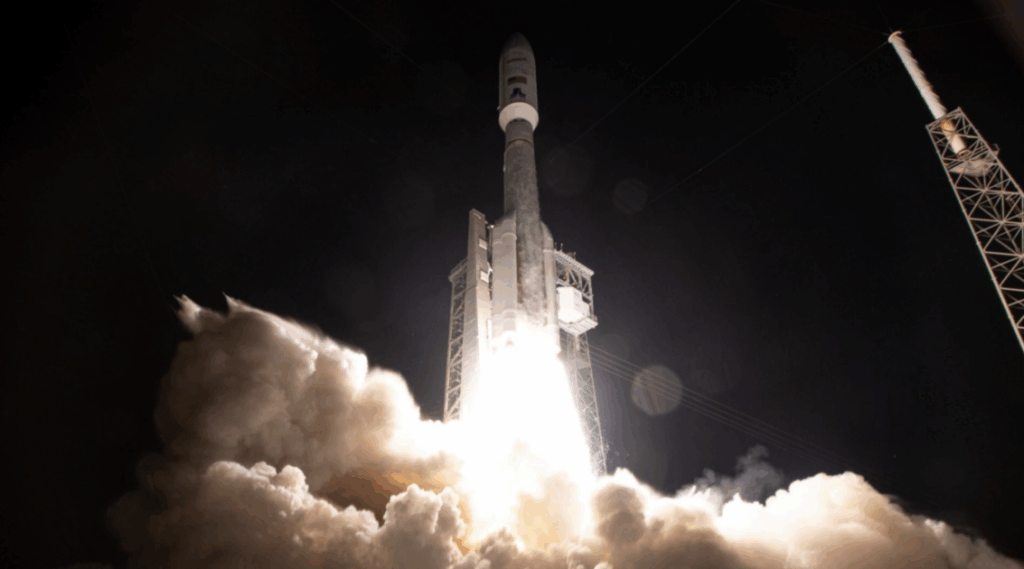
Viasat looks poised to offer faster speeds to compete with Starlink after successfully launching its new F2 satellite into orbit last night.
The next-generation F2 satellite took off from Florida on board a United Launch Alliance Atlas V551 rocket before separating from the vehicle. “The first signals were acquired shortly thereafter, confirming the satellite’s readiness for the next phase of operations,” Viasat says.
This Tweet is currently unavailable. It might be loading or has been removed.
Importantly, the company expects the F2 to enter service early next year. The satellite will serve customers in the Americas, offering download speeds of over 100+ Mbps while adding over 1Tbps of capacity to the company’s network.
The F2, which has a mass of about 6,000 kilograms (13,227 pounds), also promises to more than double Viasat’s overall network bandwidth, despite being a single satellite. It’s designed to circle the Earth at a high geostationary orbit of 22,000 miles, with the ability to beam broadband to users on the ground through “1,000+ steerable spot beams.”

(Credit: Viasat)
The F2 is crucial since Viasat’s previous attempt to upgrade its satellite constellation stumbled in 2023. The earlier F1 satellite for the Americas suffered a serious malfunction, preventing it from fully harnessing the satellite’s broadband capacity.
The F2 also arrives as Viasat has lost over half of its US customer base; it’s now down to 157,000 subscribers. In contrast, SpaceX’s Starlink has successfully grown its user base in the country to over 2 million active users, offering its satellite internet system to consumers, businesses, and government customers.
SpaceX has also become even more aggressive in offering various deals and discounts for Starlink, including a new $40-per-month plan in certain areas. However, Viasat expects the F2 to help the company attract and retain business and defense customers. This includes delivering internet to commercial airlines and maritime ships.
Recommended by Our Editors
For now, Viasat said, “In the coming days, the satellite will deploy its solar arrays and begin navigating to its final geostationary orbital location over the next several months. After reaching its final position, ViaSat-3 F2 will complete its deployments, including its reflectors, before undergoing extensive in-orbit testing and network integration, which is critical to effective operations and services.”
An F3 satellite is also slated to go up next year to serve markets in Asia. However, SpaceX is preparing to upgrade Starlink with its new fleet of V3 satellites, each of which has been designed to deliver 1Tbps of download bandwidth.
Each V3 could also weigh up to 2,000 kilograms. The company’s existing Starlink satellites currently orbit the planet in low-Earth orbit, helping to reduce latency while offering download rates that can reach as high as 400Mbps.

Get Our Best Stories!
Your Daily Dose of Our Top Tech News

Sign up for our What’s New Now newsletter to receive the latest news, best new products, and expert advice from the editors of PCMag.
Sign up for our What’s New Now newsletter to receive the latest news, best new products, and expert advice from the editors of PCMag.
By clicking Sign Me Up, you confirm you are 16+ and agree to our Terms of Use and Privacy Policy.
Thanks for signing up!
Your subscription has been confirmed. Keep an eye on your inbox!
About Our Expert

Michael Kan
Senior Reporter
Experience
I’ve been a journalist for over 15 years. I got my start as a schools and cities reporter in Kansas City and joined PCMag in 2017, where I cover satellite internet services, cybersecurity, PC hardware, and more. I’m currently based in San Francisco, but previously spent over five years in China, covering the country’s technology sector.
Since 2020, I’ve covered the launch and explosive growth of SpaceX’s Starlink satellite internet service, writing 600+ stories on availability and feature launches, but also the regulatory battles over the expansion of satellite constellations, fights with rival providers like AST SpaceMobile and Amazon, and the effort to expand into satellite-based mobile service. I’ve combed through FCC filings for the latest news and driven to remote corners of California to test Starlink’s cellular service.
I also cover cyber threats, from ransomware gangs to the emergence of AI-based malware. Earlier this year, the FTC forced Avast to pay consumers $16.5 million for secretly harvesting and selling their personal information to third-party clients, as revealed in my joint investigation with Motherboard.
I also cover the PC graphics card market. Pandemic-era shortages led me to camp out in front of a Best Buy to get an RTX 3000. I’m now following how President Trump’s tariffs will affect the industry. I’m always eager to learn more, so please jump in the comments with feedback and send me tips.