
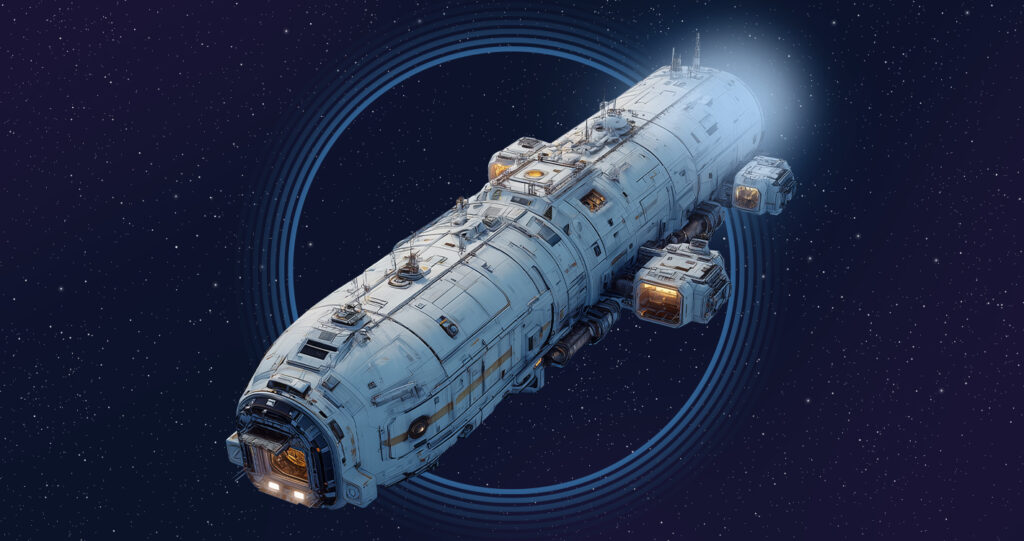
The von Neumann probe is one of the most daring concepts related to space exploration. It is a hypothetical unmanned spacecraft that can travel between stars and create copies of itself. And this idea is even crazier than it might seem.
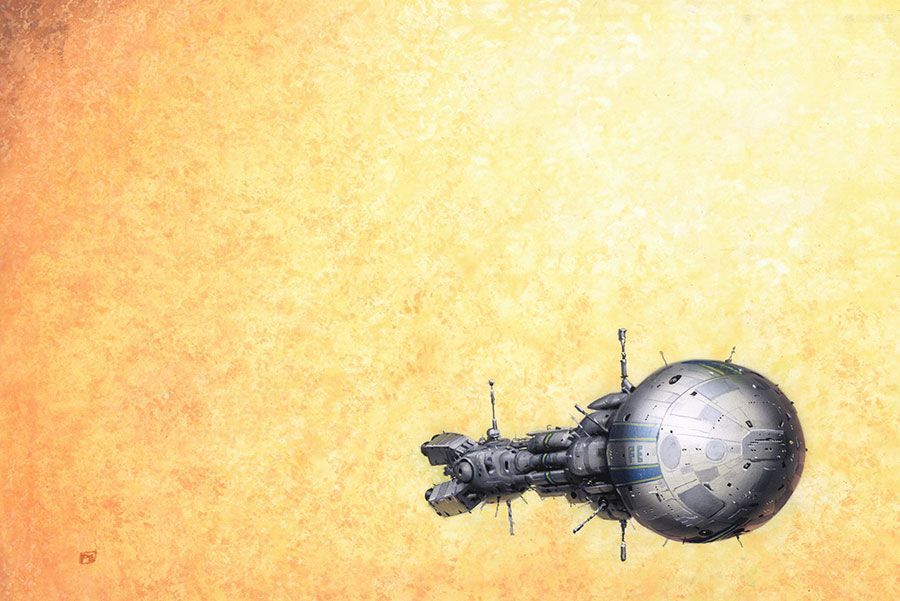 Von Neumann probe. Source: badphilosopher.com
Self-replicating machines
The arrival of interstellar comet 3I/ATLAS in the Solar System has prompted many people to recall the concept of a von Neumann probe. This is not surprising, given that any object approaching us from outer space that we have not yet been able to identify properly could potentially be one of these.
This has nothing to do with 3I/ATLAS specifically. Over the past few months, this comet has been studied many times with all possible telescopes, and we know for sure that it consists only of ice and rocks. However, it is still necessary to know what exactly to be afraid of.
The von Neumann probe is a hypothetical spacecraft designed to explore the Galaxy. It must be capable of exploring a star system, have a complete set of equipment for extracting resources in space, converting them into parts and mechanisms, and an engine capable of interstellar flight.
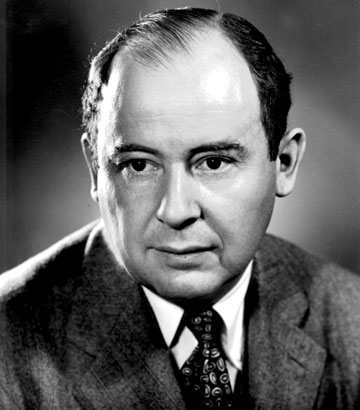 John von Neumann. Source: phys.org
The flights themselves take place at pre-light speed, meaning they take at least decades. But once it reaches a star system, the machine finds resources and begins to build copies of itself, which fly off to surrounding star systems and repeat the cycle there until they have explored the entire Milky Way.
From the title, one might think that the author of this idea is someone named von Neumann. But in fact, the Hungarian mathematician János Lajos Neumann, or John von Neumann, as he was known in the United States, never wrote anything about automatic spaceships.
He is indeed one of the authors of the very concept of computing and automation, and all our computers are built based on a scheme called “von Neumann architecture.” It was precisely this research into how complex a machine’s response to different input conditions could be that led him in 1949 to the concept of self-replicating machines.
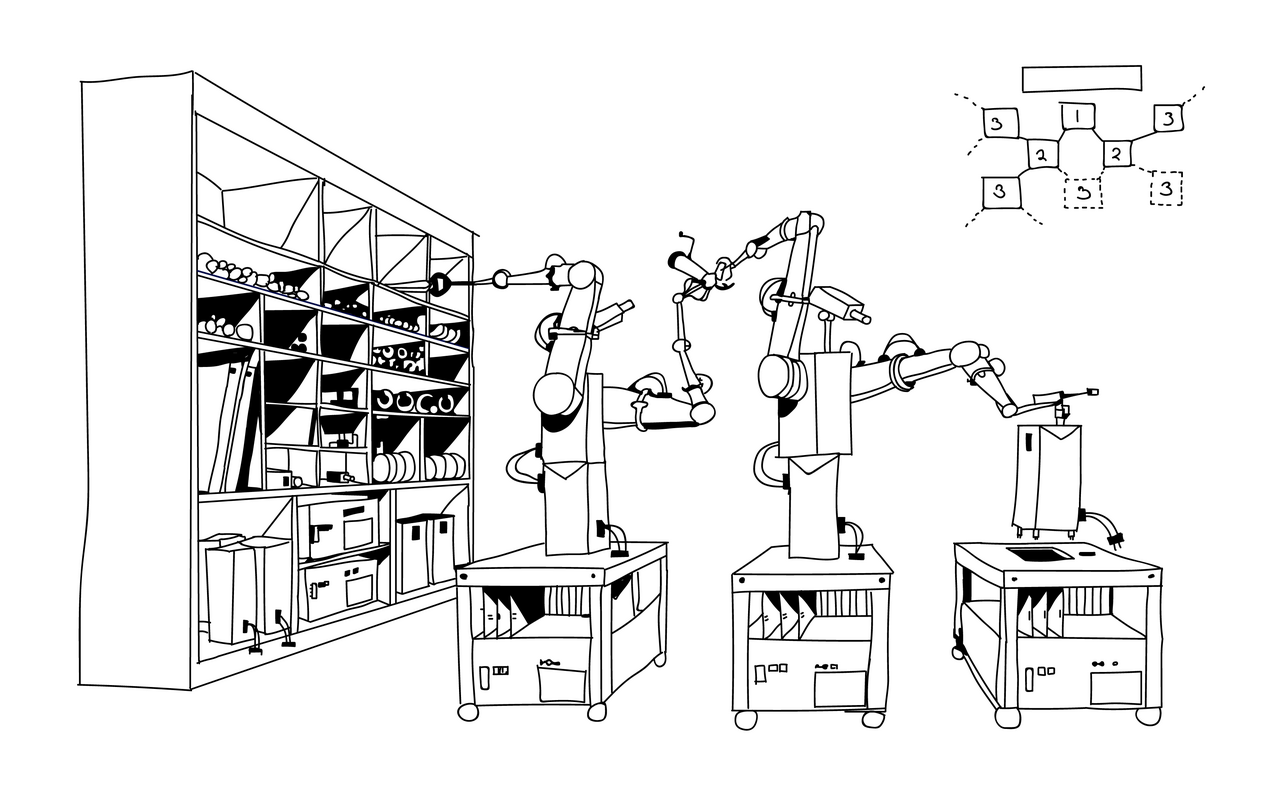 Self-replicating machines. Source: phys.org
The idea may seem revolutionary even now, but its fundamentals are quite simple. In industrial construction, machines are capable of manufacturing individual parts and assembling them, creating systems of any complexity without human involvement, provided that all processes are well thought out.
So why not create a copy of the assembly line that can make its own copies? Von Neumann’s early work focused solely on the assembly process. However, by the 1950s, it became clear that the process could be expanded to include the extraction of raw materials. In theory, copies of all this could be built according to a predetermined program.
Von Neumann probe and Fermi paradox
Von Neumann himself called such machines simply self-replicating, but as these ideas gained popularity after he died in 1957, they became known as “von Neumann machines.” It is not known for certain who first attempted to put one of them on board a spacecraft and called it a “von Neumann probe.”
The only thing that can be said with certainty is that this term was already well known among English-speaking fans of science fiction and futurology when, in 1981, American physicist Michael Hart applied this concept in his work on the Fermi paradox and the related Drake equation.
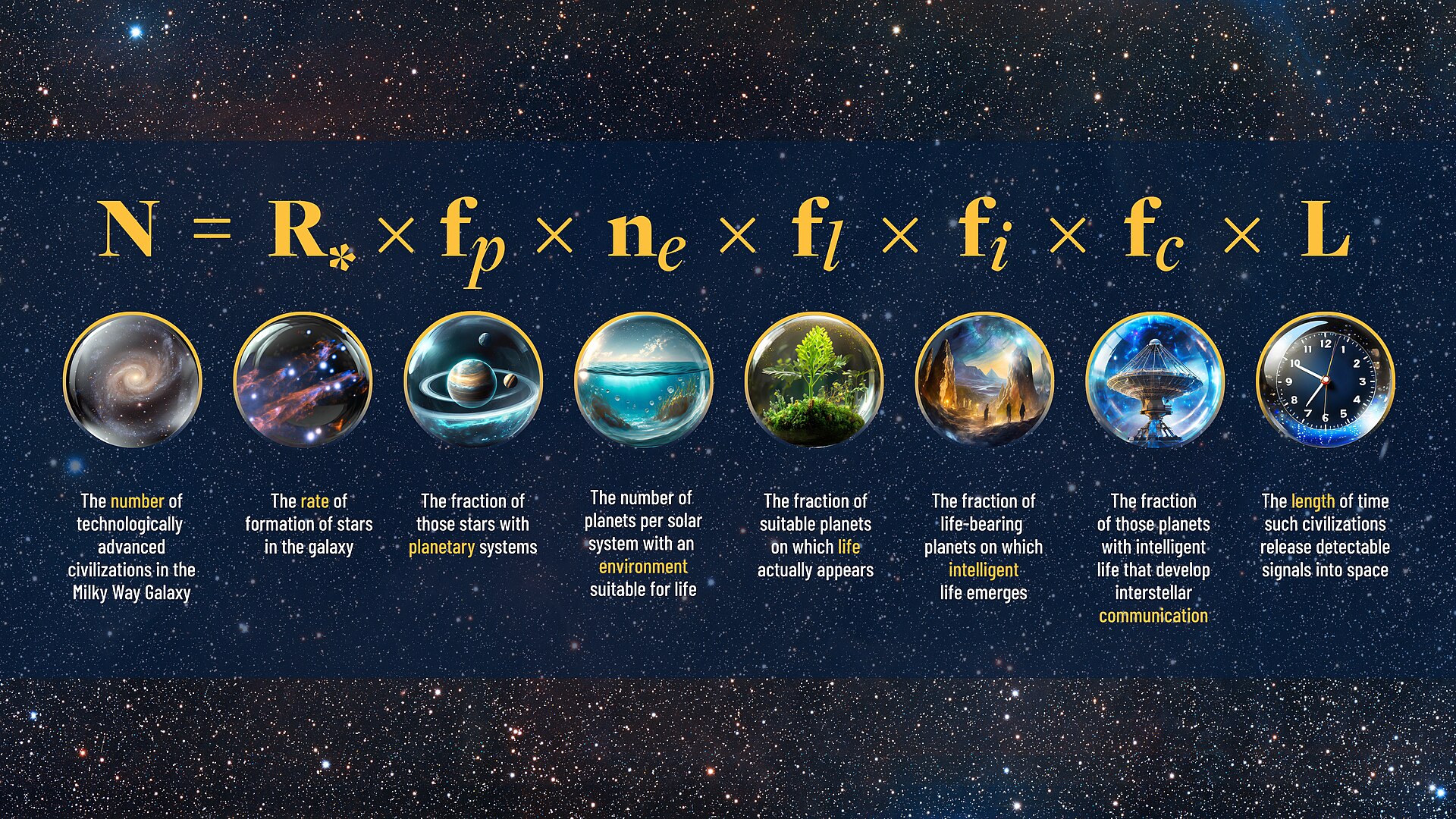 Drake equation. Source: phys.org
The Fermi paradox can be formulated as follows: if Earth is a typical planet in the universe and it gave rise to humans, then why don’t we see aliens who should have emerged on some other planet in the Milky Way? There are many approaches to solving this problem, but they all ultimately rely on unverified assumptions, so any of them could be right or wrong.
The Drake equation is a mathematical embodiment of the Fermi paradox, which, in theory, should tell us how many intelligent civilizations we should encounter while exploring the Milky Way, but in practice, it contains too many variables that are unknown to us.
However, the known data, such as the rate of star formation and the total number of stars in the Galaxy, was enough for Hart to calculate that von Neumann’s wave of probes would have to travel the Milky Way from end to end in just 640,000 light-years, meaning that if there were at least one advanced civilization other than ours, we would have already encountered its probes right here in the Solar System.
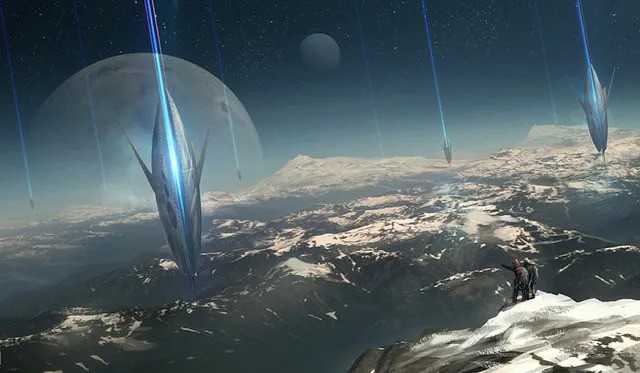 Planets could be raw materials for von Neumann probes. Source: futurism.com
And since we see nothing of the sort, the Fermi paradox is relatively easy to solve: we do not know the reason, but there are no intelligent species in the Galaxy other than us. This conclusion immediately drew criticism from renowned scientist and science popularizer Carl Sagan.
He stated that Hart was correct, but underestimated the power of self-repairing machines. If they functioned as he believed, they would have long ago not only reached the Solar System, but also dismantled Earth, us, and even their own creators and their home world for raw materials for their copies. Therefore, no truly intelligent civilization would create such machines. Consequently, the absence of von Neumann probes is not a sign of the absence of life in the Galaxy.
Since then, science and science fiction enthusiasts have repeatedly revisited Hart and Sagan’s arguments, inventing various restrictions on the replication of probes, but ultimately, it all boiled down to yet another set of theories about the Fermi paradox.
Development of the idea
The main reason why von Neumann probes are so popular is that this method of conquering the Galaxy seems to be the simplest and cheapest. Traveling faster than light is still the stuff of science fiction. To avoid a journey lasting thousands of years, the ship must be accelerated to a tenth of the speed of light. This requires an incredible amount of energy, so it is better to make it as light as possible. The payload should not exceed tens of tons.
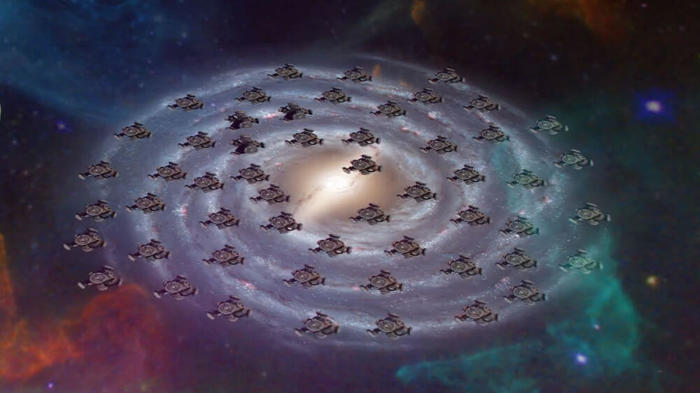 Von Neumann probes could fill the entire Galaxy. Source: x.com / joehansenxx
At the same time, the von Neumann probe itself does not necessarily have to have full-fledged artificial intelligence. However, beyond the task of “flying and copying,” other functions can be assigned to it. For example, it can simultaneously be a so-called Bracewell probe. This is another concept of an interstellar drone, whose main task is to establish contact with other civilizations.
But there could be a much worse scenario. In 1967, American science fiction writer Fred Saberhagen described a berserker – a variant of the von Neumann probe, which is armed and designed to destroy any intelligent life it encounters. It is a radical way to get rid of competitors once and for all.
There is also a concept that is radically opposed to the berserker – the seeder ship. In this case, the von Neumann probe carries biological material from its home planet or the embryos of the creatures that created it. When it reaches a world that has no biosphere or civilization, it uses its reserves to create intelligent or non-intelligent life, and only then sends out copies of itself. In this way, the Galaxy could be completely populated in a couple of million years.
There is also a lighter version of von Neumann’s probe. It is called an astro-chicken. Its author is the famous physicist Freeman Dyson, the same one who invented giant spheres. The idea is to use a very small device to explore the solar system, whose main payload will be a system for extracting resources and manufacturing parts from them. Just as a chick moves around the yard and, pecking at seeds, grows into a hen, so this device must “grow” its own equipment for movement and exploration of the planets.
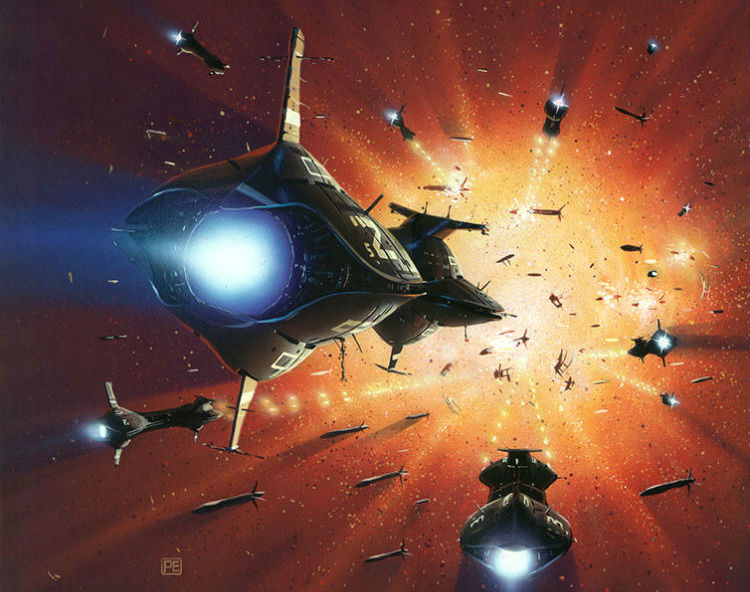 Berserkers are evil von Neumann probes. Source: badphilosopher.com
Is the von Neumann probe a form of life?
Behind all this lies a much more interesting question. We are now accustomed to thinking that if a machine is capable of performing some complex task, it must have some kind of highly intelligent control system. That is, when we think of the von Neumann probe flying to another star system, we most often imagine it with full-fledged AI.
However, Don von Neumann himself, working on the theory of self-replicating machines, thought in the opposite direction. How simple do they have to be to still retain the ability to create their own kind?
This is indeed a significant question. We are already seeing machines that have very little intelligence but are capable of effectively adapting to an extremely wide range of conditions. We are talking about biological life: RNA (including viruses), bacteria, and multicellular organisms. Human machines still cannot match them in terms of the efficiency of converting matter, in terms of the effort spent on decision-making.
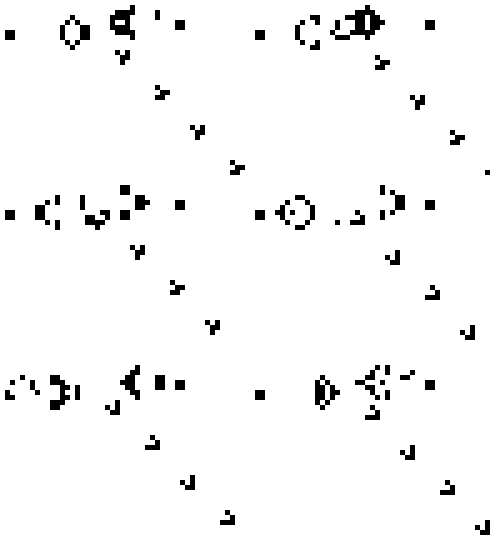 Conway’s Game of Life is governed by just three simple rules. Source: Wikipedia
A truly effective von Neumann probe is not a supercomputer in a jar, but a virus. Something like the protomolecule from James Corey’s Expanse series of novels. On the other hand, even a very cumbersome system in which a single ship cannot reproduce itself but can be rebuilt into a stationary factory already has a set of characteristics in terms of resource and energy consumption, behavior, reproduction, and information inheritance, with the possibility of changes according to the given conditions.
Altogether, this is the definition of life. It is the best we have, because even on Earth, it demonstrates an incredible variety of forms and mechanisms that are difficult to describe in more narrow terms. So, is it possible to draw a line between a self-reproducing mechanism and an organism? Especially if the former is made not of metal but of polymers.
And if von Neumann probes are equipped with artificial intelligence, will they be able to build their own civilization? Will it be a mind alien to us, or a continuation of our own? What will happen if machines created by two completely different biological species meet somewhere? Will they find more in common than their creators would have found?
There are no answers to all these questions. But searching for them is extremely interesting.