
At the kind of Los Angeles conference where big business rubs shoulders with the high and mighty of Hollywood, the astrophysicist Avi Loeb was star-spotting. Then Margot Robbie approached. “Are you Avi Loeb?” she asked. “I really wanted to hear your talk, but I have to go to a wedding, and so I might miss you speak. Can you tell me what you’re doing?”
As Loeb recalled, he spoke with Robbie for 20 minutes, briefing her on a theory of his that is all the rage in Hollywood but has sparked a fierce backlash within the scientific community. Essentially Loeb, who founded Harvard’s Black Hole Initiative and once chaired the Ivy League university’s astronomy department, has an unusual take on 3I/Atlas, only the third piece of interstellar rock we have ever seen visit our solar system. It is either a very large, very unusual icy rock — or an intergalactic alien spacecraft, Loeb said.
After Robbie had been and gone, along came another actor, this time Adrian Brody, who told Loeb he was an admirer of his and had always wanted to be a scientist. Then there was Jerry Bruckheimer, Hollywood producer royalty. “A day after I appeared on Joe Rogan,” Loeb, 63, told The Times this week, “I was invited to a Nascar car race where one of the racers put my image on the hood of his car.”

Loeb said that 3I/Atlas had anomalies and that he hoped it was better than a rock
ANIBEL MARTEL/ANADOLU/GETTY IMAGES

Margot Robbie is one of the celebrities to have taken an interest in Loeb’s work
PHILLIP FARAONE/GETTY IMAGES/VANITY FAIR
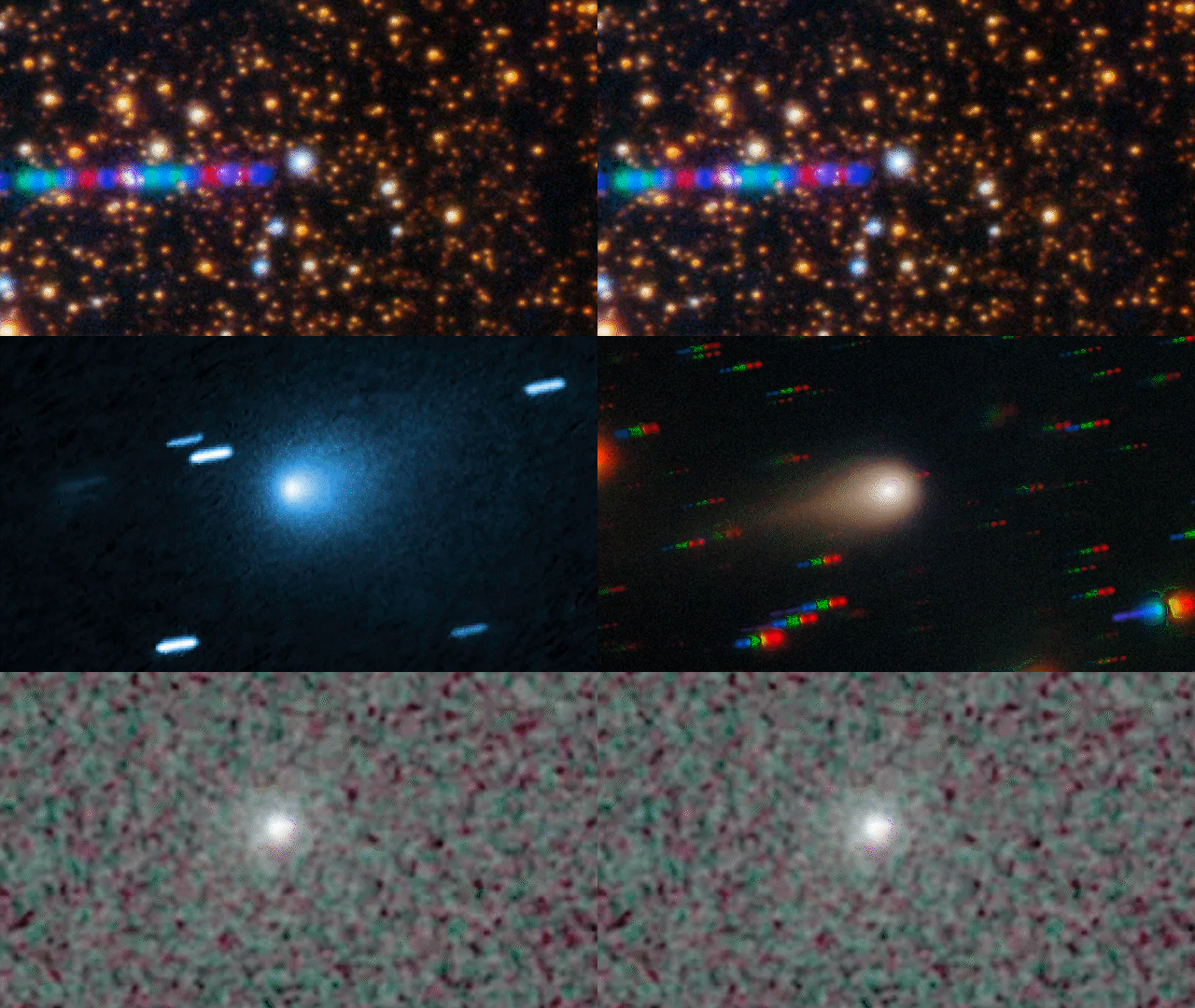
The reason for all the fuss is about the size of a city, 5km wide, and currently making its way across our solar system. While most astronomers believe 3I/Atlas is a very large comet, Loeb has a different theory. For him, there are some anomalies that make it unusual and strange. He said: “My point is, we don’t know for sure what its nature is. And, you know, it’s either a very unusual rock, an icy rock that we’ve never seen before, a different type than the comets we find in the solar system, or it could be a technological artefact or spacecraft.”
He said that there was between a 30 and 40 per cent chance that the comet had alien origins, arguing that it had unusual characteristics. Loeb pointed to what he describes as “non-gravitational acceleration” and appearing “bluer than the Sun” when it was seen by telescopes passing close by Mars. “If we see, for example, that the object broke down into pieces, or we see that the properties of the jets are natural … they are similar to what we expect from cometary evaporation, then it’s a natural comet, and that’s it,” he conceded. “However, if we see that the jets have properties that are unusual for a natural comet and resemble what we might expect for a technological thruster … then that will become very interesting.”
Many expected 3I/Atlas to break up near the sun on Thursday this week, and we will know more, according to Loeb, when it comes close to Earth, a relatively modest 170 million miles, just before Christmas. “I’m trying to figure out what this object is, and I’m willing to entertain more than one possibility,” he said. “There is nothing wrong with that. The idea is that eventually we will have enough data in the coming weeks, because it gets closer to Earth — on December 19 — by then, we will have so much data about it that we might have no doubt about the nature of the object.”
Loeb’s detractors include Professor Brian Cox, the stargazing physicist and BBC presenter. Cox says that although the comet is remarkable — not least for having survived for seven and a half billion years and being a relic of a time before Earth’s existence — Loeb’s theory is little more than “drivel”. Loeb, meanwhile, says Cox is a commentator who no longer practices science but has made a profession “talking about what other people are doing” but not “doing the work”.

Professor Brian Cox
SAMIR HUSSEIN/GETTY IMAGES
That work hit the headlines this month when none other than Kim Kardashian took up Loeb’s investigations. “Wait … what’s the tea on 3I/Atlas?” the reality television wrote to Sean Duffy, the acting administrator of Nasa, on X. That came after Kardashian questioned the authenticity of the moon landing. “Great question!” replied Duffy, thanking her for her “excitement”. He said that Nasa’s observations showed “that this is the third interstellar comet to pass through our solar system. No aliens. No threat to life here on Earth.”
Despite all evidence suggesting an alien invasion is unlikely, 3I/Atlas continues to attract speculation, particularly among conspiracy theorists such as Rogan. When the US shutdown of the federal government coincided with Nasa’s apparent inability to publish any of its data on 3I/Atlas, the mob cried foul. “I tried to ask for images that were taken by the high-rise camera on board the Mars Reconnaissance Orbiter when 3I/Atlas came closest to Mars on October 3 and representative Anna Paulina Luna also wrote a letter to Sean Duffy,” Loeb said. “But she didn’t get any response to that public request. Kim Kardashian is so excited about this object, she’s welcome to join my research team.”

Kim Kardashian — the door is open for a career in astrophysics
SPLASH NEWS
Loeb has since requested that Nasa releases the data that was “held hostage by politics for 40 days”.
He acknowledged that the furore around the giant rock has piqued interest in space, receiving fan mail from celebrities to children to his dishwasher repair man. He said that such unprecedented public interest should be utilised to invest more in space research. “We hope to collect data on millions of objects in the sky and figure out with the machine learning artificial intelligence, whether any of them might be extra-terrestrial, technological objects,” Loeb said of his newest venture, a state-of-the art Galileo Project observatory on top of the Sphere, an immersive entertainment venue in Las Vegas, which cost $2.3 billion dollars. He is hedging his bets that extra-terrestrial life will be found within the next five years, and hopes to collect data on the plethora of objects in the sky.
Loeb is an Israel-born academic who sits as a visiting professor at the Weizmann Institute, which was badly hit in the June war between Iran and Israel. He said that he was proud of his roots and recognises Jewish teachings which float the notion of aliens and the multiverse. “This would be the biggest discovery in the history of humanity, to find that we are not alone in the universe, because right now, we are viewing the universe as a lonely, cold place made of material objects like matter, radiation, stars, galaxies,” he said. “But if we realise that we have siblings out there, we will have some emotional connection to the universe that we didn’t have before.
“It’s like going on a blind date. You don’t know what’s on the other side — if it ends up being a rock, so be it. But I hope it’s something better than a rock.”