
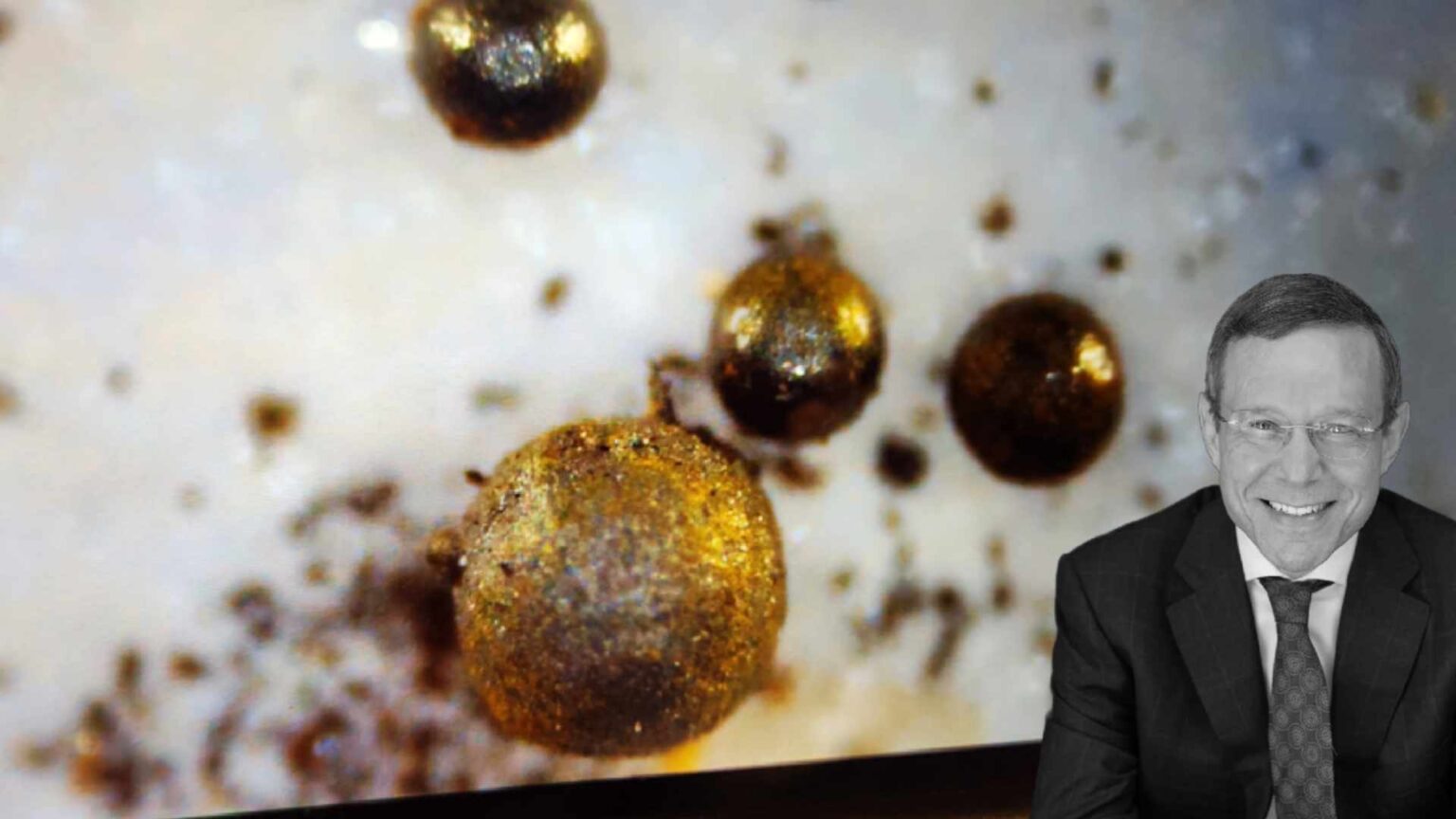
Amid the 3I/ATLAS buzz, the third-ever interstellar object to traverse the confines of Solar System, since 1I/Oumuamua (Oct 19, 2017) and 2I/Borisov (Aug 29, 2025), the first-ever interstellar meteor to strike Earth in 2014 has largely faded from public memory.
Detected on January 8, 2014, CNEOS 2014-01-08 aka IM1 crashed near the northeast coast of Papua New Guinea in the Pacific ocean, The meteor was claimed to be an interstellar object by the Harvard Astrophysicist Avi Loeb in 2019, which was also confirmed by the US Space Command in 2022 at 99.999% confidence.
In his blog dated July 3, 2023, Loeb details how his Project Galileo retrieved spherules of the meteorite. After the X-Ray Fluorescence analysis of the spherule, it depicted “84% iron, 8% silicon, 4% magnesium and 2% titanium, plus trace elements.”
In his recent blog, discussing the anomalous 3I/ATLAS, Prof. Loeb made a remark about the 1IM. He noted
We have published half a dozen papers on the findings from the expedition in peer-reviewed journals. We identified a new material with a chemical composition that was never identified in the solar system before. A Netflix documentary about the expedition is scheduled to appear in 2026, where everyone can enjoy our scientific process of discovery. I still have a scar on my leg from an injury on the deck of the expedition ship “Silver Star.”
In a previous blog, dated July 18, 2024, Professor Avi Loeb elaborated
Among the differentiated spherules, about half, namely 10% of the total number of spherules, had a chemical composition that was never reported before in the scientific literature, characterized by an enhanced abundance of some elements up to a thousand times larger than the standard solar composition. We labeled this special set: “BeLaU”-type spherules. The BeLaU composition is unfamiliar and different from the composition of the crust of the Earth, Mars, the Moon, asteroids and comets and potentially flags an origin from outside the solar system. This origin could be natural or artificial.
Despite Avi Loeb’s claim, other astronomers doubt the interstellar origin of the meteor.