
Agency
30/09/2025
553 views
8 likes
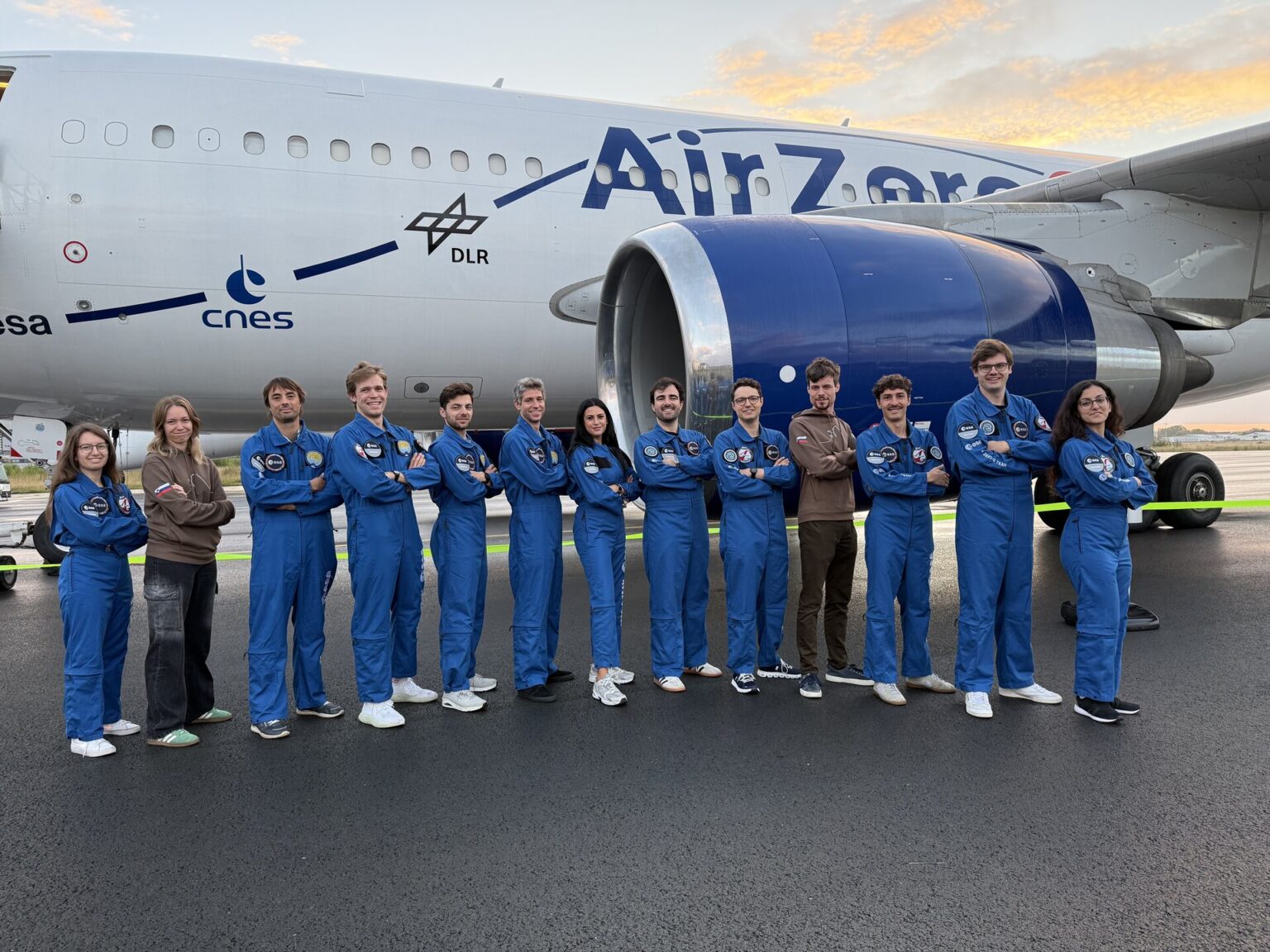
As part of the ESA Academy Experiments programme, the Slovenian team CAVE 0g and the German team MVIPER successfully completed their experiments during the 87th ESA parabolic flight campaign in September 2025. Flying aboard Novespace’s Airbus A310 from Bordeaux-Mérignac Airport, the teams tested innovative technologies designed for microgravity. CAVE 0g explored how ultrasonic cavitation drives the formation and stability of emulsions in microgravity, while MVIPER tested a magnet- and electricity-driven photobioreactor that creates a vortex to separate gas and liquid in microgravity.
A two-week flight campaign
The campaign spanned two weeks, from 1 to 12 September 2025. In the first week, both teams focused on assembling and integrating their experiments into the racks and conducting comprehensive functional tests to confirm that each setup could perform the operations required to achieve the scientific objectives.
By the end of the first week, after overcoming initial technical challenges, both teams passed the Flight Acceptance Review conducted by Novespace — a critical milestone to ensure the experiments’ safety on board the aircraft. Then, the second week offered 3 flights, each with 31 parabolas. Before the flights, the teams rehearsed their procedures on board while the aircraft was on the ground, then successfully carried them out in flight, collecting promising preliminary data.
CAVE 0g explored emulsions in microgravity
The Cavitation Emulsification in Zero Gravity (CAVE 0g) project investigated how emulsions form under microgravity using ultrasonic cavitation — a process well studied on Earth but not in space. The experiment, flown on the Air Zero-G platform, combined fluid handling, high-frequency actuation, and high-speed imaging to explore how the absence of gravity affects emulsion behaviour and stability.
This project deepens our fundamental understanding of fluid dynamics in space and lays the groundwork for future studies on emulsification in space-based environments, paving the way for potential applications in space manufacturing, medicine, and life-support systems.
MVIPER tested an innovative concept for space life support
The Magnetohydrodynamic Vortex-Inducing Photobioreactor Experiment (MVIPER) tested a novel photobioreactor concept that uses electricity and magnets to move liquid in a circular flow, creating a vortex that separates gas from liquid without any moving parts.
The team goal was to demonstrate that this process works in microgravity during a parabolic flight, supporting the development of future systems for growing algae as part of space life-support solutions.
What’s next?
All flights ran smoothly, enabling both teams to gather the necessary results. After the final flight, the experiments were removed from the aircraft, and the teams returned to their universities to begin data analysis and prepare future scientific publications.
Like