
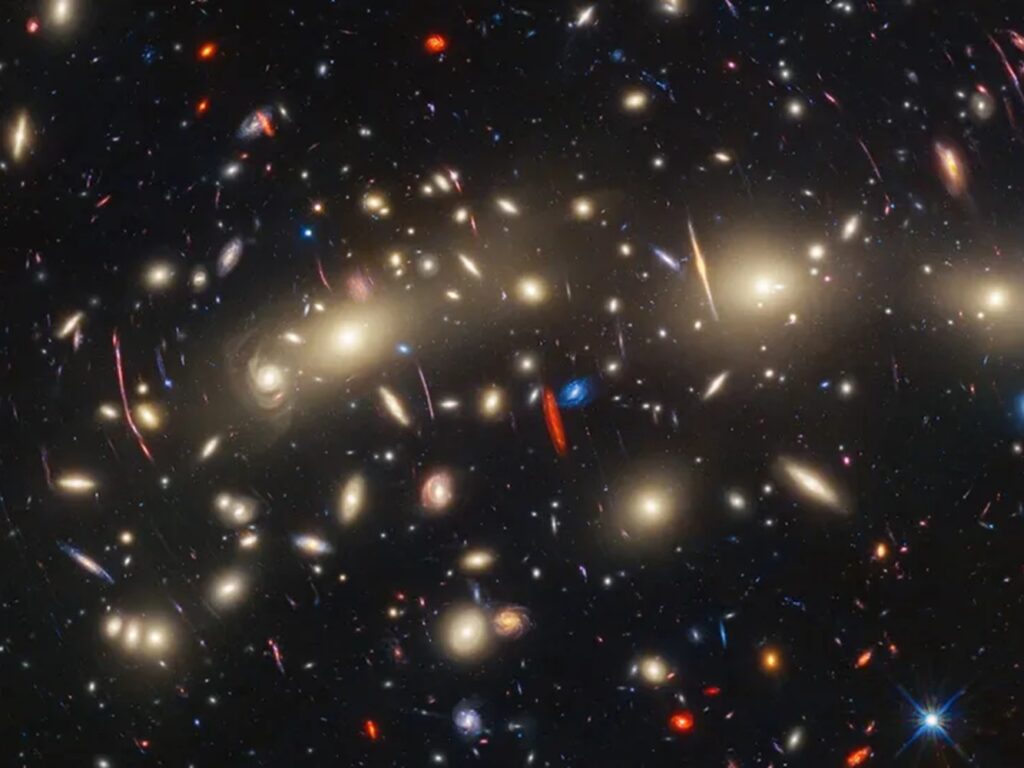
We may have had a glimpse of the first group of stars formed by the universe, thanks to the James Webb Space Telescope (JWST). Astronomers using the telescope spotted the cluster of stars known as LAP1-B, which is very distant, about 13 billion light-years away.
As reported in The Astrophysical Journal Letters, cluster LAP1-B shows signs of matching the expected characteristics of Population III, the appellation given to objects theorized to have formed from the primordial hydrogen and helium mixture of the ‘juvenile’ universe shortly after the Big Bang about 13.8 billion years ago.
A cosmic time capsule from 13 billion years ago
Population III stars are sometimes called dark stars. Scientists propose that they make the sun appear like a speck of dust, being up to thousands of times heavier and millions of times brighter, each. They would have appeared even before heavier elements existed.
According to Eli Visbal, lead author of the research, the LAP1-B cluster’s spectra showed strong emission lines of high-energy photons, a telltale sign of Population III. The astronomers also suggest that LAP1-B stars are about 100 times the weight of the sun, consistent with long-standing theoretical predictions.
Einstein’s theory brings the ancient universe into view
Meanwhile, the discovery would not have been possible without Albert Einstein’s work. The famous genius postulated the phenomenon of gravitational lensing, which states that massive objects bend light, acting like huge cosmic magnifying glasses.
In this case, a galaxy cluster named MACS J0416 bent and magnified LAP1-B’s light, throwing it into JWST’s path.
A new window into how galaxies formed
The scientists have noted that LAP1-B appears to satisfy each of the three conditions to be identified as Population III stars:
Being formed in a low-metallicity hydrogen-helium environmentPossessing a low-mass cluster harbouring a few massive starsMatch the expected initial mass function or the distribution of masses of stars at the time the cluster formed
More analysis is required, but if the initial findings are validated, LAP1-B would be the first confirmed detection of primordial stars. The discovery will expand our knowledge of how galaxies formed from ancient dark matter structures.
 David Odejide – Tech Writer – 343 articles published on Notebookcheck since 2024
I am a writer and software developer with a background in Mechanical Engineering and a distinction MSc in Environmental Management (Energy). My career spans fullstack development (building desktop, web, and Android apps for enterprise clients), Content Strategist/Business Developer in the solar industry, and writing research-driven articles on electric vehicles, renewable energy, and consumer tech.
I previously ran WindowsFoneFans (remember when Windows phones were a thing?) as a social media hub for Windows phone enthusiasts. My work includes hundreds of video scripts on EVs and sustainability, with over 100 million views on YouTube. I also write about chipsets, mobile hardware, and emerging IT trends, drawing on years of hands-on development experience.
Whether it is decoding Snapdragon nodes or analyzing offshore wind policy, I aim to deliver content that is both technically sound and widely accessible. In my spare time, I manage one of the largest LinkedIn groups for wind energy professionals and enjoy getting lost in Scotland’s natural beauty.