
Enabling & Support
26/05/2025
2264 views
23 likes
2025 marks a landmark year for Europe’s ‘bridge between Earth and space’. The European Space Agency’s Estrack satellite tracking network turns 50 – and with it, its deep space antenna in Cebreros, Spain, celebrates 20 years of connecting Earth to the agency’s most distant missions.
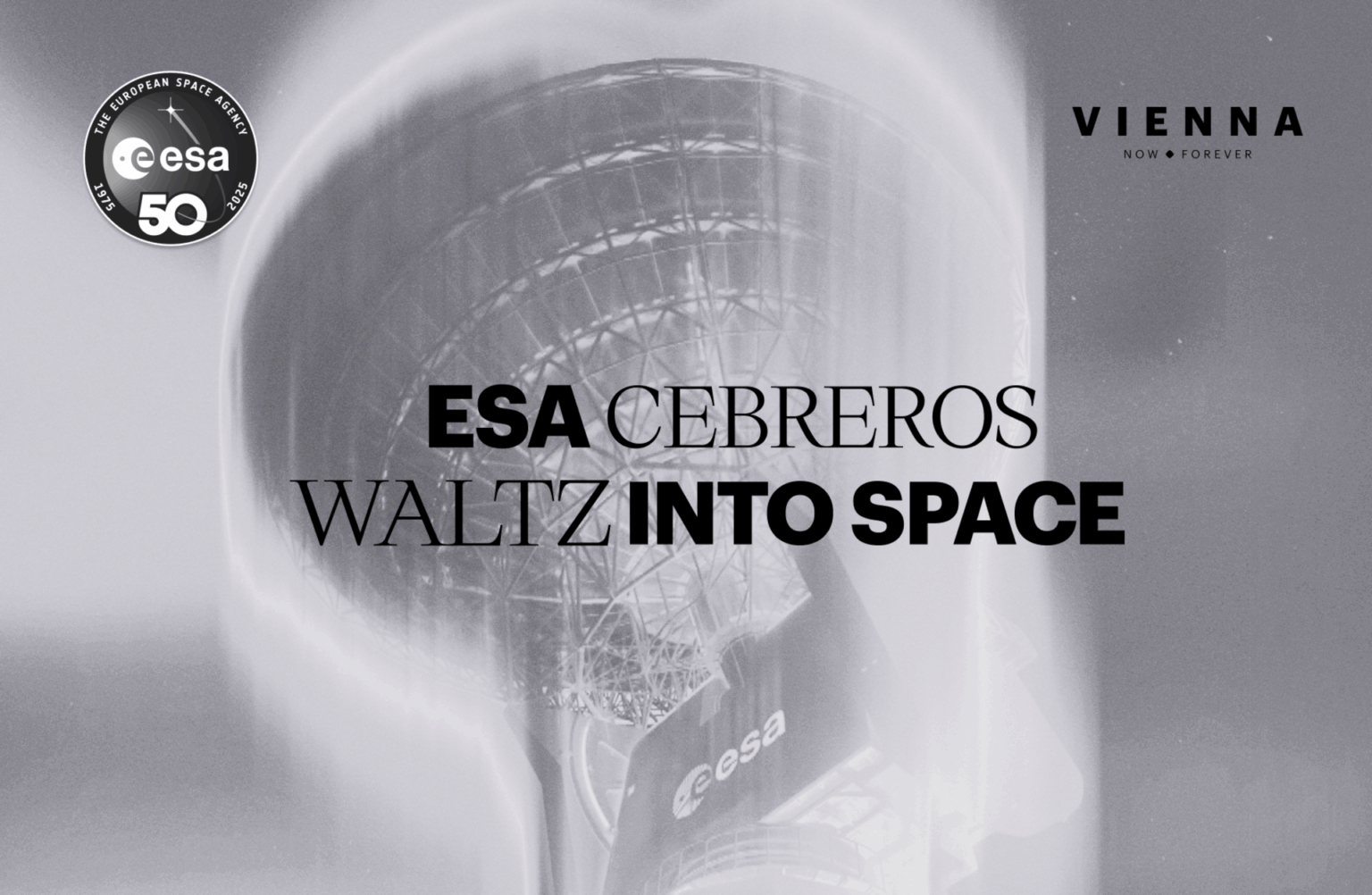
Fittingly, this celebration of technological excellence coincides with the 200th birthday of Johann Strauss II and the 50th anniversary of the ESA. To honour this convergence of milestones, ESA and the Vienna Tourist Board are orchestrating a unique mission: broadcasting The Blue Danube Waltz to its destined home among the stars.
Don’t miss the live concert of the Wiener Symphoniker (Vienna Symphony Orchestra) on Saturday, 31 May. The event will start at 20:30 CEST and the transmission from ESA’s Cebreros antenna will occur at 21:30 CEST. The live stream can be followed via space.wien.info and the Vienna Instagram channel.
Since its inception in 1975, Estrack – ESA’s global network of ground stations – has formed the vital communication bridge between satellites in orbit and mission control at the European Space Operations Centre (ESOC) in Darmstadt, Germany.
Now comprising six stations spanning six countries, Estrack has grown into a strategic asset for Europe, enabling communication with spacecraft, transmitting commands and receiving scientific data.
The network keeps an eye on satellites no matter their location: tracking them across Earth orbit, voyaging to comets or asteroids, keeping station at the scientifically important Sun-Earth Lagrange points, and deep into our Solar System. It even keeps tabs on European launchers as they soar into orbit, ensuring no rocket is ever out of reach.
Celebrating in music
Estrack’s journey began in Spain, and it is in Spain that this milestone will be celebrated. In 1975, the network’s first antenna was established in Villafranca, just outside Madrid, where the European Space Astronomy Centre (ESAC) now stands. Three decades later, in 2005, the deep space antenna in Cebreros, just a few dozen kilometres aways, joined the family – a massive 35-metre diameter dish built to listen to the missions travelling anywhere beyond the Moon.
Now, 50 years after the start of Estrack and 20 years after the inauguration of the Cebreros antenna, this double anniversary is being celebrated in style. It will be a quadruple anniversary in fact, as this year mark the 200th anniversary of the birth of composer Johann Strauss II together with the 50th anniversary of ESA.
ESA has joined forces with the Vienna Tourist Board to compose a unique event combining music, art and science.
A timelapse image makes our deep-space dish in Spain seem to spin
On Saturday, 31 May, the Cebreros station will make history by transmitting a concert performance of The Blue Danube Waltz into deep space – a gesture that symbolically places this ‘anthem of space’ among the stars, alongside the Golden Record on NASA’s Voyager.
Celebrations on Earth will echo this concert amongst the stars. A performance by the famous Vienna Symphony will be organised the MAK (Museum of Applied Arts) in Vienna, with public screening in Madrid, New York and Vienna. Moreover the 15-minutes live stream of the transmission of The Blue Danube Waltz into deep space can be watched on space.wien.info and the Vienna Instagram channel.
A parallel, special event at ESA’s Cebreros station – including media, ESA experts, dignitaries, and international partners – will mark the moment with pride with guest speakers Carole Mundell, ESA’s Director of Science, Simon Plum, ESA Head of the Mission Operations Department, and Enno Drofenik, Ambassador of the Republic of Austria to Spain.
“We are delighted that Cebreros station can support this artistic project using spare capacity to transmit a signal to the Universe,” said Octave Procope-Mamert, responsible for ground infrastructure for spacecraft operations at ESA. “Sending a work of musical genius to the stars highlights the technical genius that we apply every day in flying and communicating with European missions discovering new knowledge throughout the Solar System.”
Estrack – Half a century of European satellite tracking
‘It is not a giant, señor, but a deep space antenna’
Estrack deep space stations infographic
Estrack’s crown jewels are its trio of deep space antennas – in Cebreros (Spain), Malargüe (Argentina), and New Norcia (Australia) – forming a global ring of stations for uninterrupted deep-space communication. These stations undergo continual upgrades to stay ahead of mission needs.
In recent years, Cebreros – as well as its two sisters – has seen major improvements: in 2023, its Ka-band cryogenic feed was updated; in 2024, its frequency and timing system was enhanced. Together, these upgrades boosted the antenna’s Ka-band data throughput by 80%, virtually expanding its diameter from 35 to 47 metres.
By the end of 2025, a fourth deep space antenna will be inaugurated at New Norcia, expanding Estrack’s global reach and preparing it to support ESA’s next wave of ambitious scientific, exploration and discovery missions.
Technical expertise at the service of European science
ESA ground stations support ISRO’s Aditya-L1 solar observatory
Estrack is more than a technical marvel – it is a pillar at the service of European science. Its antennas ensure uninterrupted links to Europe’s earth observation, science, exploration and space security missions.
Cebreros, just like the other two deep space antennas, support all ESA deep space missions, including BepiColombo, Euclid, Juice and Hera. Throughout two decades of stellar technological achievement, it has supported well-known missions such as Rosetta, Mars Express, and NASA’s Perseverance rover. In a typical month, it delivers over 500 hours of flawless spacecraft connection time.
But Estrack’s reach extends beyond Europe. Through cross-support agreements, it enables collaboration with NASA, JAXA, ISRO, and commercial partners such as ispace, ensuring that space exploration remains a global, cooperative endeavour. Updating and expanding the Estrack network helps to support upcoming ESA deep-space missions and meet the fast-growing demand for scientific data download from European scientists.
Lighting the future of space communication
ESA’s laser ranging station in Tenerife aims its green laser to the sky
While Estrack continues to grow with new antennas, new technologies could make the next leap in space communication: optical links.
Using lasers instead of radio waves, optical communication could boost data transmission by 10 to 100 times, and one day enable a ‘Solar System Internet’, which would provide interoperable and secure communication and navigation services to spacecraft traveling around the Earth and to the outer planets.
ESA lays the foundations for Europe’s role in this transformation, by developing the infrastructure and standards needed for an operational European backbone of this system and strengthening the competitiveness of European industry.
ESA’s leadership in this field is not new. A decade ago, it made history by establishing a successful laser link to NASA’s LADEE mission around the Moon, and, since 2022, the Agency’s Izaña-1 laser station has served as a crucial testbed for advanced optical technologies. This year, ESA will reach a new milestone by demonstrating optical deep-space communication with NASA’s Psyche mission, at over 300 million km from Earth.
Will Estrack – Europe’s bridge between Earth and space – become a bridge of light? One thing is certain: Estrack’s future is bright and it’s travelling at the speed of light.
Like