
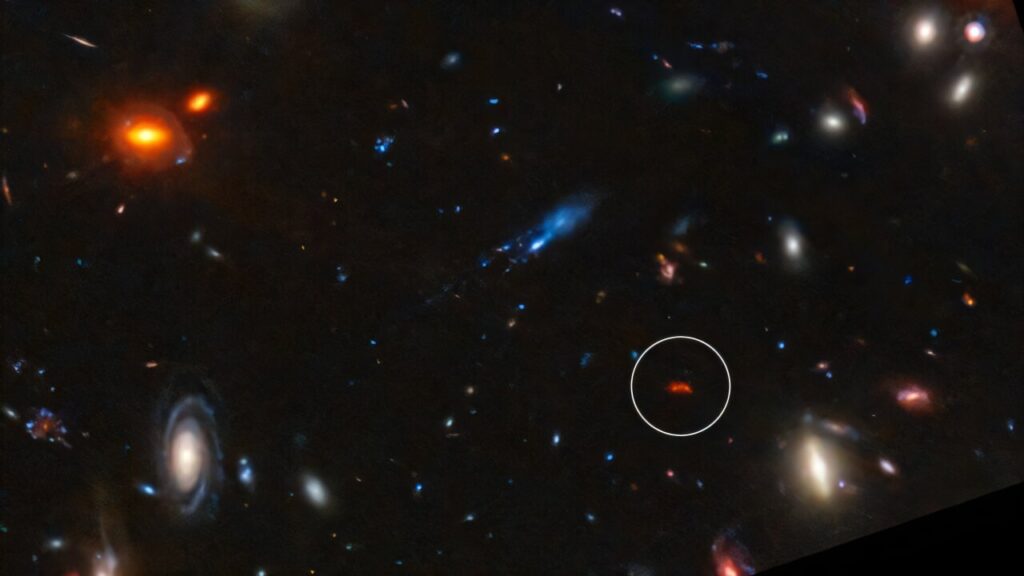
An international group of astronomers has reported the discovery of a previously unknown extreme type of star formation in a distant galaxy. It glows intensely in superheated cosmic dust, forming stars 180 times faster than our Milky Way. This discovery demonstrates how galaxies could grow rapidly when the Universe was very young, solving a long-standing puzzle for astronomers.
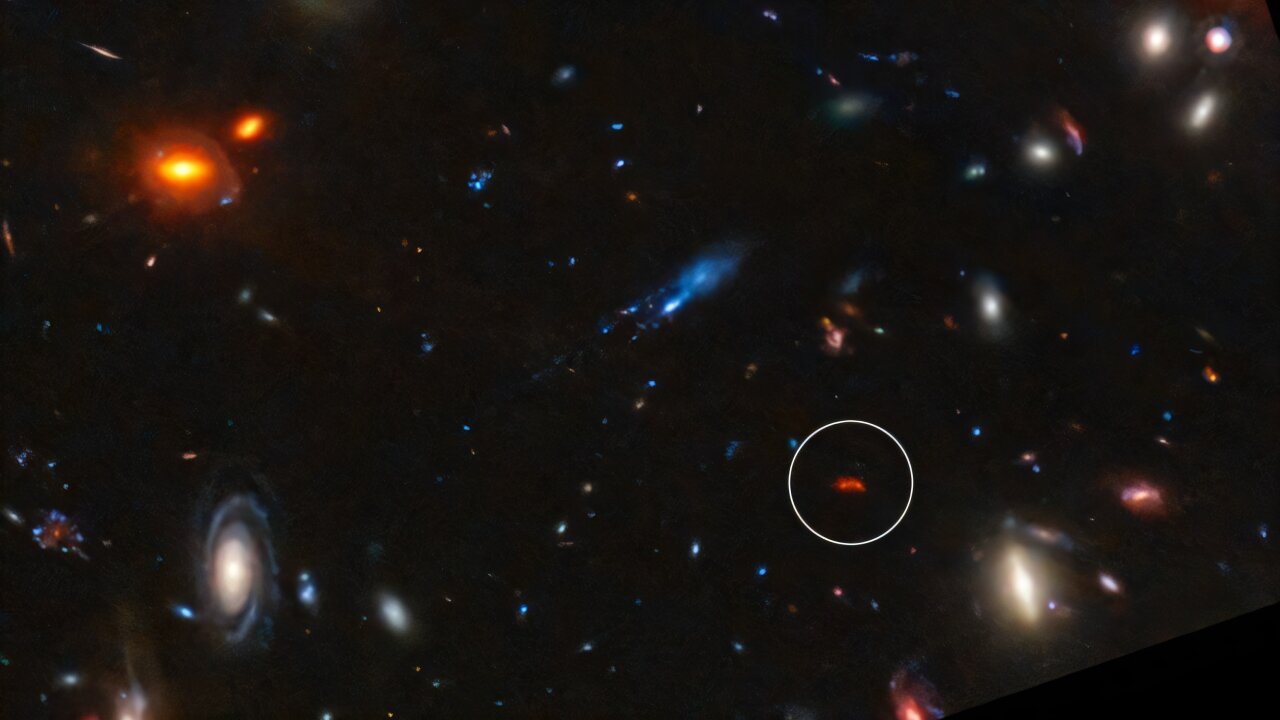 Galaxy Y1 in a photograph taken by the James Webb Space Telescope. Source: NASA, ESA, CSA, STScI, J. Diego (Institute of Physics of Cantabria, Spain), J. D’Silva (University of Western Australia), A. Koekemoer (STScI), J. Summers & R. Windhorst (ASU), and H. Yan (University of Missouri)
The first generations of stars formed under conditions very different from those we see today in the nearby Universe. Scientists study these differences using powerful telescopes capable of detecting galaxies that formed shortly after the Big Bang.
An international team of astronomers has measured the temperature of one of the most distant star-forming galaxies known, called Y1. It is so far away that the light it emitted took over 13 billion years to reach Earth.
Previous observations have revealed the presence of dust in this galaxy, making it the most distant of all those where astronomers have ever directly detected glowing dust. This led them to suspect that another, superheated type of star formation might exist there. To verify this, it was decided to measure its temperature using the ALMA radio telescope complex.
ALMA managed to accomplish this task by obtaining an image of the galaxy at a wavelength of 0.44 mm. It turned out that the dust in Y1 glows at a temperature of about -180 degrees Celsius. By everyday standards, this is certainly very low, but this figure is much higher than in any other comparable galaxy that astronomers have previously observed.
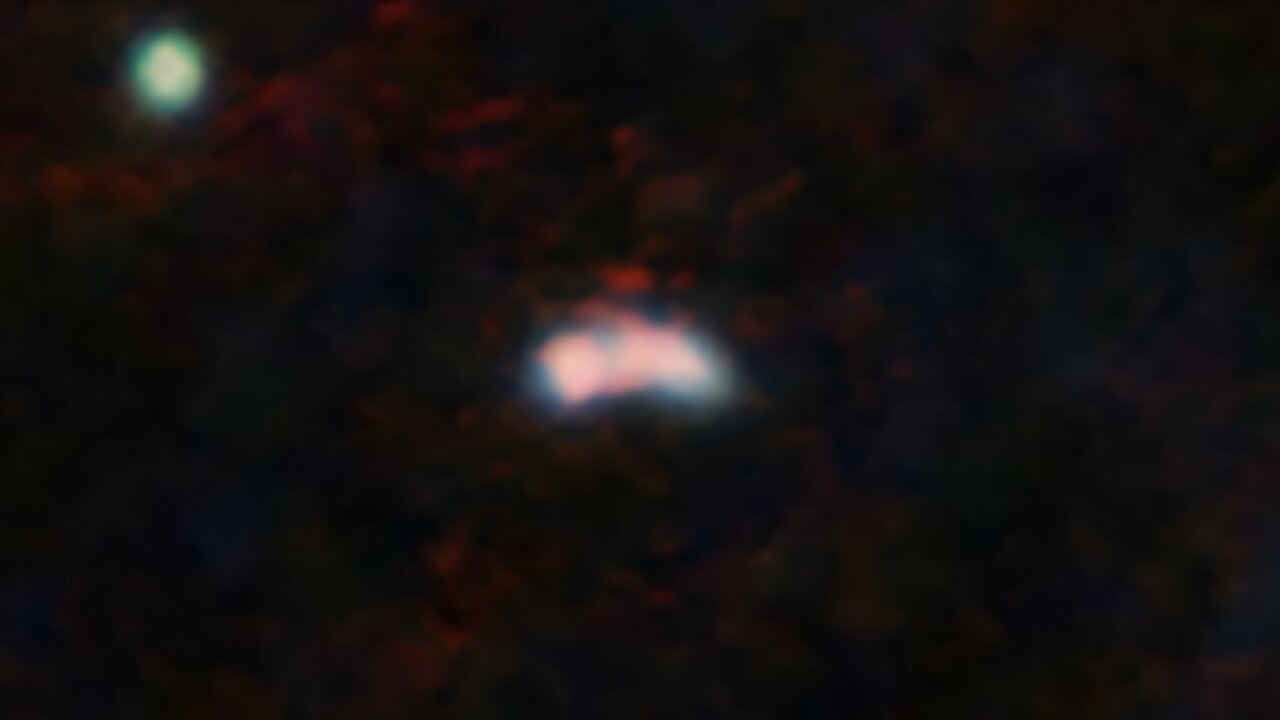 Galaxy Y1 and its surroundings. This is a composite image obtained by the James Webb and ALMA telescopes. Source: NASA, ESA, CSA (JWST), T. Bakx/ALMA (ESO/NRAO/NAOJ)
This confirms that Y1 is indeed an extreme star-forming factory. While our Milky Way creates on average one star with the mass of the Sun per year, during that era Y1 produced stars at an extreme rate of more than 180 solar masses per year.
Scientists suggest that short-lived, hidden bursts of star formation, such as those observed in Y1, may have been a common phenomenon in the early Universe. They plan to continue their observations to find more examples of such star factories.
Y1 may also help solve another cosmic mystery. Previous studies have shown that galaxies in the early Universe appear to contain much more dust than their stars could have produced in their short lifetime. Astronomers were puzzled by this, but the unusual temperature of Y1 points to a solution. A small amount of warm dust can be as bright as a large amount of cold dust, as observed in Y1.
Earlier, we reported on how ALMA helped astronomers find a galaxy hidden behind a quasar.
According to Eurekalert