
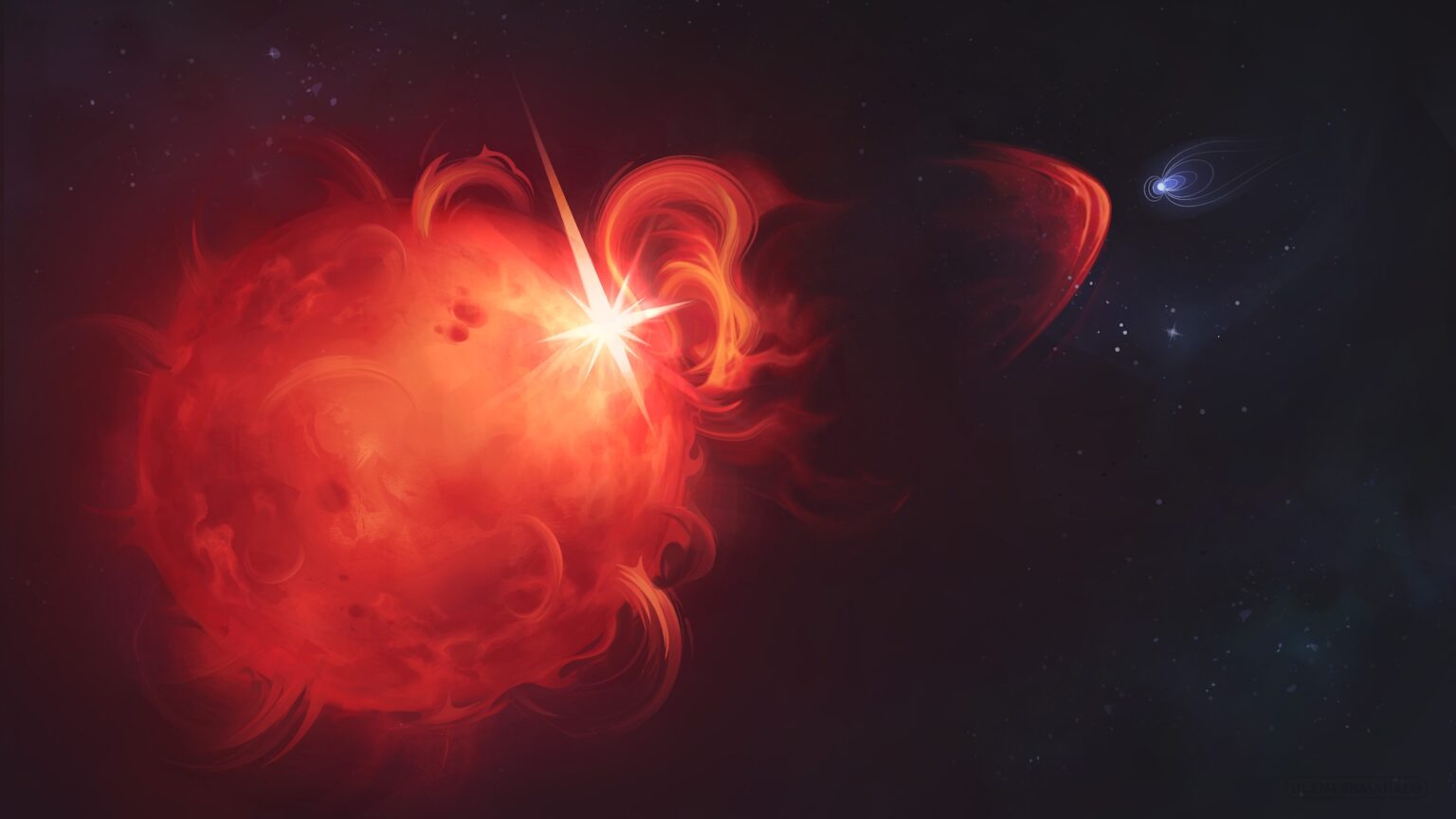
For the first time ever, astronomers have observed a coronal mass ejection (CME) coming from a star that isn’t our Sun.
CMEs are massive eruptions we often observe coming from the Sun. They drive space weather and are responsible for phenomena such as the auroras we see near the Earth’s poles.
While these explosive events are common in our solar system, astronomers had never spotted one occurring on another star. Now, a team using observations from the European Space Agency’s XMM-Newton space observatory and the LOFAR telescope has definitively recorded a CME beyond our cosmic neighborhood.
The discovery has widespread implications for the scientific community: It could help scientists better understand the impact of solar eruptions on Earth, and could even narrow the search for signs of intelligent alien life.
An explosion coming from a nearby red dwarf
When a CME erupts out of a star and out into interplanetary space, it produces a shock wave that comes with a telltale burst of radio waves. The team of astronomers detected one of these bursts of radio waves while observing a nearby star, located approximately 40 light-years away.
“Astronomers have wanted to spot a CME on another star for decades,” Joe Callingham of the Netherlands Institute for Radio Astronomy (ASTRON), author of a new paper on the discovery, published in Nature, explained. “Previous findings have inferred that they exist, or hinted at their presence, but haven’t actually confirmed that material has definitively escaped out into space. We’ve now managed to do this for the first time.”
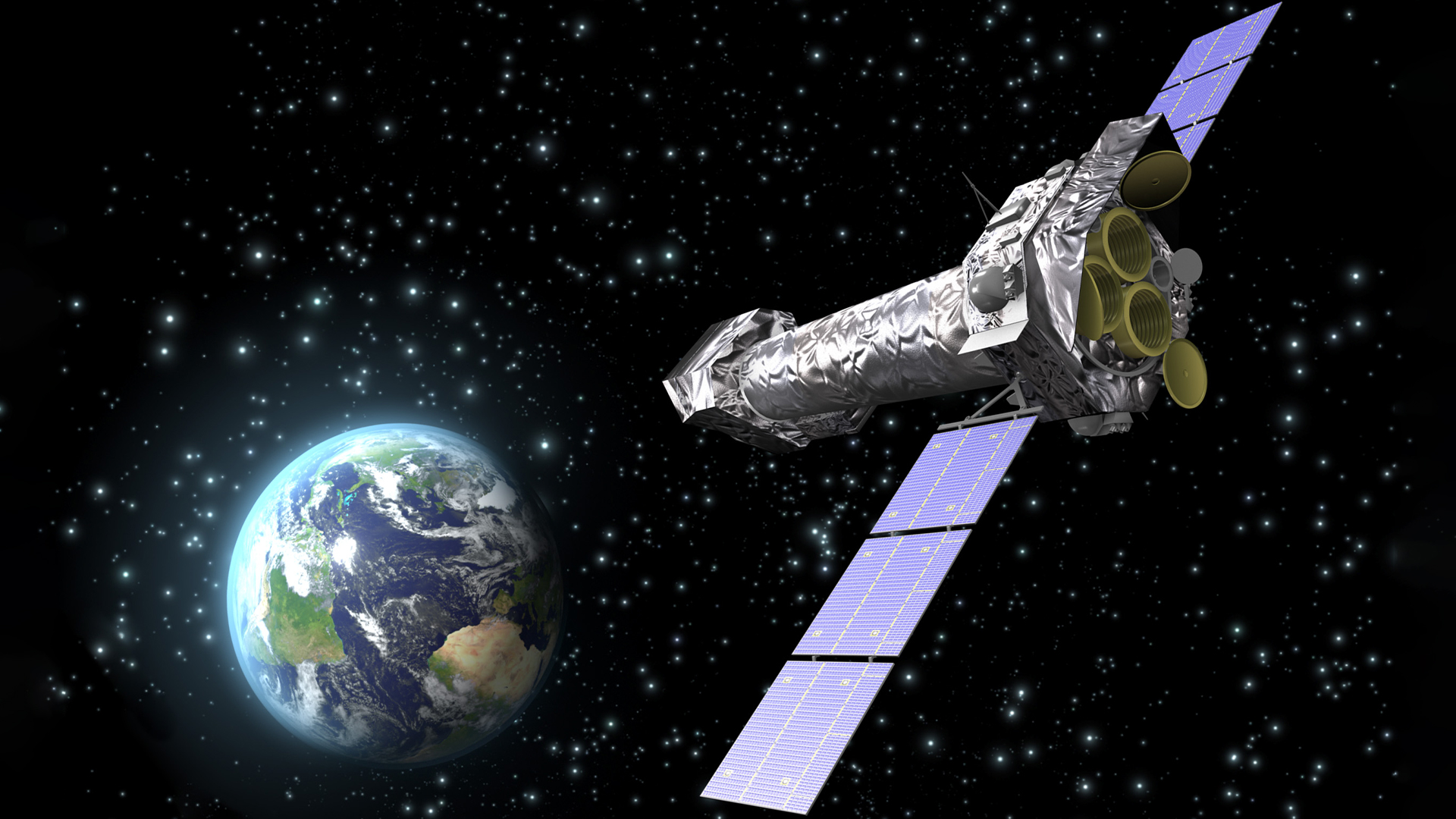 An artist’s impression of XMM-Newton. Source: ESA-C / Carreau
The researchers discovered the CME in observations of a red dwarf—a type of star that is much fainter than our Sun. The red dwarf in question has roughly half the mass of our Sun. Still, its magnetic field is 300 times more powerful and it rotates 20 times faster. These types of stars make up the majority of the star systems in the Milky Way.
The team spotted the radio signal using the Low Frequency Array (LOFAR) radio telescope. They were able to do so by leveraging new data processing methods developed by co-authors Cyril Tasse and Philippe Zarka at the Observatoire de Paris-PSL. They then compared these observations with data from ESA’s XMM-Newton. This allowed them to determine the star’s temperature, rotation, and brightness, enabling them to effectively interpret the radio signal.
The importance of investigating solar eruptions
The new observation definitely proves what was already believed to be true—that CMEs occur in other star systems. “This kind of radio signal just wouldn’t exist unless material had completely left the star’s bubble of powerful magnetism,” Joe continued. “In other words: it’s caused by a CME.”
Though it is not a wholly surprising discovery, understanding these solar eruptions has important practical applications here on Earth. Many of our electronic systems are impacted by strong CMEs here on Earth. In fact, in 2021, University of California, Irvine scientist Sangeetha Abdu Jyothi warned that a “solar tsunami” could cause a severe internet outage, costing the US economy an estimated $7.2 billion per day.
Investigating CMEs emitted by distant stars also has important implications in the search for alien life. As Henrik Eklund, an ESA research fellow based at the European Space Research and Technology Centre (ESTEC) in Noordwijk, The Netherlands, pointed out, investigating CMES beyond our solar system could help guide the search for habitable worlds.
“We’re no longer limited to extrapolating our understanding of the Sun’s CMEs to other stars,” Eklund explained in a press statement. “It seems that intense space weather may be even more extreme around smaller stars—the primary hosts of potentially habitable exoplanets. This has important implications for how these planets keep hold of their atmospheres and possibly remain habitable over time.”