
The company has not announced a new target date for a rescheduled launch.
CAPE CANAVERAL, Fla. — Blue Origin has scrubbed the second launch of its New Glenn rocket due to heightened solar activity that could affect NASA’s spacecraft onboard, the company announced Wednesday.
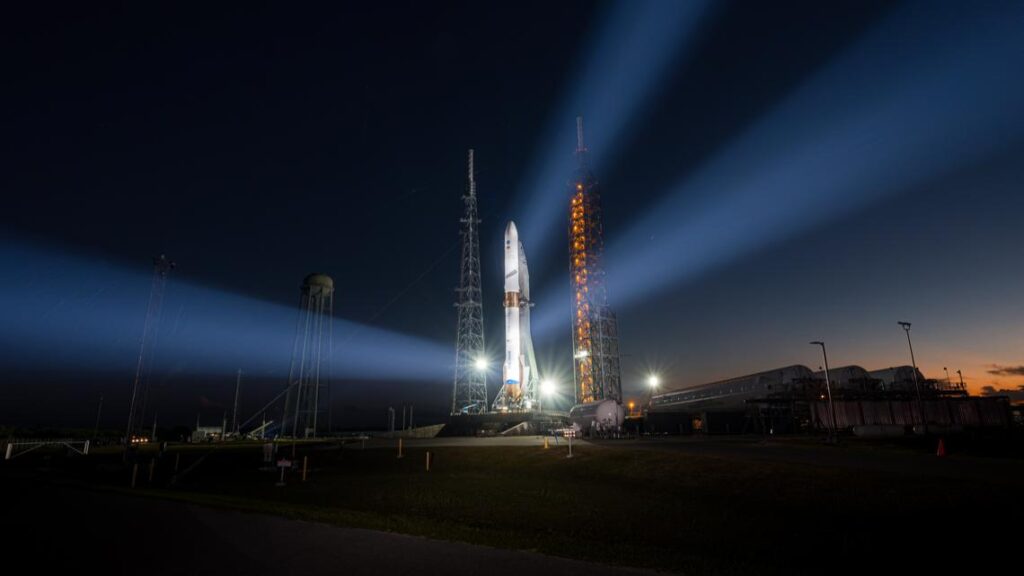
The launch, designated NG-2, was set to lift off from Launch Complex 36 at Cape Canaveral Space Force Station carrying NASA’s ESCAPADE (Escape and Plasma Acceleration and Dynamics Explorers) twin spacecraft bound for Mars. However, NASA made the decision to postpone the mission after observing highly elevated solar activity that could potentially impact the spacecraft during their journey to the Red Planet.
“Due to highly elevated solar activity and its potential effects on the ESCAPADE spacecraft, NASA is postponing launch until space weather conditions improve,” Blue Origin said in a statement.
The company added that it is currently assessing opportunities for the next launch window based on forecasted space weather conditions and range availability.
New Glenn stood ready for flight at the time of the scrub, with all systems reported nominal. The powerful heavy-lift rocket’s second stage is powered by two BE-3U engines, each generating 175,000 pounds-force of vacuum thrust.
The engines are assembled at Blue Origin’s manufacturing facility in Huntsville, and leverage more than a decade of operational experience with liquid oxygen and liquid hydrogen cryogenic propulsion systems.
In addition to the twin ESCAPADE spacecraft, which will study Mars’ magnetosphere and atmospheric escape, the mission will carry a technology demonstration from Viasat in support of NASA’s Communications Services Project.
The postponement signals a cautious approach to protecting sensitive scientific payloads from potentially damaging space weather effects during the current period of heightened solar activity. Blue Origin has not yet announced a new target launch date.