
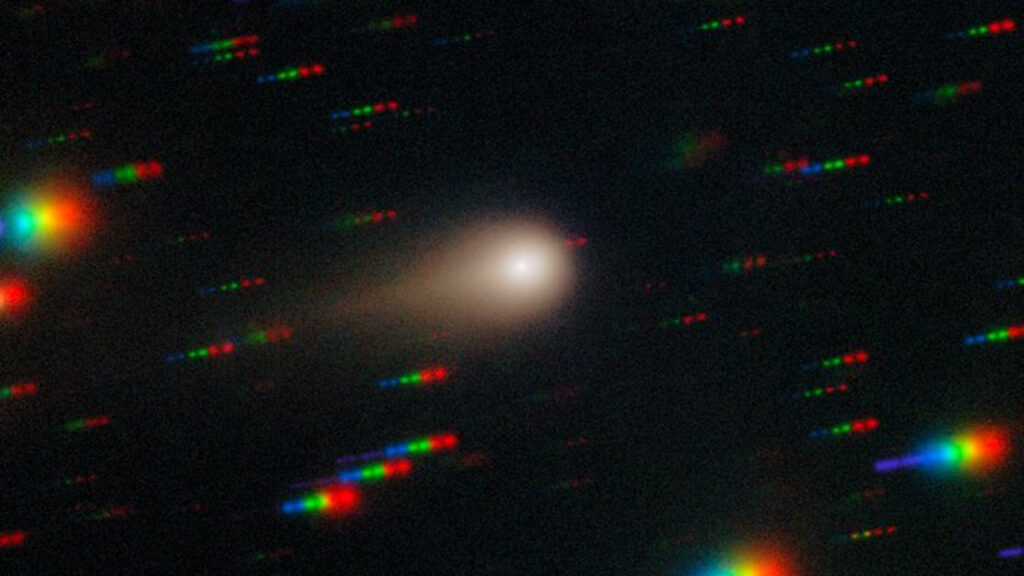
Here’s the very latest regarding comet 3I/ATLAS:
Scientists observing the interstellar comet 3I/ATLAS have revealed another set of stunning details about it. From their observations, they cite evidence of Galactic Cosmic Ray processing, which is not great news for astronomers looking to study this comet.
3I/ATLAS Might Not Provide Insight Into Other Star Systems
On 1st July 2025, the Asteroid Terrestrial-impact Last Alert System (ATLAS) survey telescope in Chile first observed the interstellar comet 3I/ATLAS. Astronomers suspect that this might be the oldest comet ever observed, estimating it to be over three billion years older than the Solar System.
This comet is of particular concern to space agencies around the world, as they hope to learn more about the star system it originated from. However, a discovery by a team of astronomers from Belgium and the US reveals some concerning traits of this comet.
The research is built on data from JWST, the Spectro-Photometer for the History of the Universe, Epoch of Reionisation, and Ices Explorer (SPHEREx). After studying these data sets, the team discovered an odd ratio of carbon dioxide to water (CO2/H2O = 7.6 ± 0.3) in the comet’s coma, the highest ever seen in a comet.
One possible explanation for this occurrence is the conversion of carbon monoxide into carbon dioxide by galactic cosmic rays. Over the course of this comet’s life, this conversion will have created an organic-rich irradiated crust on its nucleus.
This means that the pristine core of this comet, which might give us insight into the star system it originates from, is not accessible. According to the paper, which has not yet been peer-reviewed, 3I/ATLAS may carry signatures of processed materials gathered over its lifetime.
A Possible Change In The Way Astronomers View Interstellar Comet 3I/ATLAS
With this new understanding, astronomers might need to change the way they look at interstellar comet 3I/ATLAS. Instead of looking at this comet as a window to learn more about distant star systems, astronomers can study its spectra to learn more about its journey to our solar system.
However, there is still a need for further study into the findings of the team of astronomers that made this discovery. This might create a clearer understanding of this comet.
As it continues its journey through our solar system, more details regarding its composition will be revealed. You can follow the comet’s trajectory here.