
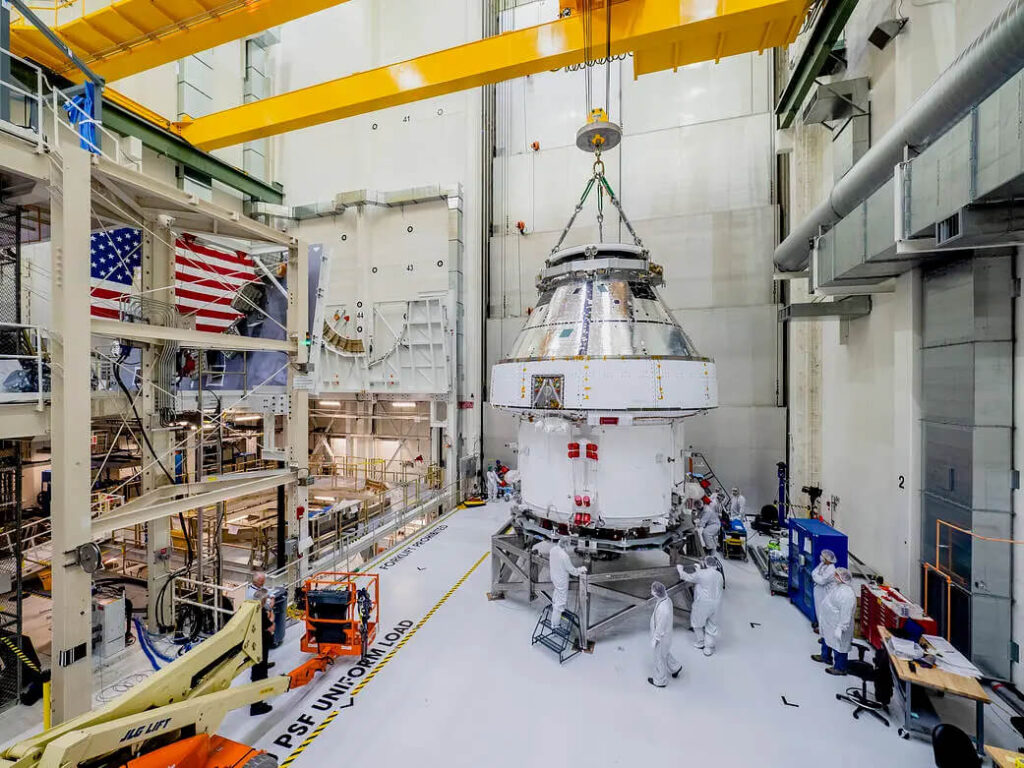
Airbus has dispatched the fourth European Service Module (ESM-4) from Bremen to NASA’s Kennedy Space Center, where it will be tested and mated to Orion’s crew module for Artemis IV. The company says the shipment marks the handover from European assembly to U.S. integration ahead of the mission’s next build phase.
Power and Propulsion Systems
ESM-4 provides Orion with in-space propulsion, electrical power, and consumables for the crew. The service module hosts four solar wings that can generate about 11.2 kW; most of that power flows to the crew module, with roughly a tenth used by the ESM itself, according to Airbus.
ESA notes that the module carries 33 engines of various sizes, plus tanks for thousands of litres of propellant, as well as water and air. The structure for this flight arrived in Bremen in 2022 and has since undergone multi-year integration and test by teams from across Europe.
Artemis IV is planned to fly with Orion atop SLS, with ESM-4 forming the spacecraft’s service element during the outbound and return legs. After arrival in Florida, NASA will run acceptance checks before stacking the service module beneath the crew capsule.
Airbus, under ESA contract, is building multiple ESM units for the early Artemis sequence. The first module flew on Artemis I in 2022, providing Orion’s propulsion and electrical supply during the circumlunar mission. With ESM-4 heading to Florida, teams at Kennedy will take over for final testing and the initial build-up of the Artemis IV stack.
Industry coverage points out that shipment proceeds even as programme schedules remain subject to change. For Europe, the delivery keeps the service-module line moving and maintains continuity between Bremen assembly and U.S. operations.
 Published by Ben Ward
Ben Ward studied English Literature and Language at the University of Bristol. With a background in analytical news writing and an interest in space exploration, his work focuses on the connection between science, history, and language. He has a measured approach to space journalism, always prioritising accuracy. He is interested in how the decisions of private industry, government agencies, and scientific institutions shape the future of space exploration. When not writing, He closely follows updates in Geopolitics, Aerospace and Planetary science, considering how humanity’s presence on earth has an influence far beyond it.